
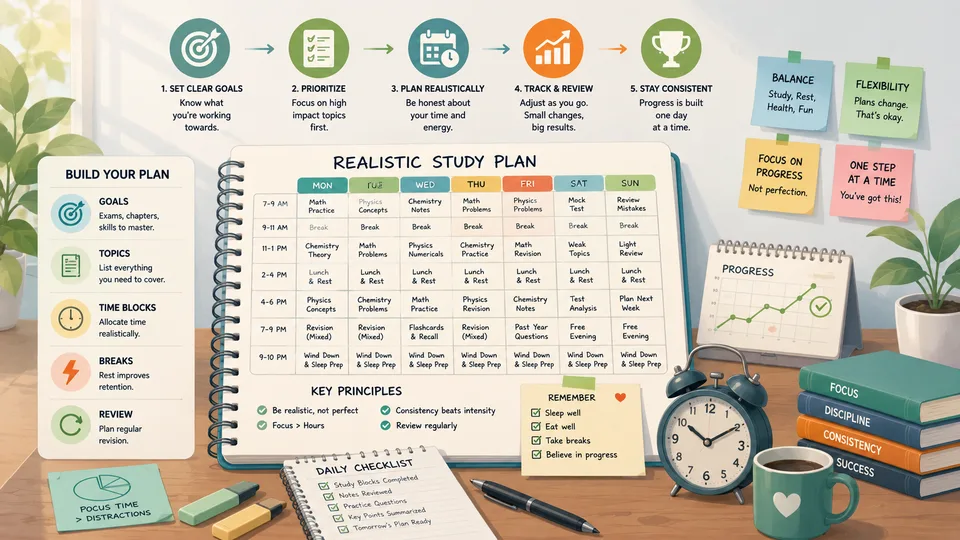
My first proper study plan was built during a resit period and the difference it made to my results was immediate and obvious.
There is a particular kind of exhaustion that only studying seems to create. It is not always physical tiredness either. Sometimes it feels more like mental static. You sit down intending to work for an hour and somehow spend half the time reorganising tabs, checking messages or staring at the same paragraph repeatedly without absorbing a single sentence.
I think a lot of education advice online accidentally makes this worse because it presents learning as if students are tiny productivity machines. Perfect desk setup. Perfect motivation. Colour-coded revision timetables that look beautiful for approximately three days before reality destroys them.
Real studying is usually messier than that.
The Human Side of Revision Matters
One thing I noticed during exams years ago was how rarely anybody talked honestly about the emotional side of revision. People discussed techniques endlessly but avoided admitting how strange studying can feel psychologically.
You can know a subject reasonably well at home and then suddenly forget basic information the moment pressure appears. You can spend an evening revising while feeling deeply guilty for not revising hard enough. You can technically be “working” while your brain is completely overloaded and retaining almost nothing.
That disconnect confuses students because effort and results do not always feel proportional. Sometimes a calm focused hour genuinely teaches more than six anxious hours spent half-panicking.
Good Intentions Can Still Create Bad Study Habits
What makes studying difficult is that ineffective revision often feels productive in the moment. Rewriting notes neatly feels organised. Highlighting entire pages feels active. Spending eight straight hours at a desk feels disciplined.
But learning and the feeling of learning are not identical things.
I remember spending entire weekends rewriting notes because it made me feel in control. My folders looked fantastic afterwards. Unfortunately I could barely recall the information a week later because I had spent most of the time copying rather than retrieving knowledge from memory.
That is partly why active recall techniques work so well even though people resist them initially. Testing yourself feels uncomfortable because it exposes gaps immediately. Passive revision protects your confidence temporarily while active revision improves it long term.
Why Pressure Makes Revision Feel Different
One of the stranger things about exams is that stress itself becomes part of the challenge. Students often assume poor performance means they are unintelligent when sometimes their brain is simply overloaded.
Sleep quality drops. Anxiety increases. Concentration fragments. Suddenly small distractions become impossible to ignore. You reread the same sentence repeatedly because your thoughts are somewhere else entirely.
I think this is why unrealistic revision culture becomes dangerous. People treat exhaustion as evidence of commitment. Students quietly compete over who slept least or revised longest as if burnout itself proves seriousness.
In reality, exhaustion usually reduces learning efficiency dramatically.
The Emotional Loop Behind Delayed Study
People often describe procrastination as laziness but that explanation misses most of what is actually happening. A lot of procrastination comes from emotional resistance rather than lack of ambition.
Sometimes tasks feel so large and undefined that avoiding them briefly creates temporary relief. The problem is that avoidance compounds pressure. One missed session turns into several. The workload grows silently in the background until opening your notes starts triggering stress automatically.
Almost everybody has experienced the strange guilt of relaxing while knowing unfinished work exists somewhere nearby.
And the annoying thing is that procrastination often disappears once somebody starts. The anticipation is frequently worse than the work itself.
Steady Revision Beats Last-Minute Intensity
This is probably the least exciting advice students receive, which is unfortunate because it is also one of the most useful.
Extreme bursts of motivation are unreliable. Sustainable routines matter far more. A realistic study plan built around actual energy levels usually outperforms aggressive schedules that collapse after four days.
I became much better at studying once I stopped designing revision timetables for an imaginary hyper-disciplined version of myself.
Instead of planning twelve-hour revision marathons, I started building shorter focused sessions I could repeat consistently without resenting them. Oddly enough, that approach felt less impressive but produced far better results.
Why Perfect Revision Plans Rarely Survive Contact With Exams
Modern study culture online can become oddly performative. Endless productivity videos create the impression that successful students permanently operate at maximum efficiency while calmly drinking aesthetic coffee beside spotless notebooks.
Most actual students are far less composed than that.
People get distracted. They panic. They lose momentum. They waste afternoons. They underestimate tasks. They overestimate energy levels. None of this automatically means somebody is failing.
The danger is comparing your private messy experience against somebody else's edited productivity highlights.
What Actually Moves the Needle
The students I knew who coped best with pressure were rarely the people using the most extreme methods. Usually they were the people with stable routines, realistic expectations and decent self-awareness.
They slept properly before exams. They revised consistently enough that panic stayed manageable. They accepted that some discomfort is normal without turning stress into an identity.
Most importantly, they understood that studying is partly psychological. Managing energy, focus and emotional state matters almost as much as the material itself.
Make the Plan Human Enough to Use
Learning is much less mechanical than people pretend. Memory, focus, stress, motivation and energy all interact constantly, which is why revision advice that sounds perfect in theory often falls apart in real life.
The good news is that students usually do not need perfect discipline or perfect methods. They mostly need sustainable systems that survive ordinary human inconsistency.
And honestly, once you realise nearly everybody else also feels overwhelmed, distracted and underprepared at times, studying becomes a little less psychologically isolating.
If academic performance is part of what you are tracking, the GPA calculator can help you understand where your grades currently sit and what you need to hit your target.