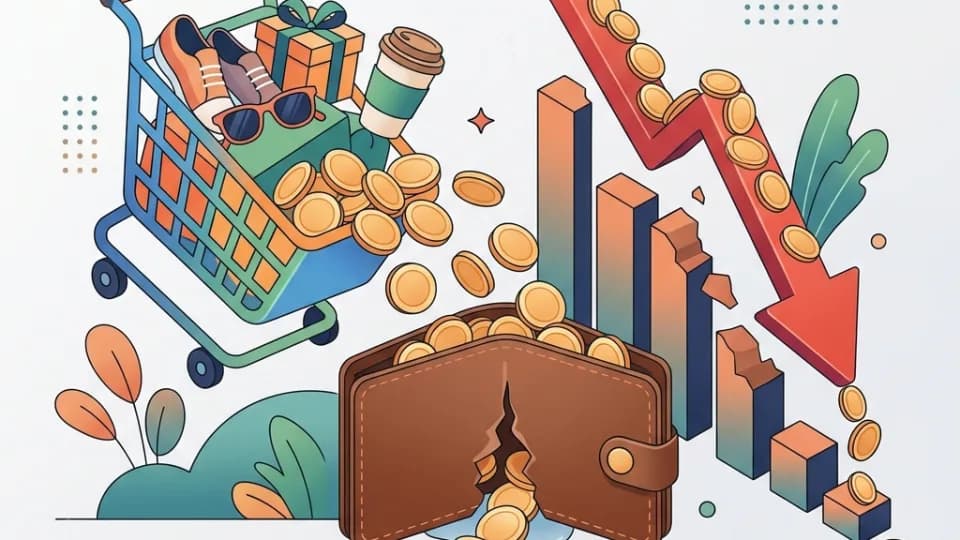
Impulse purchases are not failures of character. They are the predictable output of commercial systems designed with considerable sophistication to produce exactly this result. Understanding why you buy things you did not plan to buy is more useful than feeling bad about it — because the structural responses work better than willpower at the point of temptation.
Psychology of Impulse Spending
Two cognitive tendencies make impulse purchases almost inevitable without deliberate friction:
Present bias is the tendency to overvalue immediate rewards relative to future ones. A purchase that costs £40 and provides immediate satisfaction is psychologically weighted more heavily than the same £40 invested and worth significantly more in 20 years. This is not irrational in a strict sense — present consumption is certain, future returns are not — but it systematically underweights the future in ways that compound over time.
Loss aversion applied to discounts means that a sale does not just make a purchase more attractive — it makes not purchasing feel like a loss. Missing a 40% off flash sale triggers the same neural response as losing money, even when you were not planning to buy the item before seeing the discount. Combined with artificial scarcity (limited time, limited stock), this creates urgency that bypasses deliberate evaluation.
Online retail has optimised both of these effects. One-click purchasing removes the physical act of paying. Recommended items appear when purchase intent is highest. Notifications alert you to sales on items you looked at last month. The gap between impulse and purchase is now seconds, and every second of additional friction is deliberately engineered out.
Long-Term Financial Impact
The immediate cost of impulse spending is obvious — you spent money you did not plan to spend. The long-term cost is less visible but substantially larger.
Consider someone spending £50 per week in unplanned purchases — roughly two impulse buys. That is £2,600 per year. Invested instead at 7% annual return:
- Over 10 years: approximately £36,000
- Over 20 years: approximately £106,000
- Over 30 years: approximately £245,000
The items purchased with that £2,600/year are largely forgotten within months. The foregone investment value is permanent. Use the Impulse Purchase Cost Calculator to run your own numbers. Estimate your average weekly unplanned spending — honestly, including small purchases — and see what that pattern costs across different time horizons.
The Categories That Add Up Fastest
Not all impulse spending is equal in impact. Categories with both high frequency and high spend-per-occasion accumulate the fastest:
Online retail: The easiest category to overspend in and the hardest to track, because purchases are distributed across many small transactions. Browser saved payment details, wish lists that convert to purchases, and algorithmic recommendations all drive volume up.
Food and drink: The highest frequency category for most people. Impulse food spending — the upgrade, the addition, the meal out that was not planned — is also the most invisible because each individual transaction is small.
Entertainment and subscriptions: Lower per-transaction cost but high persistence. A subscription signed up for impulsively typically runs for months before being cancelled. The actual cost is often three to five times the price of the initial purchase decision.
Breaking the Habit
Add a waiting period. A 24 or 48-hour rule on any unplanned purchase above a minimum threshold (say, £20) eliminates a significant proportion without any ongoing effort at the point of purchase. The vast majority of impulses do not survive 24 hours when action is simply deferred.
Remove purchase friction that retailers have removed. Delete saved card details from retail sites. Turn off one-click purchasing. Remove shopping apps from the home screen. The few seconds of additional friction this adds to each purchase is enough to interrupt the automated nature of impulse buying.
Separate your spending allowance. Keep discretionary spending in a separate current account with a fixed monthly transfer. When the balance is low, the remaining allowance is visible in real time. Running out mid-month is informative. A credit card statement six weeks later is not.
Reduce trigger exposure. Marketing emails, push notifications, and social media advertising are all designed to create purchase desire for things you were not looking for. Unsubscribing from retailer communications and disabling shopping app notifications reduces the number of impulse decisions the day requires, without depending on willpower at the moment of temptation.