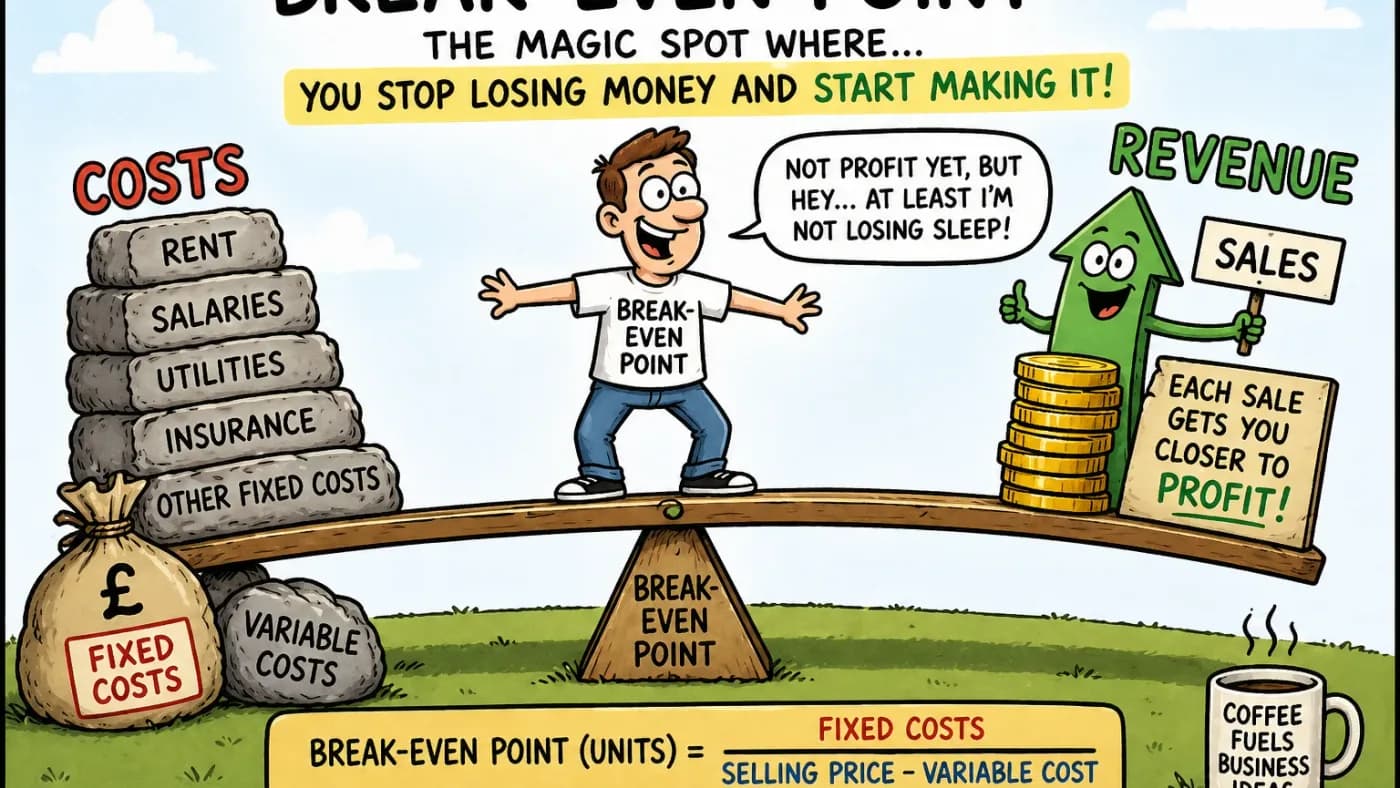
Break-even point is the point where your business has covered its costs but has not yet made a profit. In simple terms, it tells you how many units you need to sell before you stop losing money and start making money.
This is one of the most useful calculations for pricing, product launches, business planning, and deciding whether an idea is financially realistic.
This guide explains how to calculate break-even point step by step using fixed costs, variable costs, selling price, and contribution margin.
What Is Break-Even Point?
The break-even point is the sales level where total revenue equals total costs.
At break-even:
- Your business has covered all fixed and variable costs
- Your profit is exactly zero
- Every sale after that point starts contributing to profit
For example, if your break-even point is 500 units, you need to sell 500 units before the business begins making a profit.
Break-Even Point Formula
The most common break-even formula is:
Break-Even Point (Units) = Fixed Costs ÷ (Selling Price per Unit − Variable Cost per Unit)
The part in brackets is called the contribution margin per unit.
So the formula can also be written as:
Break-Even Point (Units) = Fixed Costs ÷ Contribution Margin per Unit
Where:
- Fixed costs are costs that stay the same regardless of how many units you sell
- Selling price per unit is how much you charge for each product or service
- Variable cost per unit is the cost of producing or delivering one unit
- Contribution margin is the amount each sale contributes toward fixed costs and profit
How to Calculate Break-Even Point Step by Step
Example 1: Break-Even Point in Units
A business has fixed costs of £2,000 per month. It sells a product for £25, and each product costs £10 to make.
Step 1: Calculate contribution margin per unit.
Contribution Margin = Selling Price − Variable Cost
Contribution Margin = £25 − £10 = £15
Step 2: Apply the break-even formula.
Break-Even Point = Fixed Costs ÷ Contribution Margin
Break-Even Point = £2,000 ÷ £15 = 133.33 units
Since you cannot usually sell part of a unit, you would need to sell at least 134 units to break even.
Break-Even Sales Revenue Formula
You can also calculate break-even point as sales revenue instead of units.
First calculate the contribution margin ratio:
Contribution Margin Ratio = Contribution Margin per Unit ÷ Selling Price per Unit
Then use:
Break-Even Sales Revenue = Fixed Costs ÷ Contribution Margin Ratio
Example 2: Break-Even Revenue
Using the same example:
- Fixed costs = £2,000
- Selling price = £25
- Variable cost = £10
- Contribution margin = £15
Contribution Margin Ratio = £15 ÷ £25 = 0.60
Break-Even Sales Revenue = £2,000 ÷ 0.60 = £3,333.33
The business needs around £3,333.33 in sales revenue to break even.
What Are Fixed Costs?
Fixed costs are costs that usually stay the same even if sales increase or decrease.
Common fixed costs include:
- Rent
- Software subscriptions
- Insurance
- Salaries
- Equipment leases
- Website hosting
- Business loan repayments
Fixed costs are important because they need to be covered before the business can become profitable.
What Are Variable Costs?
Variable costs change depending on how many units you sell or produce.
Common variable costs include:
- Raw materials
- Packaging
- Shipping per order
- Payment processing fees
- Sales commissions
- Manufacturing costs per unit
The lower your variable cost per unit, the higher your contribution margin will be.
Why Break-Even Analysis Matters
Break-even analysis helps you understand whether your pricing, costs, and sales expectations are realistic.
It is useful for:
- Setting prices
- Planning a new product launch
- Understanding how many sales you need
- Checking whether a business idea is viable
- Comparing different pricing strategies
- Estimating risk before spending money
If your break-even point is too high, you may need to reduce costs, raise prices, or improve your sales strategy.
How Price Changes Affect Break-Even Point
Changing your selling price has a direct effect on break-even point.
If you increase your price while costs stay the same, your contribution margin increases, so you need fewer sales to break even.
If you lower your price through discounts or promotions, your contribution margin decreases, so you need more sales to break even.
Example 3: Higher Price, Lower Break-Even Point
Suppose fixed costs are £2,000 and variable cost is £10 per unit.
If the selling price is £25:
Contribution margin = £25 − £10 = £15
Break-even point = £2,000 ÷ £15 = 134 units
If the selling price increases to £30:
Contribution margin = £30 − £10 = £20
Break-even point = £2,000 ÷ £20 = 100 units
A higher price means fewer sales are needed to break even, assuming demand does not fall too much.
Use the Break-Even Calculator
For quick calculations, use our Break-Even Calculator to calculate break-even units, break-even revenue, contribution margin, and profit targets.
You may also find the Profit Margin Calculator useful for checking product profitability, and the Percentage Calculator useful for working with percentage changes.
Common Break-Even Mistakes
Forgetting Variable Costs
If you only look at fixed costs and ignore variable costs, your break-even point will be too low and misleading.
Using Total Costs Instead of Cost per Unit
The formula needs variable cost per unit, not total variable cost for all units.
Ignoring Discounts
Discounts reduce selling price and contribution margin. That means you need more sales to break even.
Assuming Sales Demand Stays the Same
Raising prices may reduce the number of customers willing to buy. Break-even analysis shows the maths, but it does not predict demand.
Frequently Asked Questions
What is break-even point?
Break-even point is the level of sales where total revenue equals total costs. At this point, the business has made no profit and no loss.
What is the break-even point formula?
The formula is Break-Even Point = Fixed Costs ÷ (Selling Price per Unit − Variable Cost per Unit).
What is contribution margin?
Contribution margin is the amount left from each sale after variable costs are deducted. It contributes toward fixed costs and profit.
How do I calculate break-even revenue?
Calculate the contribution margin ratio, then divide fixed costs by that ratio.
Can break-even point change?
Yes. It changes when fixed costs, variable costs, or selling prices change.
Why is break-even analysis useful?
It helps businesses understand how many sales are needed to cover costs and whether a product, service, or business idea is financially realistic.
Conclusion
Break-even point is a simple but powerful business calculation. It shows how many units you need to sell, or how much revenue you need to generate, before your business starts making a profit.
The key formula is:
Break-Even Point = Fixed Costs ÷ Contribution Margin per Unit
Once you understand fixed costs, variable costs, and contribution margin, break-even analysis becomes one of the most useful tools for pricing and planning. For faster results, use the Break-Even Calculator.