
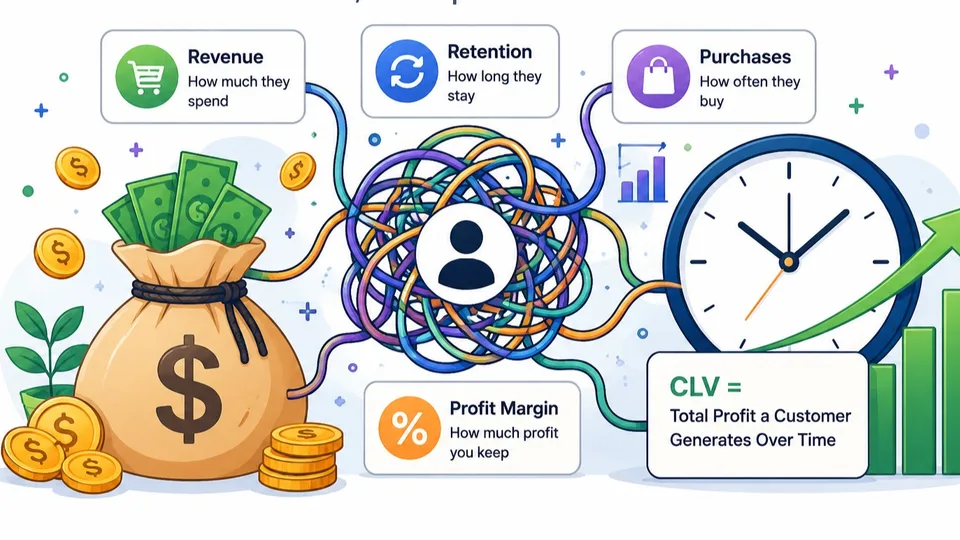
Customer Lifetime Value, often shortened to CLV or LTV, is one of the most important business metrics you can calculate. It helps you estimate how much a customer is worth to your business over the full length of the relationship.
The problem is that many explanations make CLV sound simpler than it really is. They give one formula and leave it there. In reality, the best way to calculate customer lifetime value depends heavily on the type of business you run, the data you have available, and what decision you are trying to make.
For some companies, a simple estimate is enough. For others, especially SaaS, ecommerce, and subscription businesses, customer lifetime value can become a much more detailed model involving churn, retention, margins, cohorts, and acquisition costs.
What Is Customer Lifetime Value?
Customer Lifetime Value is the estimated total value a customer brings to a business over the entire customer relationship.
In simple terms, CLV helps answer questions such as:
- How much is an average customer worth?
- How much can we afford to spend acquiring a customer?
- Which customer segments are most profitable?
- Which marketing channels bring in the best customers?
- How much does retention affect long-term profitability?
Without CLV, a business can easily confuse revenue growth with profitable growth. A company may be acquiring customers quickly but still losing money if those customers do not stay long enough or generate enough profit to justify the acquisition cost.
The Basic Customer Lifetime Value Formula
A simple customer lifetime value formula is:
Customer Lifetime Value = Average Purchase Value × Purchase Frequency × Customer Lifespan
For example, imagine a customer spends £80 per order, buys 4 times per year, and remains a customer for 3 years.
The calculation would be:
£80 × 4 × 3 = £960
In this example, the estimated customer lifetime value is £960.
This type of formula is useful as a starting point, especially if you want a quick estimate. For a faster practical calculation, you can use this LTV calculator to model customer lifetime value using your own numbers.
Why Revenue-Based CLV Can Be Misleading
One of the biggest mistakes businesses make is calculating CLV using revenue alone.
Revenue is not the same as profit.
A customer who generates £5,000 in revenue is not automatically worth £5,000 to the business. The real value depends on margins, fulfilment costs, support costs, payment fees, refunds, discounts, and other variable costs.
For example:
- Customer A generates £5,000 in revenue at a 15% margin
- Customer B generates £5,000 in revenue at an 80% margin
Customer A contributes around £750 in gross profit.
Customer B contributes around £4,000 in gross profit.
Both customers produce the same revenue, but they are not equally valuable. This is why CLV should often be calculated using gross profit or contribution margin rather than top-line revenue.
Subscription and SaaS CLV Formula
Subscription businesses often use churn-based customer lifetime value formulas because recurring revenue makes customer behaviour easier to model.
A common SaaS CLV formula is:
CLV = Average Revenue Per User ÷ Churn Rate
For example:
- Average monthly revenue per user = £100
- Monthly churn rate = 5%
The calculation would be:
£100 ÷ 0.05 = £2,000
In this example, the estimated customer lifetime value is £2,000.
This formula works best when churn is reasonably stable and customer behaviour is predictable. However, it can become inaccurate if churn changes significantly over time, if customers upgrade or downgrade plans regularly, or if there are major differences between customer segments.
How Ecommerce Businesses Calculate CLV
Ecommerce customer lifetime value is usually more complicated than SaaS CLV because purchase behaviour is less predictable.
Some customers buy once and never return. Others make repeat purchases for years. Some buy only during discounts, while others purchase full-price products regularly.
Because of this, ecommerce businesses often need to look at:
- Average order value
- Repeat purchase rate
- Purchase frequency
- Gross margin
- Customer lifespan
- Cohort behaviour
- Refund and return rates
A skincare brand, for example, may find that customers acquired through organic search have a lower first order value but a much higher repeat purchase rate than customers acquired through paid social ads.
This is why CLV is often most useful when comparing groups of customers rather than relying on one overall average.
High-Ticket Businesses Need a Different CLV Approach
High-ticket businesses often need to think about CLV differently.
Examples include:
- Consulting firms
- Agencies
- Legal services
- Property services
- Luxury products
- Enterprise software
These businesses may not have frequent repeat purchases, but each customer can still be extremely valuable.
A client might only buy once, but that one purchase could be worth thousands of pounds. They may also return later, refer other clients, upgrade to a larger package, or create long-term contract value.
For this type of business, CLV should consider more than simple purchase frequency. Referrals, renewals, upsells, repeat contracts, and account expansion can all matter.
Why CLV Matters for Customer Acquisition Cost
Customer Lifetime Value becomes especially useful when compared with Customer Acquisition Cost, often called CAC.
CAC is the amount it costs to acquire a new customer. This can include advertising spend, sales costs, software costs, agency fees, and other acquisition-related expenses.
If it costs £500 to acquire a customer who produces £300 in lifetime gross profit, the business has a problem.
If it costs £500 to acquire a customer who produces £5,000 in lifetime gross profit, the economics are much stronger.
This relationship helps businesses decide whether their marketing is sustainable. You can test this relationship directly with an LTV vs CAC breakeven calculator to see how long it takes for customer value to recover acquisition costs.
CLV Is Most Useful When Compared Across Segments
CLV is not just useful as one standalone number. In many cases, it becomes more valuable when you compare it across customer groups.
For example, you might compare:
- Customers from Google Ads vs customers from organic search
- Monthly subscribers vs annual subscribers
- Small business customers vs enterprise customers
- First-time buyers vs repeat buyers
- Discount customers vs full-price customers
These comparisons can reveal which customers are genuinely profitable and which only look attractive at first glance.
Small Retention Improvements Can Have a Big Impact
Retention has a major effect on customer lifetime value.
If customers stay longer, CLV usually increases. If customers churn quickly, CLV falls.
This is why businesses often invest heavily in onboarding, customer support, product improvements, account management, and retention campaigns.
In subscription businesses, even a small reduction in churn can have a major effect on long-term customer value. For ecommerce businesses, increasing repeat purchase rates can be just as important as acquiring new customers.
Early-Stage Businesses Should Keep CLV Simple
Early-stage businesses often do not have enough data to build a perfect CLV model.
That is fine.
A rough but sensible estimate is usually better than no estimate at all.
At an early stage, focus on:
- Average order value or average monthly revenue
- Gross margin
- Estimated retention
- Repeat purchase behaviour
- Customer acquisition cost
- Payback period
As more data becomes available, your CLV model can become more accurate.
Common Customer Lifetime Value Mistakes
Using Revenue Instead of Profit
This can make customers look far more valuable than they really are. Always consider gross margin or contribution margin where possible.
Ignoring Churn
Churn directly reduces customer lifetime value. If customers leave quickly, acquisition becomes much harder to justify.
Using One Average for Every Customer
Not all customers behave the same way. Segmenting customers by channel, product, plan, or behaviour usually gives better insight.
Overestimating Customer Lifespan
Small changes in assumed customer lifespan can dramatically change CLV. Be realistic rather than optimistic.
Ignoring CAC
CLV only becomes truly useful when compared with the cost of acquiring the customer.
Final Thoughts
Customer Lifetime Value is not just a finance metric. It is a practical way to understand whether your business model makes sense.
The best CLV formula depends on the type of business you run. SaaS companies may focus on churn and recurring revenue. Ecommerce stores may need repeat purchase behaviour and cohort analysis. High-ticket businesses may need to consider referrals, renewals, and long-term account value.
The most important point is this: CLV should help you make better decisions.
It can guide how much you spend on acquisition, which customers you focus on, which channels deserve investment, and where retention improvements could have the biggest impact.
If you are analysing a subscription or SaaS business specifically, this guide to LTV:CAC ratios for SaaS businesses explains how customer lifetime value connects with acquisition cost, payback periods, and growth efficiency.