How to Calculate Discount Percentage (With Examples)
You're standing in a shop, eyeing something with a "SALE" sticker. The original price was €80. Now it says €60. Great deal — but is it actually a good discount? And more importantly, how do you work it out without pulling out a pen and paper in the middle of the aisle?
This guide explains exactly how to calculate discount percentage, how to find the sale price from a percentage off, and how to double-check whether that "50% off" sign is telling the truth.
What Is a Discount Percentage?
A discount percentage tells you how much of the original price has been knocked off, expressed as a percentage. If something is "20% off", that means you're paying 80% of the original price. Simple in theory — slightly fiddly in practice if you're doing it in your head.
There are two common situations you'll run into:
- You know both prices (original and sale) and want to find the discount percentage
- You know the original price and the percentage off and want to find the sale price
Both are straightforward once you know which formula to use.
How to Calculate Discount Percentage (Original Price → Percentage Off)
Use this when you can see the original price and the sale price, and you want to know what percentage discount that is.
Formula:
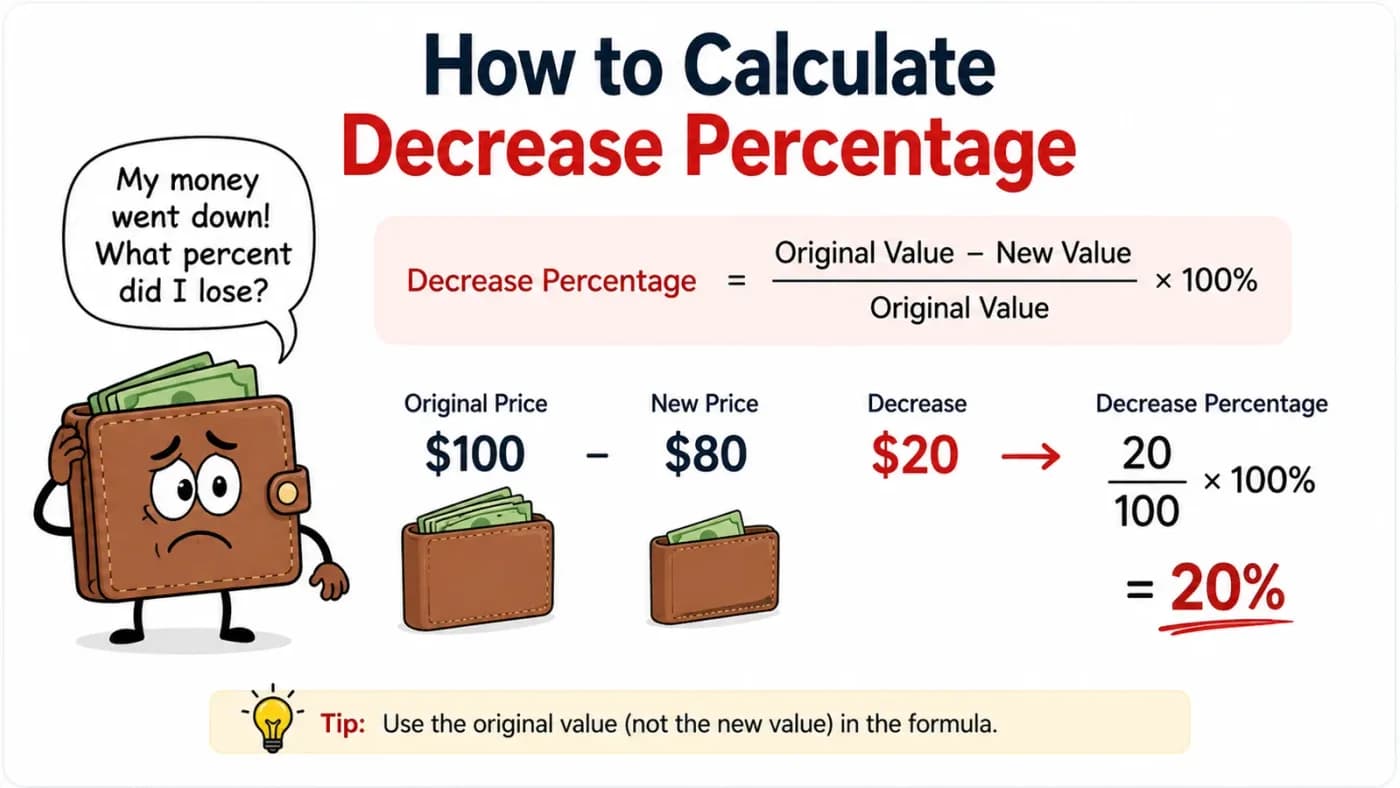
Discount % = ((Original Price − Sale Price) ÷ Original Price) × 100
Example
A jacket was €120 and is now €84.
Step 1: Subtract the sale price from the original price.
120 − 84 = 36
Step 2: Divide by the original price.
36 ÷ 120 = 0.30
Step 3: Multiply by 100.
0.30 × 100 = 30%
The jacket is 30% off.
How to Calculate the Sale Price (Percentage Off → Final Price)
Use this when you know the original price and the discount percentage, and want to know what you'll actually pay.
Formula:
Sale Price = Original Price × (1 − Discount% ÷ 100)
Example
Trainers originally cost €95. They're 25% off. What's the sale price?
Step 1: Convert the percentage to a decimal.
25 ÷ 100 = 0.25
Step 2: Subtract from 1.
1 − 0.25 = 0.75
Step 3: Multiply by the original price.
€95 × 0.75 = €71.25
You'd pay €71.25 — saving €23.75.
How to Calculate the Amount Saved
Sometimes you just want to know the euro amount you're saving, not the percentage. That's even simpler:
Amount Saved = Original Price × (Discount% ÷ 100)
Example
A laptop was €1,200 and is 15% off.
€1,200 × 0.15 = €180 saved
Sale price = €1,200 − €180 = €1,020
Quick Mental Maths Shortcuts
Not near a calculator? Here are some shortcuts worth memorising:
- 10% off: Move the decimal one place left. €80 → €8 off → pay €72
- 20% off: Find 10%, then double it. €80 → €8 → €16 off → pay €64
- 25% off: Divide by 4. €80 ÷ 4 = €20 off → pay €60
- 50% off: Divide by 2. €80 ÷ 2 = €40. Easy.
- 15% off: Find 10%, add half of that. €80 → €8 + €4 = €12 off → pay €68
These won't work for odd percentages, but they'll handle most common sale signs with no calculator needed.
Use the Discount Calculator
If you'd rather skip the maths altogether, our Discount Calculator handles both scenarios instantly — enter the original price and percentage off to get the sale price, or enter both prices to find the discount percentage.
For broader percentage problems, the Percentage Calculator covers everything from percentage change to finding what one number is as a percentage of another.
How Retailers Use Discount Percentages (And Why It Matters)
Understanding discount maths helps you spot when a deal is less impressive than it looks. Retailers sometimes inflate the "original price" before applying a discount — a practice sometimes called reference pricing. Knowing the formula lets you verify whether the discount percentage they're advertising actually holds up when you check both numbers yourself.
According to the European Commission's Omnibus Directive, retailers in the EU are now required to display the lowest price from the previous 30 days when advertising a discount — precisely to prevent misleading "original price" inflation. Worth knowing when you're shopping sales.
Frequently Asked Questions
How do I calculate 20% off a price?
Multiply the original price by 0.80 (which is 1 minus 0.20). For example, 20% off €50 = €50 × 0.80 = €40.
What is the formula for discount percentage?
Discount % = ((Original Price − Sale Price) ÷ Original Price) × 100. This tells you what percentage has been taken off the original price.
How do I find the original price from a discounted price?
Divide the sale price by (1 − discount% ÷ 100). For example, if something costs €75 after a 25% discount: €75 ÷ 0.75 = €100 original price.
Is a 30% discount the same as paying 70% of the price?
Yes, exactly. If 30% is removed, you pay the remaining 70%. Multiply the original price by 0.70 to get the sale price directly.
How do I calculate the amount saved in a sale?
Multiply the original price by the discount percentage divided by 100. For example, 15% off €200 = €200 × 0.15 = €30 saved.
Can a discount be more than 100%?
No. A 100% discount means the item is free. Anything advertised as "more than 100% off" is either a marketing gimmick or includes cashback — not a straightforward price reduction.
Conclusion
Calculating a discount percentage comes down to two simple formulas: one to find the percentage off from two prices, and one to find the sale price from a percentage. Once you know both, you can quickly check whether a deal is as good as it looks — and avoid being misled by inflated "original" prices.
Next time you're eyeing a sale, run the numbers. Or let the Percentage Calculator do it for you in seconds.