
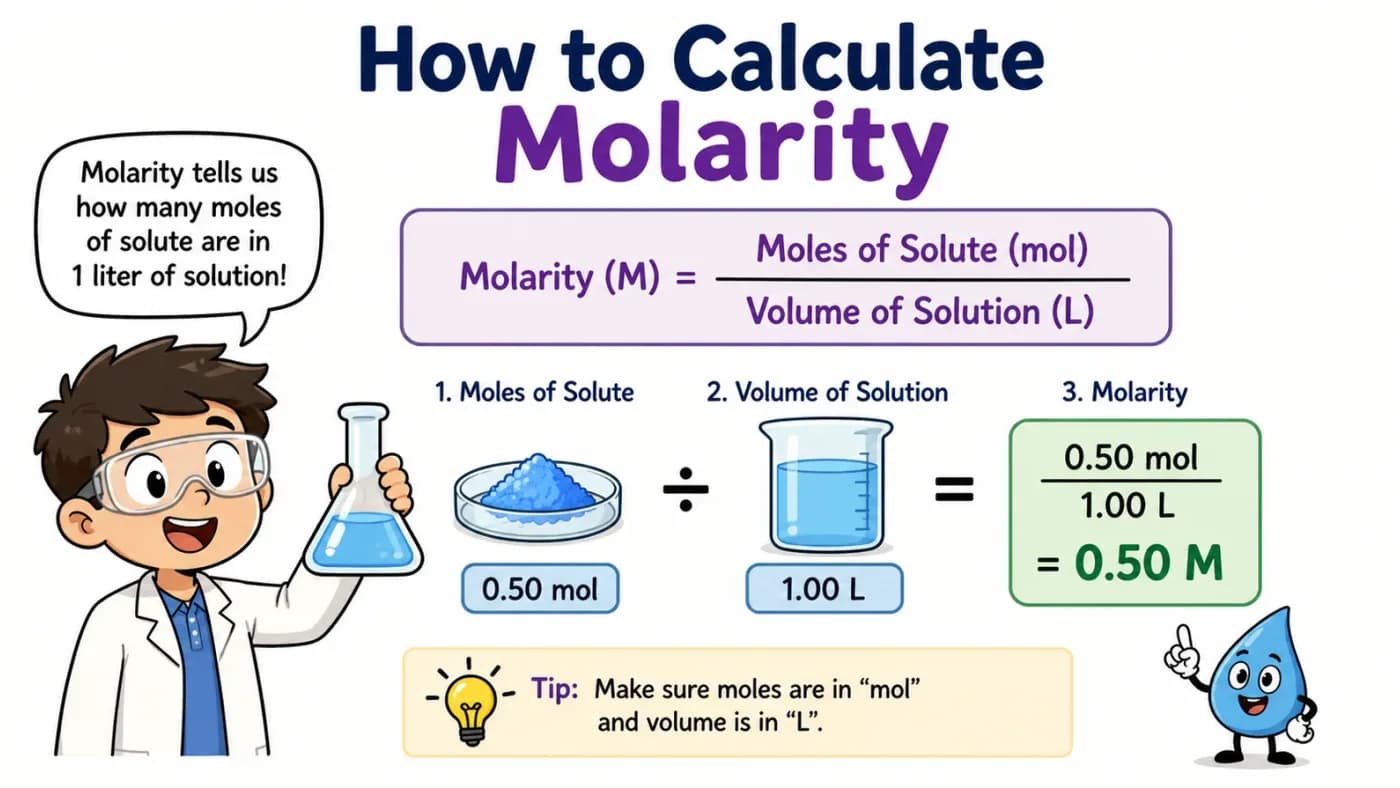
Molarity is one of those chemistry concepts that sounds intimidating until you see the formula — and then it clicks. It's simply a way of expressing how concentrated a solution is: how many moles of a substance are dissolved in a litre of solution. Once you understand that, the rest follows naturally.
This guide explains what molarity is, how to calculate it step by step, and how to work backwards from molarity to find the amount of solute you need — which is the bit that actually comes up in lab work.
What Is Molarity?
Molarity (symbol: M) is a measure of concentration. It tells you how many moles of solute are dissolved in one litre of solution.
A mole is a standard unit in chemistry that represents 6.022 × 10²³ particles (atoms, molecules, ions — whatever you're working with). It's the chemist's equivalent of a "dozen", just with a lot more zeros.
Molarity is expressed in units of mol/L, also written as M. So a 2M solution contains 2 moles of solute per litre of solution.
The Molarity Formula
Molarity (M) = Moles of Solute ÷ Litres of Solution
Or written out:
M = n ÷ V
- M = Molarity (mol/L)
- n = moles of solute (mol)
- V = volume of solution (L)
Note: the volume is the total volume of the solution, not just the solvent. This distinction matters when making up solutions in a lab.
How to Calculate Molarity: Step by Step
Example 1 — Basic Molarity Calculation
You dissolve 2 moles of sodium chloride (NaCl) in enough water to make 500 mL of solution. What is the molarity?
Step 1: Convert volume to litres.
500 mL ÷ 1000 = 0.5 L
Step 2: Apply the formula.
M = n ÷ V
M = 2 ÷ 0.5 = 4 mol/L (4M)
The solution has a molarity of 4M.
Example 2 — Starting From Mass
In practice, you rarely measure moles directly — you weigh out a mass of substance and convert to moles using the molar mass.
You dissolve 5.85 g of NaCl in water to make 250 mL of solution. What is the molarity?
The molar mass of NaCl = 23 (Na) + 35.5 (Cl) = 58.5 g/mol
Step 1: Convert mass to moles.
n = mass ÷ molar mass
n = 5.85 ÷ 58.5 = 0.1 mol
Step 2: Convert volume to litres.
250 mL ÷ 1000 = 0.25 L
Step 3: Apply the molarity formula.
M = 0.1 ÷ 0.25 = 0.4 mol/L (0.4M)
How to Rearrange the Formula
The molarity formula can be rearranged to find any of the three variables:
- To find moles: n = M × V
- To find volume: V = n ÷ M
- To find molarity: M = n ÷ V
Example — How Much Solute Do You Need?
You need to make 2 litres of a 0.5M glucose solution. How many moles of glucose do you need?
n = M × V
n = 0.5 × 2 = 1 mol of glucose
If you then need the mass: multiply by the molar mass of glucose (180 g/mol).
Mass = 1 × 180 = 180 g
Common Mistakes to Avoid
Using mL instead of L. The formula requires volume in litres. Always convert millilitres by dividing by 1000 before plugging into the formula.
Confusing solution volume with solvent volume. Molarity is based on the total volume of the final solution — not just the water you added. In a lab, you add the solute first, then top up to the required volume mark.
Using the wrong molar mass. Double-check your molar mass calculation by adding up the atomic masses of every element in the compound, multiplied by how many times each appears. A periodic table is your friend here.
Use the Molarity Calculator
If you're preparing solutions in a lab or working through chemistry problems, our Molarity Calculator handles all three versions of the formula — find molarity, find moles, or find volume — instantly.
Need to work out exactly how to prepare a solution from a stock concentration? The Solution Preparation Calculator walks you through dilution calculations using the C₁V₁ = C₂V₂ equation.
Molarity vs Molality — What's the Difference?
These two are easy to mix up. Molarity (M) uses volume of solution in the denominator (mol/L). Molality (m) uses mass of solvent in the denominator (mol/kg). Molality is more useful when working with experiments where temperature changes, since volume can expand or contract with temperature while mass stays constant. For most standard chemistry work, molarity is the one you'll use.
For a thorough explanation of solution chemistry and concentration units, the LibreTexts Chemistry reference on solution concentration is an excellent free resource used widely in university chemistry courses.
Frequently Asked Questions
What is molarity in chemistry?
Molarity is a measure of solution concentration. It tells you how many moles of a solute are dissolved in one litre of solution. It's expressed in units of mol/L, often written simply as M.
What is the formula for molarity?
Molarity = moles of solute ÷ litres of solution. Written as M = n ÷ V, where n is moles and V is volume in litres.
How do I convert grams to moles for molarity?
Divide the mass in grams by the molar mass of the substance (in g/mol). Molar mass is found by adding up the atomic masses of all atoms in the compound. For example, water (H₂O) has a molar mass of 18 g/mol.
What is a 1M solution?
A 1M (one molar) solution contains 1 mole of solute dissolved in enough solvent to make exactly 1 litre of solution.
What units is molarity measured in?
Molarity is measured in mol/L (moles per litre), also written as M. Sometimes you'll see mmol/L (millimolar) used in biology and medicine for very dilute solutions.
Is molarity the same as concentration?
Molarity is one way of expressing concentration — specifically, moles per litre. Concentration can also be expressed in other units such as grams per litre or percentage by mass, but molarity is the most commonly used in chemistry.
Conclusion
Molarity comes down to one formula: moles of solute divided by litres of solution. The main practical step is converting grams to moles using molar mass before applying the formula. Once that becomes second nature, preparing and working with solutions in chemistry becomes much more straightforward.
For quick calculations — whether you're preparing a lab solution or checking your homework — the Molarity Calculator has you covered.