Mortgage payments can look complicated at first, but they all come down to a standard formula. Once you understand how the numbers fit together, you can estimate monthly payments, total cost, and how much interest you’ll pay over time.
This guide explains how to calculate mortgage payments step by step, with clear examples and a breakdown of how interest works.
---What Is a Mortgage Payment?
A mortgage payment is the amount you pay each month to repay a home loan. It typically includes:
- Principal – the amount you borrowed
- Interest – the cost of borrowing
Some mortgages also include taxes and insurance, but the core calculation is based on loan amount, interest rate, and loan term.
---Mortgage Payment Formula
The standard formula for calculating monthly mortgage payments is:
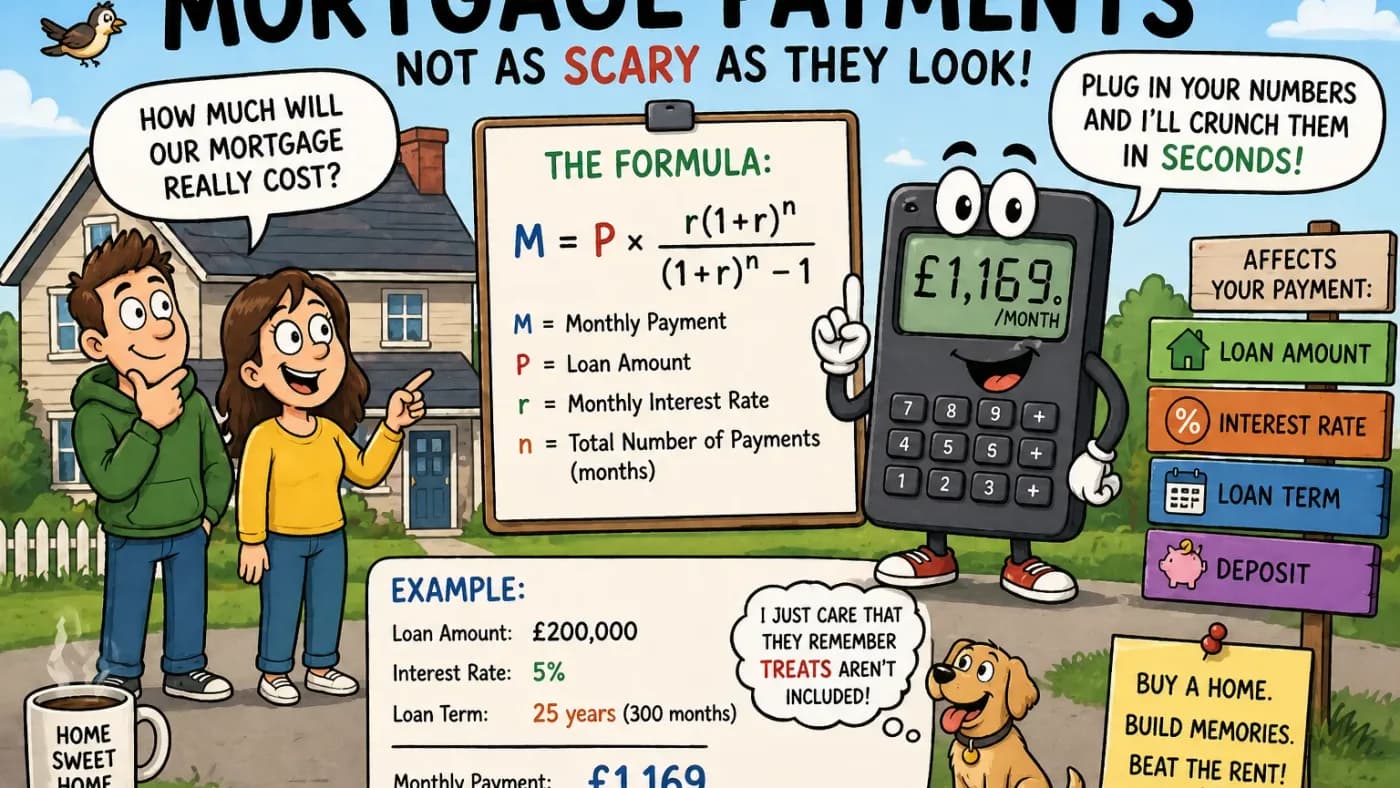
M = P × [r(1 + r)n] ÷ [(1 + r)n − 1]
Where:
- M = Monthly payment
- P = Loan amount
- r = Monthly interest rate (annual rate ÷ 12 ÷ 100)
- n = Total number of payments (months)
How to Calculate Mortgage Payments Step by Step
Example 1: Basic Mortgage Calculation
You take out a mortgage of £200,000 at an interest rate of 5% over 25 years.
Step 1: Convert interest rate to monthly.
5% ÷ 12 ÷ 100 = 0.004167
Step 2: Calculate total payments.
25 × 12 = 300 payments
Step 3: Apply the formula.
The monthly payment is approximately £1,169.
---Example 2: Higher Interest Rate
Same loan (£200,000), but interest increases to 7%.
New monthly payment ≈ £1,414
This shows how sensitive mortgage payments are to interest rates.
---How Interest Affects Your Mortgage
Even small changes in interest rate can significantly affect your monthly payment and total cost.
- Lower rates → lower monthly payments
- Higher rates → higher payments and more total interest
Over long terms like 25–30 years, interest can add tens of thousands to the total cost.
---Total Mortgage Cost
Your total mortgage cost is:
Total Paid = Monthly Payment × Number of Payments
Using Example 1:
£1,169 × 300 = £350,700
Total interest paid:
£350,700 − £200,000 = £150,700
---What Affects Mortgage Payments?
Several factors influence your monthly payment:
- Loan amount – bigger loan = higher payments
- Interest rate – higher rates increase cost
- Loan term – longer terms reduce monthly payments but increase total interest
- Deposit – larger deposit reduces loan amount
Shorter vs Longer Mortgage Terms
Shorter terms (e.g. 15 years):
- Higher monthly payments
- Less total interest
Longer terms (e.g. 30 years):
- Lower monthly payments
- More total interest
Use the Mortgage Calculator
To calculate payments instantly, use our Mortgage Calculator.
You can also use the Loan Calculator for general loan estimates, or the Percentage Calculator for working with interest rates.
---Common Mortgage Mistakes
Ignoring Total Interest
Monthly payments may look affordable, but the total interest over time can be significant.
Focusing Only on Monthly Payment
Lower monthly payments often mean a longer loan and higher total cost.
Not Comparing Interest Rates
Even a small difference in rates can have a large financial impact.
---Frequently Asked Questions
How are mortgage payments calculated?
They are calculated using loan amount, interest rate, and loan term with a standard amortization formula.
What is included in a mortgage payment?
Mainly principal and interest. Some loans include taxes and insurance.
How can I reduce my mortgage payment?
You can reduce it by increasing your deposit, choosing a longer term, or securing a lower interest rate.
Why does interest matter so much?
Because mortgages last many years, interest compounds and significantly increases total cost.
---Conclusion
Mortgage payments are calculated using a standard formula based on loan amount, interest rate, and term. While the formula looks complex, the concept is simple: you repay the loan plus interest over time.
Understanding how mortgage payments work helps you make better financial decisions when buying property. For quick calculations, use the Mortgage Calculator.