Whether you're comparing last month's sales to this month's, checking how much a price went up, or figuring out how much weight you've lost — percentage change is one of those calculations that comes up constantly in everyday life. The good news: once you understand the formula, it's surprisingly simple.
This guide will walk you through exactly how to calculate percentage increase and decrease, with clear examples and no unnecessary jargon.
What Is Percentage Change?
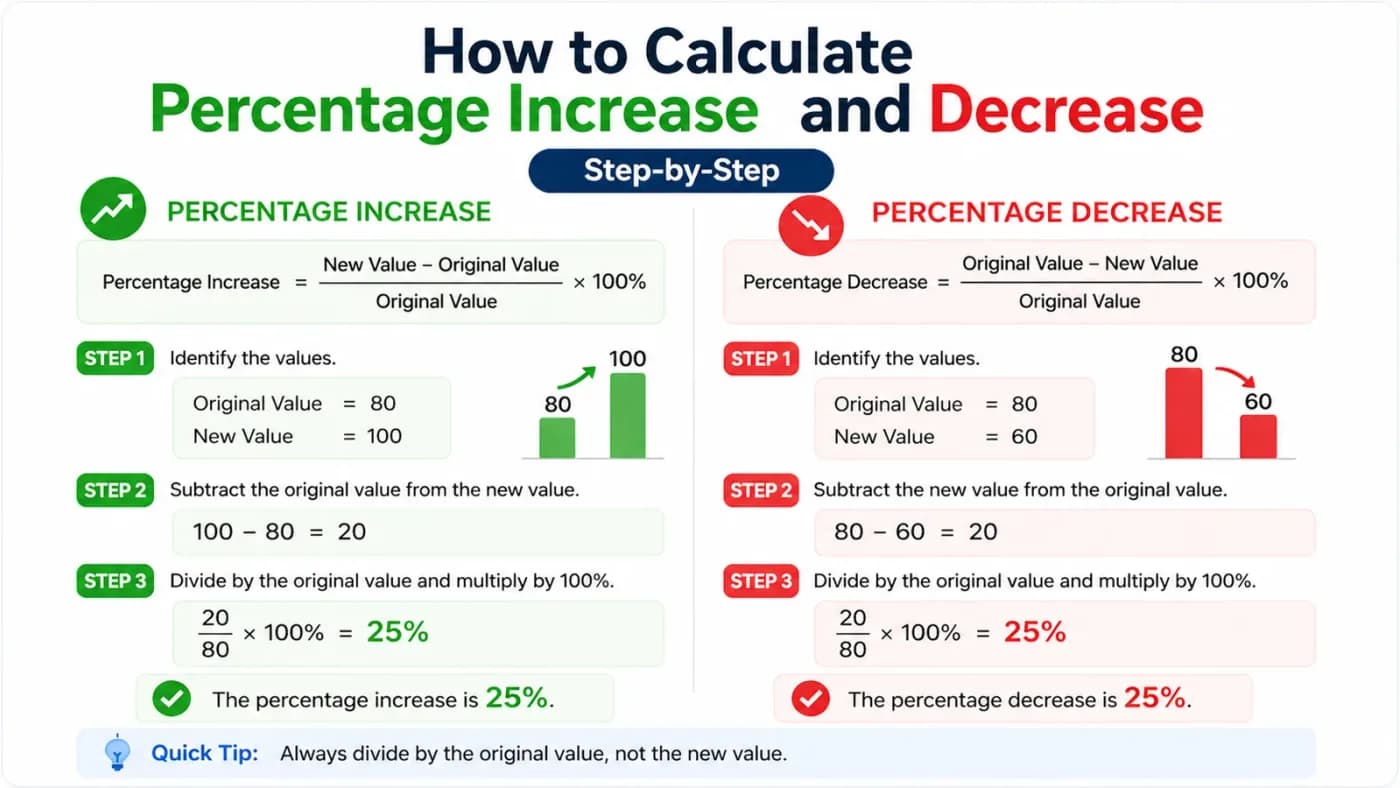
Percentage change tells you how much something has changed relative to its original value, expressed as a percentage. It works for both increases and decreases — the math is the same either way.
There are two outcomes:
- Positive result → percentage increase (the value went up)
- Negative result → percentage decrease (the value went down)
The Percentage Change Formula
Here's the formula you need:
Percentage Change = ((New Value − Old Value) ÷ Old Value) × 100
That's it. Subtract the old value from the new one, divide by the old value, then multiply by 100 to express it as a percentage.
How to Calculate Percentage Increase
Let's say a product cost €40 last month and now costs €52.
Step 1: Subtract the old value from the new value.
52 − 40 = 12
Step 2: Divide by the old value.
12 ÷ 40 = 0.30
Step 3: Multiply by 100.
0.30 × 100 = 30%
The price increased by 30%.
How to Calculate Percentage Decrease
Now imagine your electricity bill dropped from €200 to €155.
Step 1: Subtract the old value from the new value.
155 − 200 = −45
Step 2: Divide by the old value.
−45 ÷ 200 = −0.225
Step 3: Multiply by 100.
−0.225 × 100 = −22.5%
Your bill decreased by 22.5%. The negative sign tells you it went down — no need to use a separate formula for decreases.
Common Mistakes to Avoid
Mixing up old and new values. Always divide by the original (old) value, not the new one. Using the wrong base number is the most common error and will give you a completely different result.
Forgetting to multiply by 100. The formula gives you a decimal — multiplying by 100 converts it to the percentage form most people expect.
Confusing percentage change with percentage points. If an interest rate goes from 2% to 3%, that's a 1 percentage point increase — but it's actually a 50% increase in the rate itself. These are very different things, and the distinction matters in finance and statistics.
Real-World Examples
Example 1: Salary Raise
Your annual salary goes from €35,000 to €38,500.
(38,500 − 35,000) ÷ 35,000 × 100 = 10% increase
Example 2: Weight Loss
Someone goes from 90 kg to 81 kg.
(81 − 90) ÷ 90 × 100 = −10% (a 10% decrease)
Example 3: Website Traffic
Your site had 1,200 visitors last month and 900 this month.
(900 − 1,200) ÷ 1,200 × 100 = −25% decrease
Skip the Math — Use the Calculator
If you'd rather not crunch numbers by hand (no judgment), our Percentage Change Calculator does this instantly. Just enter the old and new values and it handles the rest.
For general percentage problems — like finding what percentage one number is of another — the Percentage Calculator covers all the common variations in one place.
How Percentage Change Is Used in the Real World
Percentage change shows up everywhere:
- Finance: Tracking stock performance, revenue growth, or inflation rates
- Health: Monitoring changes in body weight, blood pressure, or lab results
- Education: Comparing test scores or grade improvements
- Business: Measuring KPIs, conversion rates, and sales targets
According to the U.S. Bureau of Labor Statistics, percentage change is the standard method used to calculate inflation — specifically the Consumer Price Index (CPI) — by comparing price levels between two time periods. It's one of the most widely used calculations in economic reporting worldwide.
Frequently Asked Questions
What is the formula for percentage increase?
Percentage increase = ((New Value − Old Value) ÷ Old Value) × 100. If the result is positive, the value went up.
What is the formula for percentage decrease?
It's the same formula: ((New Value − Old Value) ÷ Old Value) × 100. A negative result means the value decreased.
How do I calculate a 20% increase on a number?
Multiply the original number by 1.20. For example, a 20% increase on €50 = €50 × 1.20 = €60.
What's the difference between percentage change and percentage points?
Percentage change is relative to the original value. Percentage points refer to the absolute arithmetic difference between two percentages. If a rate goes from 5% to 8%, that's a 3 percentage point increase — but a 60% relative increase.
Can percentage change be more than 100%?
Yes. If something doubles, that's a 100% increase. If it triples, that's a 200% increase. There's no upper limit on percentage increase.
What if the original value is zero?
The formula breaks down if the old value is zero, because you'd be dividing by zero — which is mathematically undefined. In practice, this situation is handled by noting that growth started from nothing rather than calculating a percentage.
Conclusion
Calculating percentage increase and decrease comes down to one formula: subtract the old value from the new one, divide by the old value, and multiply by 100. A positive result means an increase; a negative result means a decrease.
Once you get the hang of it, you'll spot opportunities to use it everywhere — from comparing grocery prices to analyzing your savings. And when you'd rather skip the manual steps, the Percentage Change Calculator is always there to do the heavy lifting.
.