Profit margin is one of the most useful numbers in business. It tells you how much of your revenue you actually keep as profit after costs are taken into account.
Whether you sell products, run a service business, manage an online store, or price freelance work, understanding profit margin helps you make better pricing decisions and avoid undercharging.
This guide explains how to calculate profit margin step by step, with simple formulas, worked examples, and a clear explanation of the difference between margin and markup.
What Is Profit Margin?
Profit margin is the percentage of revenue that remains as profit after costs are deducted.
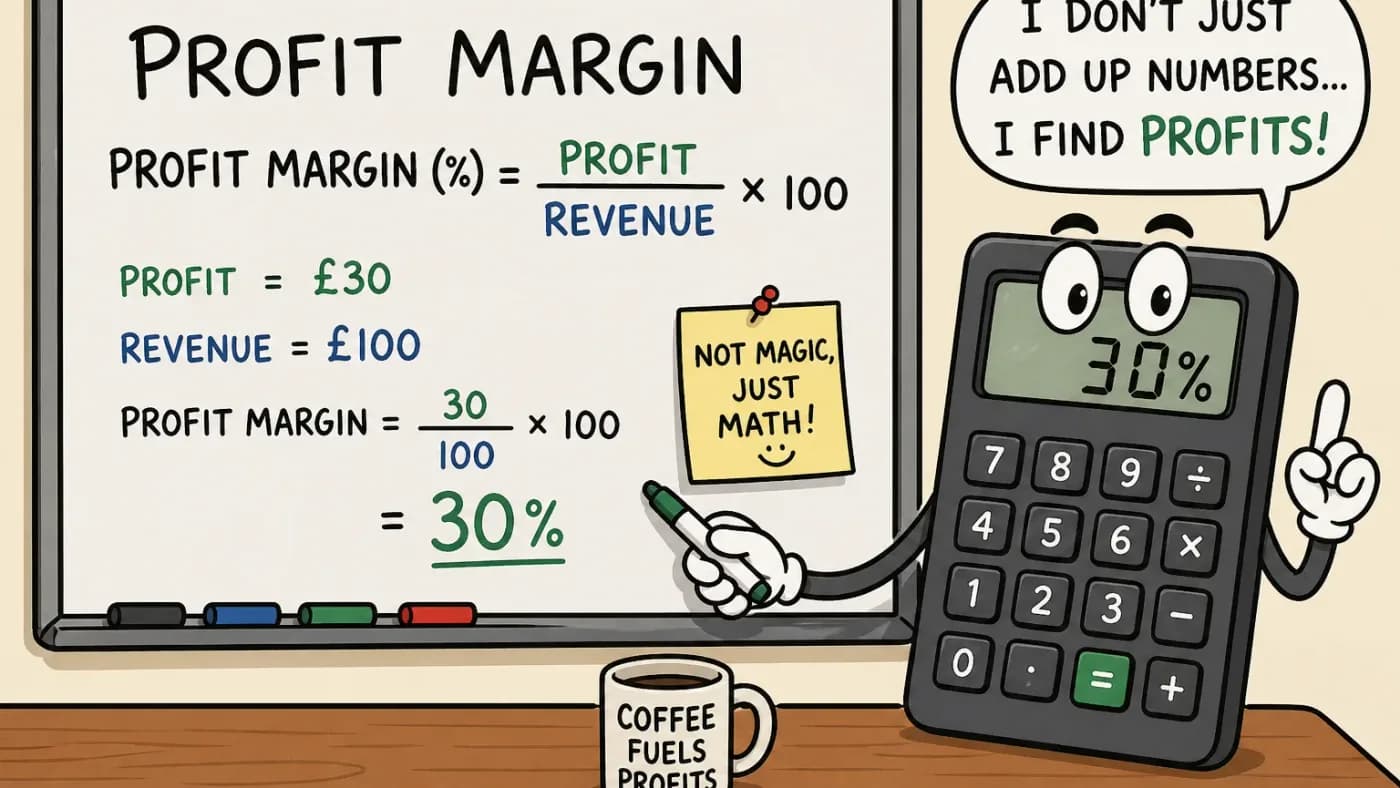
For example, if you sell something for £100 and it costs you £70, your profit is £30. Your profit margin tells you what percentage of the £100 selling price is profit.
In this case, the profit margin is 30%.
Profit Margin Formula
The basic profit margin formula is:
Profit Margin (%) = (Profit ÷ Revenue) × 100
Where:
- Profit = Revenue − Cost
- Revenue = Selling price or total sales
- Cost = The cost of producing, buying, or delivering the product or service
You can also write the formula like this:
Profit Margin (%) = [(Selling Price − Cost) ÷ Selling Price] × 100
How to Calculate Profit Margin Step by Step
Example 1: Basic Profit Margin Calculation
Imagine you sell a product for £100, and the product costs you £70.
Step 1: Calculate the profit.
Profit = Selling Price − Cost
Profit = £100 − £70 = £30
Step 2: Divide profit by the selling price.
£30 ÷ £100 = 0.30
Step 3: Multiply by 100 to convert to a percentage.
0.30 × 100 = 30%
The profit margin is 30%.
Example 2: Lower Margin Product
You sell an item for £50, and it costs £40.
Profit = £50 − £40 = £10
Profit Margin = (£10 ÷ £50) × 100 = 20%
The profit margin is 20%.
Example 3: Service Business Profit Margin
A freelancer charges £800 for a project. Their direct costs, software, subcontractor help, and other project expenses total £200.
Profit = £800 − £200 = £600
Profit Margin = (£600 ÷ £800) × 100 = 75%
The profit margin is 75%.
Gross Profit Margin vs Net Profit Margin
There are different types of profit margin. The two most common are gross profit margin and net profit margin.
Gross Profit Margin
Gross profit margin looks at revenue after direct costs, such as the cost of goods sold.
Gross Profit Margin = (Gross Profit ÷ Revenue) × 100
This is useful for product pricing and understanding whether your core sales are profitable.
Net Profit Margin
Net profit margin looks at revenue after all business expenses are included, such as rent, wages, marketing, software, taxes, and other overheads.
Net Profit Margin = (Net Profit ÷ Revenue) × 100
Net profit margin gives a fuller picture of overall business profitability.
Margin vs Markup: What Is the Difference?
Margin and markup are often confused, but they are not the same thing.
- Margin is based on the selling price.
- Markup is based on the cost.
The markup formula is:
Markup (%) = (Profit ÷ Cost) × 100
Margin vs Markup Example
You buy a product for £50 and sell it for £75.
Profit = £75 − £50 = £25
Markup:
(£25 ÷ £50) × 100 = 50%
Margin:
(£25 ÷ £75) × 100 = 33.3%
This is why margin and markup should not be used interchangeably. A 50% markup does not mean a 50% profit margin.
How to Calculate Selling Price from Desired Margin
Sometimes you know your cost and the profit margin you want, but you need to calculate the selling price.
The formula is:
Selling Price = Cost ÷ (1 − Desired Margin)
When using this formula, write the desired margin as a decimal. For example, 40% becomes 0.40.
Example: Selling Price from Margin
You have a product that costs £60, and you want a 40% profit margin.
Selling Price = £60 ÷ (1 − 0.40)
Selling Price = £60 ÷ 0.60 = £100
You need to sell the product for £100 to achieve a 40% profit margin.
How to Calculate Cost from Selling Price and Margin
You can also work backwards if you know the selling price and target margin.
The formula is:
Cost = Selling Price × (1 − Margin)
Example
You sell a product for £120 and want a 35% margin.
Cost = £120 × (1 − 0.35)
Cost = £120 × 0.65 = £78
To keep a 35% margin, your cost should be no more than £78.
Why Profit Margin Matters
Profit margin helps you understand whether your pricing actually works. A business can have strong sales but still struggle if the margin is too low.
Profit margin is useful for:
- Setting product prices
- Checking whether a sale or discount is still profitable
- Comparing different products or services
- Understanding business performance
- Planning growth and cash flow
- Deciding whether costs need to be reduced
Common Profit Margin Mistakes
Confusing Margin and Markup
This is the biggest mistake. Markup is calculated from cost, while margin is calculated from selling price. They produce different percentages.
Ignoring Extra Costs
If you only include the product cost and ignore shipping, payment fees, packaging, advertising, or labour, your real margin may be lower than expected.
Using Revenue Instead of Profit
Revenue is not profit. Revenue is the total amount received from sales. Profit is what remains after costs are deducted.
Forgetting Discounts
Discounts reduce selling price, which can reduce margin quickly. Always check your margin before running sales or promotions.
Use the Profit Margin Calculator
For quick calculations, use our Profit Margin Calculator to calculate margin, markup, profit, selling price, and cost.
You may also find our Discount Calculator useful when checking sale prices and promotional pricing.
Frequently Asked Questions
What is profit margin?
Profit margin is the percentage of revenue that remains as profit after costs are deducted. It shows how much of each sale is kept as profit.
What is the formula for profit margin?
The formula is Profit Margin = (Profit ÷ Revenue) × 100. Profit is calculated by subtracting cost from revenue.
What is a good profit margin?
A good profit margin depends on the industry. Some businesses operate on low margins with high volume, while others have higher margins and lower sales volume.
Is margin the same as markup?
No. Margin is based on the selling price, while markup is based on the cost. A 50% markup does not equal a 50% margin.
How do I calculate selling price from margin?
Use the formula Selling Price = Cost ÷ (1 − Desired Margin). For example, if cost is £60 and desired margin is 40%, the selling price is £100.
Can profit margin be negative?
Yes. If your costs are higher than your revenue, your profit is negative, which means your profit margin is also negative.
Conclusion
Profit margin is a simple but powerful business metric. It shows how much of your revenue remains as profit and helps you make better pricing, sales, and cost decisions.
The key formula is:
Profit Margin (%) = (Profit ÷ Revenue) × 100
Once you understand the difference between margin and markup, profit margin becomes much easier to use correctly. For fast calculations, use the Profit Margin Calculator.