
What Is Real Return?
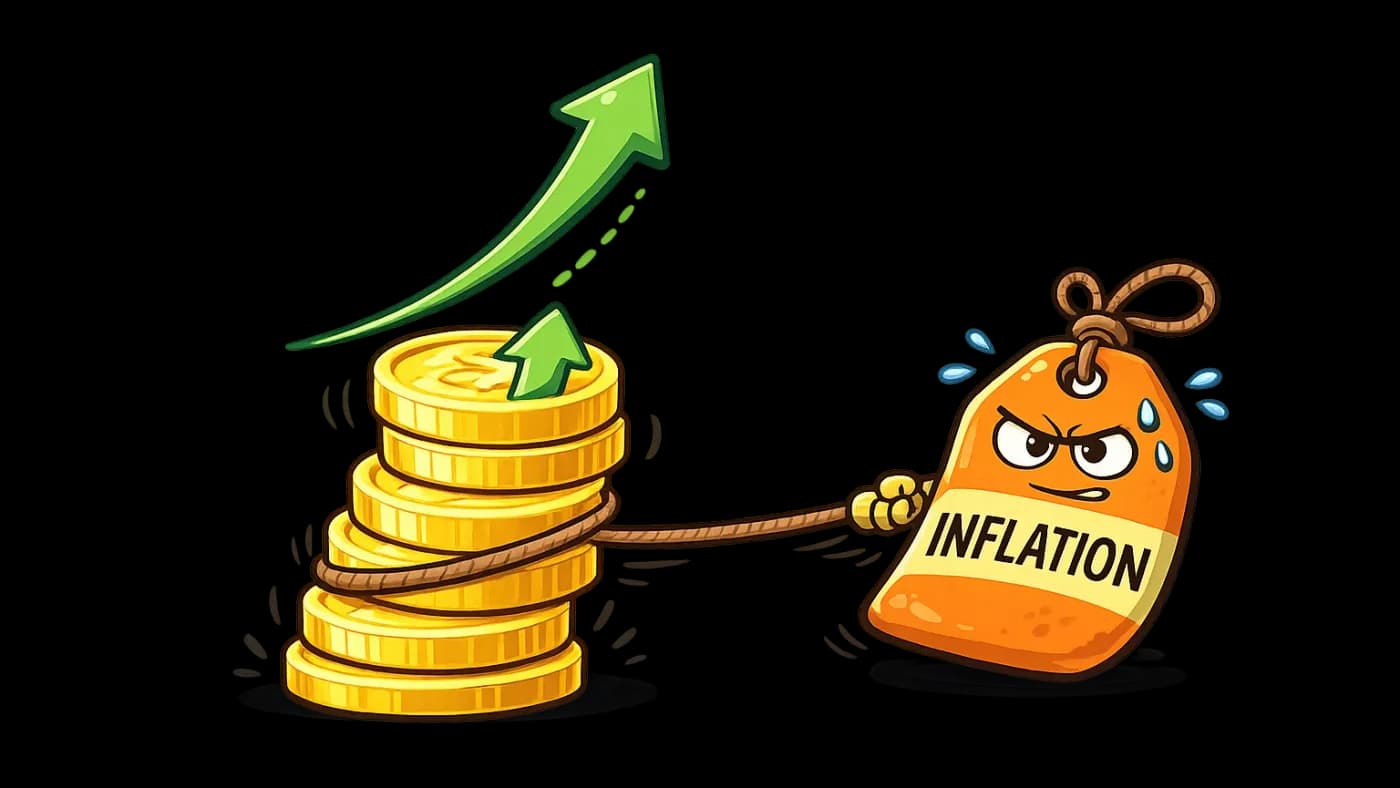
Real return (also called inflation-adjusted return) shows how much your investment actually grows after taking inflation into account.
If your investment earns 8% per year, but inflation is 3%, your real return is lower than 8%. Real return gives you the true increase in purchasing power.
Without adjusting for inflation, your returns can look better than they really are.
Nominal vs Real Return
Nominal return is the percentage return you see on paper.
Real return is what you actually gain after inflation reduces the value of money.
- Nominal return: 8%
- Inflation: 3%
- Real return: about 5%
This difference is why inflation matters when evaluating investments.
Real Return Formula
The accurate formula is:
Real Return = [(1 + Nominal Return) ÷ (1 + Inflation Rate)] − 1
For quick estimates, many people use:
Real Return ≈ Nominal Return − Inflation
This simpler version works well for small percentages.
How to Calculate Real Return Step by Step
Example 1: Simple Approximation
Your investment earns 7% and inflation is 2%.
Real Return ≈ 7% − 2% = 5%
This is a quick estimate and works for most everyday situations.
Example 2: More Accurate Calculation
Nominal return = 10%
Inflation = 4%
Step 1: Convert to decimals
10% = 0.10
4% = 0.04
Step 2: Apply the formula
Real Return = (1.10 ÷ 1.04) − 1
Real Return = 1.0577 − 1 = 0.0577 (5.77%)
Your actual return is about 5.77%, not 10%.
Why Real Return Matters
Inflation reduces what your money can buy over time. Even if your investment grows, rising prices can cancel out part of that growth.
Real return helps you understand:
- The true value of your investment growth
- Whether your savings are keeping up with inflation
- If your long-term financial plan is realistic
This is especially important for retirement planning and long-term investing.
Real-World Example
You invest £10,000 and earn 8% in a year.
Your investment grows to £10,800.
But if inflation is 5%, your real return is closer to 3%.
This means your money grew, but not as much as it appears when adjusting for rising prices.
Common Mistakes to Avoid
Ignoring Inflation
Looking only at nominal returns can give a false sense of growth.
Using the Simple Formula for Large Values
The approximation (return − inflation) becomes less accurate when percentages are higher.
Mixing Time Periods
Make sure both return and inflation are measured over the same time period (e.g. both annual).
Use the Inflation-Adjusted Return Calculator
To calculate real return instantly, use our Inflation-Adjusted Return Calculator.
You can also use the Compound Interest Calculator to estimate long-term growth, and the FIRE Calculator to plan for financial independence.
Frequently Asked Questions
What is real return?
Real return is the return on an investment after adjusting for inflation. It shows the true increase in purchasing power.
What is the difference between nominal and real return?
Nominal return is the stated return, while real return accounts for inflation.
Why is real return important?
It shows whether your money is actually growing in value, not just increasing in numbers.
Can real return be negative?
Yes. If inflation is higher than your investment return, your real return will be negative.
Is the simple formula accurate?
It is a good estimate for small values, but the full formula is more precise.
Conclusion
Real return gives you a clearer picture of how your investments are performing by accounting for inflation.
The key formula is:
Real Return = [(1 + Nominal Return) ÷ (1 + Inflation)] − 1
Once you understand this, you can make better decisions about saving, investing, and long-term financial planning.