
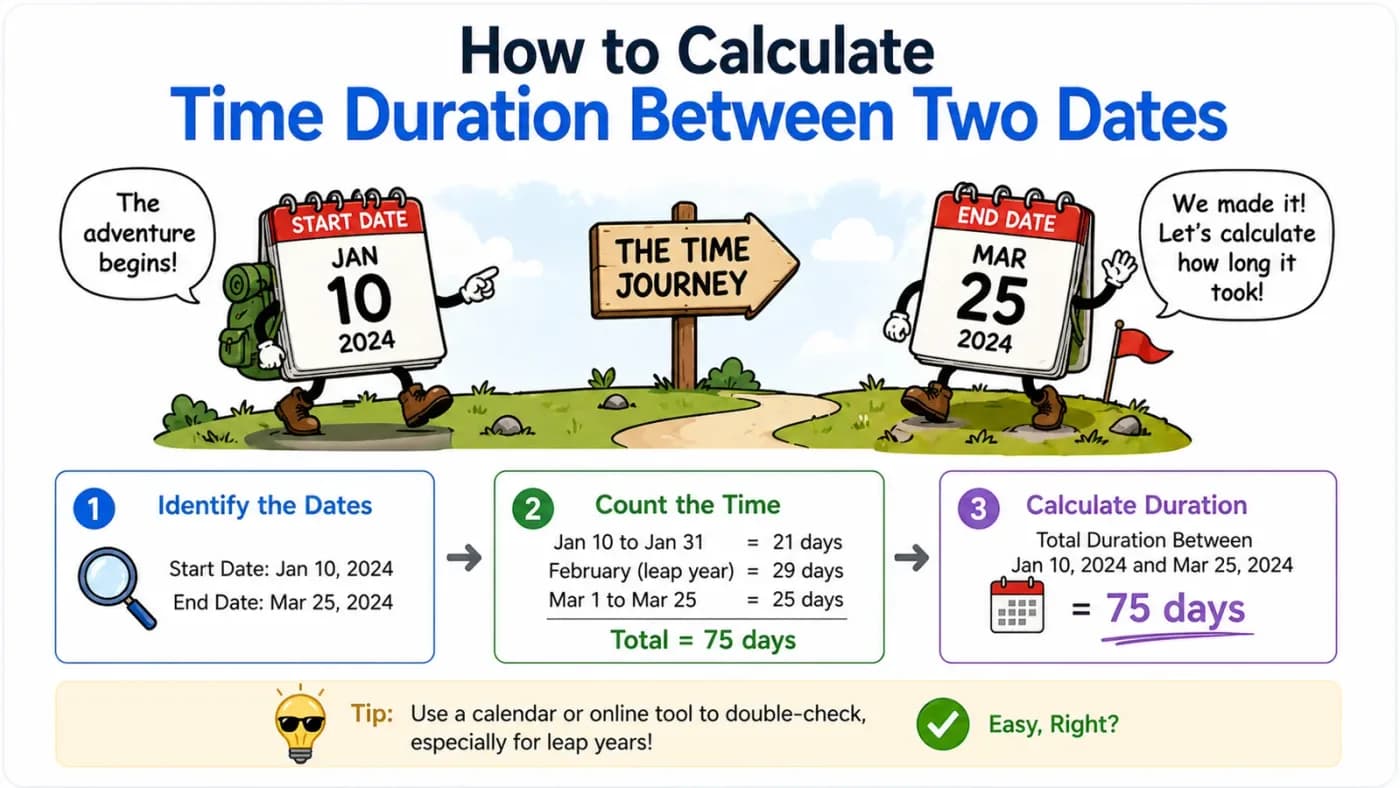
How many days until your holiday? How long have you been at your job? How many weeks are left in the year? These are all the same type of problem: calculating the duration between two dates. It sounds simple — and usually it is — but dates have a habit of being trickier than they look once months with different lengths and leap years get involved.
This guide walks you through how to calculate time duration between two dates, with clear examples and a breakdown of how to express the result in days, weeks, months, or years.
The Simplest Case: Counting Days
The most straightforward way to measure time between two dates is in days. To do this manually, you subtract the earlier date from the later date. In practice, that means counting forward from the start date to the end date.
Example
How many days are between 1 March and 15 April?
- March has 31 days. From 1 March to 31 March = 30 days (you don't count the start date)
- From 1 April to 15 April = 15 days
- Total: 30 + 15 = 45 days
That approach works fine for short spans. For anything longer — or when months and years are involved — it gets fiddly fast.
How to Calculate Duration in Weeks
Once you have the number of days, converting to weeks is easy:
Weeks = Total Days ÷ 7
If the result isn't a whole number, the remainder is the leftover days. So 45 days = 6 weeks and 3 days (45 ÷ 7 = 6 remainder 3).
How to Calculate Duration in Months
This is where things get a little more complicated, because months have different lengths. The general approach:
Step 1: Count the full calendar months between the two dates.
Step 2: Account for the remaining days at the start and end.
Example
From 10 February to 25 August (same year, non-leap year):
- Full months from March through July = 5 months
- Days remaining in February after the 10th: 28 − 10 = 18 days
- Days into August up to the 25th: 25 days
- Total: 5 months, 18 + 25 = 43 days → 5 months and 43 days, or approximately 6 months and 13 days
As you can see, doing this precisely by hand requires care. A single miscounted month length (February being 28 or 29 days, for instance) throws off the whole result.
How to Calculate Duration in Years, Months, and Days
For longer spans — like calculating someone's exact age or how long a contract has been running — you'll want the full breakdown in years, months, and days.
Example
From 14 June 2019 to 3 November 2024:
Step 1 — Count full years:
14 June 2019 to 14 June 2024 = 5 years
Step 2 — Count remaining full months:
14 June 2024 to 14 October 2024 = 4 months
Step 3 — Count remaining days:
14 October 2024 to 3 November 2024 = 20 days
Result: 5 years, 4 months, and 20 days
The Leap Year Problem
Leap years add an extra day (29 February) every four years — with some exceptions. The rule is:
- A year is a leap year if it's divisible by 4
- Except if it's divisible by 100 — then it's not a leap year
- Except if it's also divisible by 400 — then it is a leap year
So 2000 was a leap year. 1900 was not. 2024 is. This matters when calculating date spans that cross February, as a single day difference can change your result. It's one of the main reasons manual date arithmetic is error-prone for longer durations.
For a thorough reference on calendar systems and leap year rules, the Time and Date reference on leap years is a reliable resource used by developers and date calculation tools worldwide.
Use the Date Duration Calculator
Manual date maths is satisfying to understand, but tedious to do repeatedly — especially across month and year boundaries. Our Date Calculator works out the exact duration between any two dates instantly, giving you the result in days, weeks, months, and years all at once.
Need to calculate hours and minutes between two times on the same day? The Time Calculator handles time-of-day durations with the same ease.
Common Use Cases
- Project planning: How many working days are left before a deadline?
- Contracts and leases: How long has an agreement been running?
- Age calculation: Exactly how old is someone in years, months, and days?
- Countdowns: How many days until an event, holiday, or due date?
- Financial periods: How many days of interest have accrued?
Frequently Asked Questions
How do I calculate the number of days between two dates?
Subtract the earlier date from the later date. Count forward from the start date to the end date, adding up the days in each month you pass through. For quick calculations, use a date duration calculator to avoid errors caused by varying month lengths.
Does the start date count when calculating duration?
It depends on what you're measuring. For elapsed time (e.g. how long something has been running), you typically don't count the start date — day one begins the day after. For event countdowns, you might count it. Most calculators let you choose.
How do leap years affect date calculations?
Leap years add one extra day (29 February) every four years. If your date range crosses February in a leap year, the total day count will be one higher than in a non-leap year. This is easy to miss when doing manual calculations.
How do I calculate weeks between two dates?
First find the total number of days between the dates, then divide by 7. The whole number is the weeks; the remainder is the extra days. For example, 52 days = 7 weeks and 3 days.
How do I calculate months between two dates?
Count the full calendar months between the two dates, then handle the remaining days separately. This gets complex when months have different lengths, which is why a date calculator is more reliable than doing it by hand.
What is the easiest way to count days between dates?
Use a date duration calculator. For a quick mental estimate, count the months between the dates, multiply by 30, and adjust for the extra or missing days at each end.
Conclusion
Calculating time duration between two dates is straightforward for short spans — just count the days. For longer durations spanning multiple months or years, the varying lengths of months and the occasional leap year make manual calculation error-prone. The safest approach is to understand the method (years first, then months, then days) and let a calculator handle the precise arithmetic.
Whether you're planning a project, checking a contract, or just counting down to something exciting, the Date Calculator gives you the exact answer in seconds.