
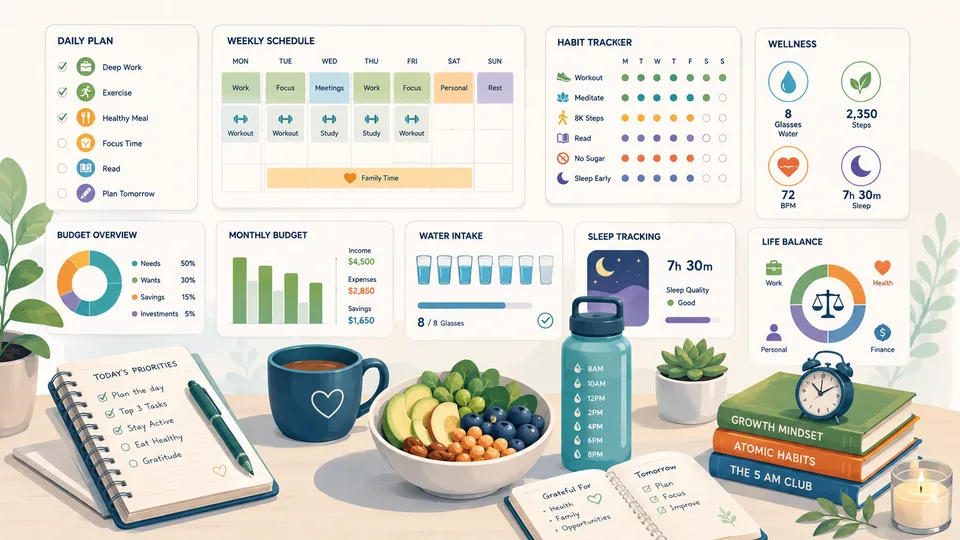
Most Lifestyle Problems Are Really System Problems
I've had periods of life that felt chaotic despite being technically productive, and others that felt manageable despite being genuinely busy — the difference was usually planning. A lot of people feel permanently busy, distracted or exhausted without fully understanding why. Days blur together. Tasks pile up. Healthy habits disappear during stressful periods. Sleep gets worse. Money feels tighter. Motivation becomes unreliable.
Usually this is not caused by one dramatic failure. It is caused by small systems gradually breaking down.
Lifestyle design is really about building everyday structures that reduce chaos and make good decisions easier to repeat consistently.
This guide explores routines, productivity, time management, wellness habits, budgeting and everyday planning in a realistic way rather than pretending life can be perfectly optimised.
Motivation Is Unreliable
One of the biggest mistakes people make is relying too heavily on motivation.
Motivation changes constantly depending on sleep, stress, work, health, energy levels and mood. Some days everything feels easy. Other days even basic tasks feel difficult.
This is why routines matter.
Good routines reduce the number of decisions you need to make repeatedly. They create structure that continues functioning even when motivation is low.
Simple repeatable systems are often more valuable than complicated optimisation plans that collapse after two weeks.
Time Management Is Mostly Energy Management
People often treat time management as if every hour of the day has equal productivity potential. In reality, energy levels fluctuate constantly.
Sleep quality, workload, stress, exercise, food intake and mental fatigue all influence how effectively you use time.
This is why productivity systems that look perfect on paper often fail in real life. They assume humans behave like machines.
Better planning usually includes:
- realistic scheduling
- breaks and recovery
- buffer time
- fewer simultaneous priorities
- repeatable daily anchors
The goal is not squeezing maximum productivity out of every minute. The goal is creating sustainable momentum.
Small Habits Quietly Compound
Most people underestimate how much small repeated behaviours shape long-term outcomes.
Sleeping slightly less every night. Spending slightly more than intended. Walking less. Working later. Scrolling more. Skipping exercise repeatedly. None of these feel dramatic individually.
But habits compound over time.
The same is true in positive directions. Small improvements maintained consistently often outperform occasional extreme effort.
This is why habit systems matter more than short bursts of discipline.
Work-Life Balance Usually Means Boundary Management
Modern work often leaks into everything else. Notifications continue after hours. Freelancers feel pressure to always be available. Remote work removes separation between work and personal life.
Without boundaries, recovery disappears gradually.
Work-life balance does not necessarily mean perfectly equal time distribution. It usually means preventing one area of life from permanently overwhelming everything else.
That may involve:
- fixed working hours
- scheduled recovery time
- exercise routines
- screen-free periods
- better sleep structure
- reducing unnecessary commitments
Balance is less about perfection and more about sustainability.
Money Stress Affects Lifestyle More Than People Admit
Financial stress quietly affects productivity, health, relationships and overall wellbeing.
Budgeting is not only about numbers. It is also about reducing uncertainty and preventing constant low-level anxiety around money.
Many lifestyle problems become worse when finances feel unstable. Sleep suffers. Stress increases. Decision-making becomes reactive rather than planned.
This is why basic budgeting and financial awareness are part of a healthy lifestyle system rather than completely separate topics.
Health Habits Support Everything Else
Sleep, movement, hydration and nutrition affect nearly every other part of life.
People often try to solve productivity problems while consistently sleeping too little, exercising rarely and running on stress.
Health habits are not separate from performance. They directly influence focus, recovery, mood and energy management.
That does not mean life must become perfectly optimised. It means the basics matter more than many people realise.
Technology Is Helpful Until It Creates Noise
Apps, trackers and productivity tools can genuinely improve organisation and awareness.
But many people eventually create systems that are more complicated than the problems they were trying to solve.
Too many dashboards, reminders, notifications and optimisation systems can create mental clutter instead of clarity.
The best systems are usually simple enough to maintain consistently.
Useful Lifestyle Calculators
- Daily Routine Calculator — structure consistent daily habits and routines.
- Time Management Calculator — estimate how time is actually being used.
- Productivity Calculator — measure work output and task efficiency.
- Sleep Calculator — estimate healthier sleep timing and recovery patterns.
- Water Intake Calculator — estimate hydration needs.
- Budget Calculator — manage income and spending balance.
- Macro Calculator — estimate nutrition targets.
- Calorie Calculator — estimate daily energy needs.
- Work Hours Calculator — track work time and workload patterns.
- Pomodoro Calculator — structure focused work and break sessions.
Where To Start
If life currently feels chaotic or exhausting, avoid trying to fix everything simultaneously.
Start by improving a few high-impact areas:
- sleep consistency
- daily structure
- basic budgeting
- movement and exercise
- recovery time
- reduced mental clutter
Small stable systems usually create more long-term improvement than dramatic lifestyle overhauls that become impossible to maintain.
The goal is not building a perfectly optimised life. The goal is building one that remains functional, healthy and sustainable under real-world pressure.