
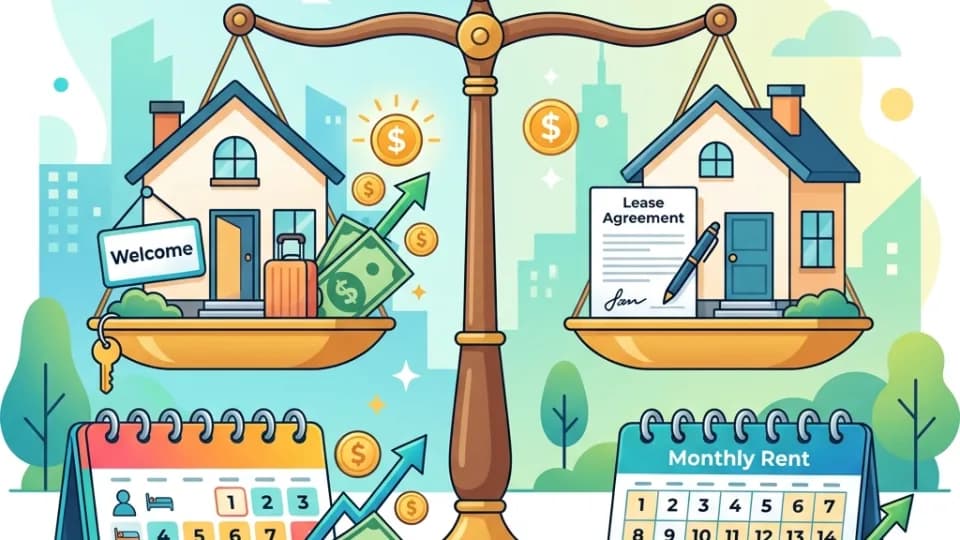
Airbnb and short-term rental platforms promise higher nightly rates than traditional tenancies, and in the right location they can deliver significantly more income. But the comparison between short-term and long-term rental income is more complicated than a simple nightly rate multiplication. Costs, occupancy, effort, and risk all differ substantially — and the option that looks more lucrative on a back-of-envelope calculation frequently looks different after a full cost analysis.
Short-Term Rental Income Potential
The income potential of short-term rental depends heavily on location and property type. City centre apartments in tourist or business travel markets, coastal holiday lets, and properties near major event venues generate the highest occupancy and nightly rates. A one-bedroom flat in central Edinburgh might achieve £120 to £180 per night and 70% to 85% occupancy during peak periods, producing gross annual income of £31,000 to £56,000. The equivalent long-term rental rate might be £1,100 to £1,400 per month — £13,200 to £16,800 annually.
The gap is large but requires context. The short-term figure is gross of all platform fees, cleaning costs, and the additional costs that long-term letting does not involve. The long-term figure is simpler to achieve and requires far less active management.
Outside premium tourist locations, the Airbnb premium shrinks considerably. A suburban property in a non-tourist town might achieve £70 to £90 per night and 40% to 55% occupancy — producing £10,000 to £18,000 gross annually. The long-term rental equivalent in the same market might be £750 to £900/month — £9,000 to £10,800 annually. The Airbnb premium in this scenario, before costs, is modest to negligible.
Long-Term Rental Stability
Long-term letting provides stable, predictable monthly income with significantly lower management intensity. A good tenant in a well-maintained property generates a fixed monthly receipt with minimal landlord intervention. Void periods average two to four weeks per year at most for well-managed properties in reasonable demand areas. The income is highly predictable and requires no ongoing active marketing or property turnaround.
The regulatory environment for long-term letting is also more established. Landlord obligations are well-understood; the process for handling problem tenancies, while slower than before, follows a known path. Short-term rental regulation is evolving rapidly — several UK local authorities have introduced or are considering restrictions on short-term letting, and the regulatory risk of committing to a short-term model in an area where it may be constrained or banned is real.
Cleaning, Platform Fees, and Management Costs
Airbnb charges hosts between 3% and 5% of the booking value as a service fee on most listings. Cleaning costs — either paid to a professional cleaner or the time cost of self-cleaning — typically run £40 to £80 per turnover for a one-bedroom property, £60 to £120 for two bedrooms. At three to four turnovers per week during peak season, cleaning alone can cost £600 to £1,500 per month.
If professional management is used — particularly if the property is not near the landlord — Airbnb property management companies typically charge 20% to 30% of gross income. A property generating £3,000/month gross at 25% management fee generates £2,250 after management, then minus cleaning, platform fees, and utilities, leaving considerably less than the headline rate implies.
Occupancy Rate Makes or Breaks the Numbers
The variable that most determines whether Airbnb beats long-term renting is occupancy rate. At high occupancy (70%+), the income premium is often real after costs. At moderate occupancy (40% to 55%), the premium after costs is marginal or negative in most markets. At low occupancy (below 40%), long-term renting is almost always financially superior.
Most properties do not achieve the occupancy rates visible on competitor listings, for two reasons: the data visible on Airbnb shows calendars, not actual bookings, and new listings take time to accumulate reviews and improve in search ranking. Projecting income from the highest-performing comparable listing produces optimistic estimates; using median occupancy for your specific submarket and property type is more reliable.
How to Use the Calculator
The Airbnb vs Long-Term Rental Calculator compares both options after all costs. Enter your nightly rate, expected occupancy, cleaning cost per turnover, platform fee percentage, and any management fee alongside the equivalent long-term rent. The output shows net annual income from each option and the break-even occupancy rate at which Airbnb becomes financially superior to long-term letting.