
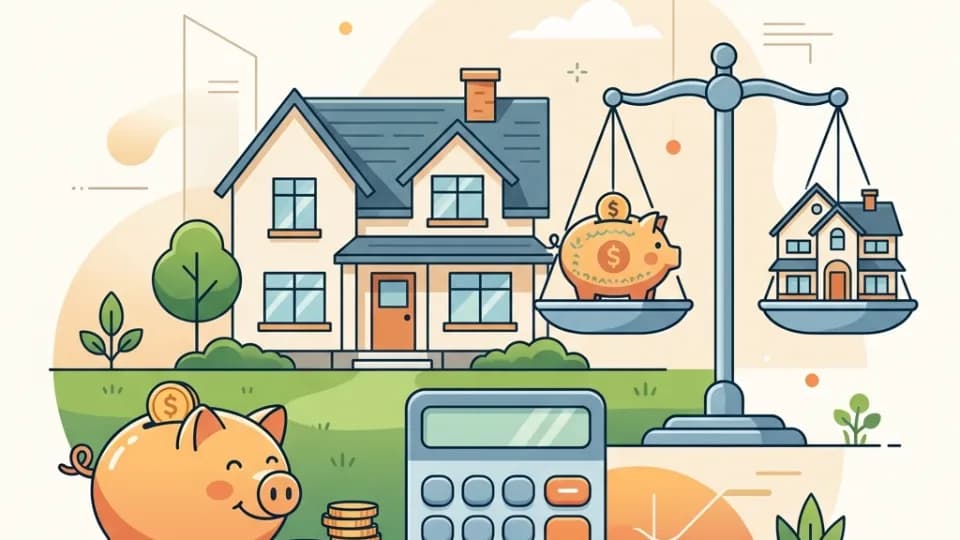
Upgrading to a bigger home is one of the most common financial decisions people make — and one of the most consequential. The costs of a larger property extend well beyond the higher mortgage payment, and the lifestyle and financial constraints created by stretching to buy are often underestimated until they are being lived. Here is how to assess whether the upgrade is genuinely affordable.
The Temptation to Stretch Your Budget
The argument for buying at the top of your budget is familiar: property appreciates, so buying as much as you can is always better long-term. The children will grow into the space. You will earn more in a few years. Interest rates might fall. Each of these arguments has some merit in some circumstances and is used to justify purchases that leave households financially overextended in ways that are not fully visible until rates rise, income growth disappoints, or an unexpected cost emerges.
The specific danger of stretching to buy at the top of lending capacity is that the safety margins disappear. At a comfortable housing cost ratio, an unexpected boiler replacement is a manageable expense. At 50% of take-home pay in housing costs, the same repair requires either debt or liquidating savings. The property is valuable; the financial position is fragile.
Extra Costs That Come With a Bigger Home
A larger property costs more to own in ways that compound the higher mortgage payment:
Stamp duty: For a move from £280,000 to £450,000, stamp duty increases from approximately £4,000 to £12,500 — an additional £8,500 in transaction costs that must be recovered from appreciation before any real benefit is realised.
Maintenance costs: A larger property has more to maintain. A 1% annual maintenance provision on a £450,000 property is £4,500/year; on a £280,000 property it was £2,800/year. The additional £1,700/year in maintenance provision may not be immediately visible but compounds over a decade into a significant difference in total ownership cost.
Energy costs: A larger property costs more to heat and power. An extra bedroom and bathroom, or a detached property versus a semi-detached, can add £50 to £200/month in energy costs depending on age, insulation, and usage.
Council tax: Higher-value properties typically sit in higher council tax bands. Moving from Band D to Band E or F can add £400 to £1,000/year.
The cumulative additional monthly cost of a significantly larger property — higher mortgage, higher maintenance provision, higher energy, higher council tax — can easily run to £500 to £800/month above the headline mortgage difference. This figure must be affordable from current income, not from projected future income.
How Housing Costs Affect Your Lifestyle
The practical test of affordability is what the budget looks like after all housing costs are paid. Use the Am I House Poor Calculator to model the proposed property's total monthly housing cost against your take-home pay. If the result leaves less than 30% to 35% of take-home pay for all non-housing expenses — food, transport, childcare, pension, savings, discretionary spending — the property is stretching your budget beyond what allows a financially stable life.
Discretionary spending is the first casualty. Holidays, restaurants, social activities, clothing — these are cut when housing costs are too high. For some households, some period of reduced discretionary spending is an acceptable trade-off for a step up in property. The question is how long the constraint lasts and whether income growth will genuinely provide relief.
Stress-Testing Your Budget
Before committing to a larger mortgage, stress-test the budget under adverse scenarios. What happens to the monthly position if the mortgage rate increases by 1% at the next remortgage? What if one income is lost for six months? What if a major maintenance item (roof, boiler, structural repair) costs £8,000 in year two?
None of these scenarios is unlikely. They should all be survivable without financial crisis if the purchase is genuinely within budget. If any of them produces a situation that would require selling the property, accumulating significant debt, or failing to meet other financial obligations, the purchase is stretching beyond what is financially resilient.
When a Bigger House Is Not Worth It
A bigger house is not worth the cost when it creates persistent financial constraint that limits life choices, prevents saving and investing, and removes the flexibility to navigate setbacks. Property is a useful asset — but it is one asset among several, and concentrating an excessive proportion of income in a single illiquid asset is a structural financial vulnerability, not a wealth-building strategy.