
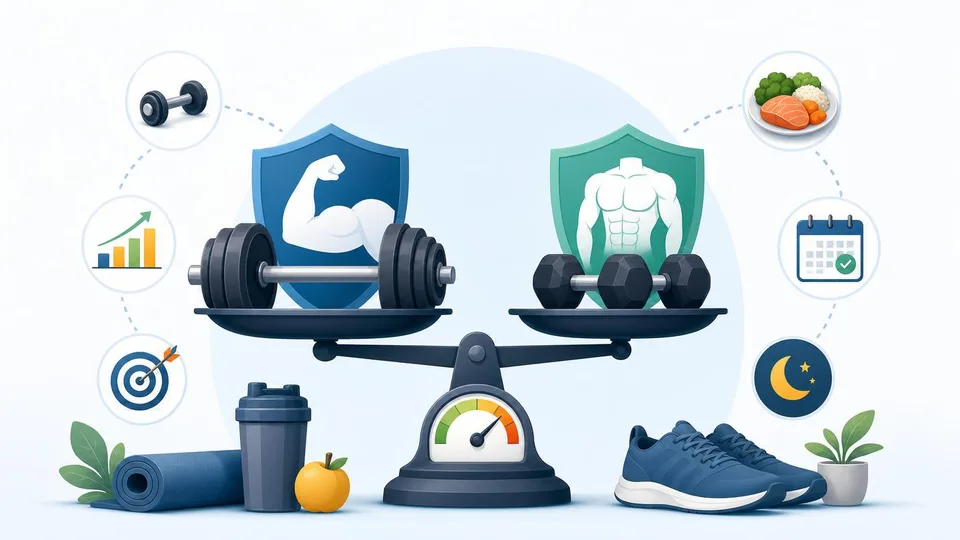
My early lifting years were muddled because I never made a clear decision about whether I was training for strength or size — so I drifted between the two and got limited results from either.
Fitness advice online often sounds strangely simple considering how complicated real human behaviour actually is. Spend five minutes on social media and you would think everybody either transformed their body in twelve weeks or completely failed because they “didn't want it enough.” Real fitness progress is usually slower, less dramatic and far more psychologically messy than that.
I realised this years ago after going through the familiar cycle a lot of people experience: extreme motivation, unsustainable training, exhaustion, frustration, then starting over again a few months later. The strange thing is that most people are not lacking effort. They are usually drowning in contradictory advice while expecting their body to respond faster than biology realistically allows.
Why Balanced Fitness Advice Is Easy to Miss
One problem with modern fitness culture is that balanced advice rarely spreads as aggressively as extreme advice. “Lose weight gradually while sleeping properly and managing stress” does not generate the same excitement as dramatic transformations or punishing routines.
That creates unrealistic expectations almost immediately. People start assuming muscle growth should happen rapidly, fat loss should be linear and motivation should remain permanently high. Then normal setbacks start feeling like personal failure instead of ordinary human inconsistency.
I remember becoming convinced at one point that my training plan was failing simply because progress slowed after the beginner stage. Looking back now, the problem was mostly expectation management. Social media had quietly convinced me that visible progress should happen every week forever.
Hard Work Only Helps If the Body Can Adapt
This is probably one of the most overlooked parts of fitness entirely. People become obsessed with the visible part of progress — the workout itself — while ignoring sleep, recovery, stress and consistency.
Recovery is frustrating because it feels passive. Nobody posts glamorous photos of sleeping eight hours or taking sensible recovery days. But the body does not really care about motivational culture. Muscle repair, hormonal recovery and nervous system fatigue still exist whether somebody wants dramatic results or not.
One of the strangest lessons in fitness is realising that more effort is not always better effort. There is a point where training quality starts collapsing because recovery cannot keep pace.
Body Changes Are Messier Than Charts Suggest
People often underestimate how psychologically strange body composition changes can feel. Weight fluctuates constantly. Water retention masks progress. Muscle growth happens slowly enough that people convince themselves nothing is changing right before comparing old photos and suddenly noticing massive differences.
Fat loss is especially deceptive because progress rarely arrives in a perfectly predictable line. Some weeks feel incredibly productive despite little visible change. Other times results suddenly appear after a frustrating plateau.
I think this unpredictability is why people become vulnerable to extreme methods. Slow sustainable progress feels emotionally unsatisfying compared to dramatic promises. But aggressive approaches often create rebound behaviour later because they rely on unsustainable pressure.
The Context Missing From Popular Advice
This is something I notice repeatedly with nutrition and training myths. Completely ridiculous claims usually disappear quickly. The persistent myths are the ones containing small pieces of truth wrapped inside oversimplification.
Cardio does burn calories. Metabolism does vary slightly between people. Protein matters for recovery. Heart rate zones can improve endurance training. But internet fitness culture tends to flatten these ideas into absolute rules people repeat without context.
That is how people end up believing they permanently “damaged” their metabolism or that one specific training style secretly burns fat dramatically faster than everything else.
Small Repeatable Effort Wins More Often
The people I know who maintained impressive long-term fitness results were rarely the most extreme individuals. Usually they were simply the most consistent.
They built routines that survived normal life stress instead of routines that only worked under perfect conditions. They understood that missing one workout is irrelevant while quitting entirely for three months matters a lot.
Oddly enough, sustainable fitness often looks less impressive day-to-day. Moderate calorie deficits. Sensible recovery. Gradual progressive overload. Long walks. Consistent protein intake. Repeating relatively boring behaviours long enough for biology to compound them.
That approach is less exciting than transformation marketing, but it works far more reliably.
The Human Side of Fitness Planning
Fitness decisions are rarely purely logical. People eat emotionally, compare themselves emotionally and train emotionally. Stress changes hunger. Poor sleep changes cravings. Body image affects motivation in complicated ways.
This is partly why exercise alone often fails for fat loss despite being incredibly valuable overall. Training can improve health massively while still being undermined by recovery problems, appetite changes or inconsistent eating habits.
I think a lot of fitness frustration comes from expecting the body to behave like simple mathematics while ignoring how human behaviour actually works under stress, exhaustion and normal daily life.
The Sustainable Route Usually Wins
The annoying reality is that most effective fitness advice sounds repetitive because the fundamentals genuinely matter more than shortcuts. Consistent training. Sustainable nutrition. Recovery. Patience. Gradual progression.
None of this sounds revolutionary, which is probably why people keep searching for hidden answers elsewhere.
But after enough years around fitness culture, one thing becomes obvious: the people who make long-term progress are usually not the people chasing perfection. They are the people who build systems realistic enough to continue even when motivation disappears temporarily.
If you want to apply this practically, the calorie calculator gives you a personalised starting point based on your weight, height, age, and activity level.