
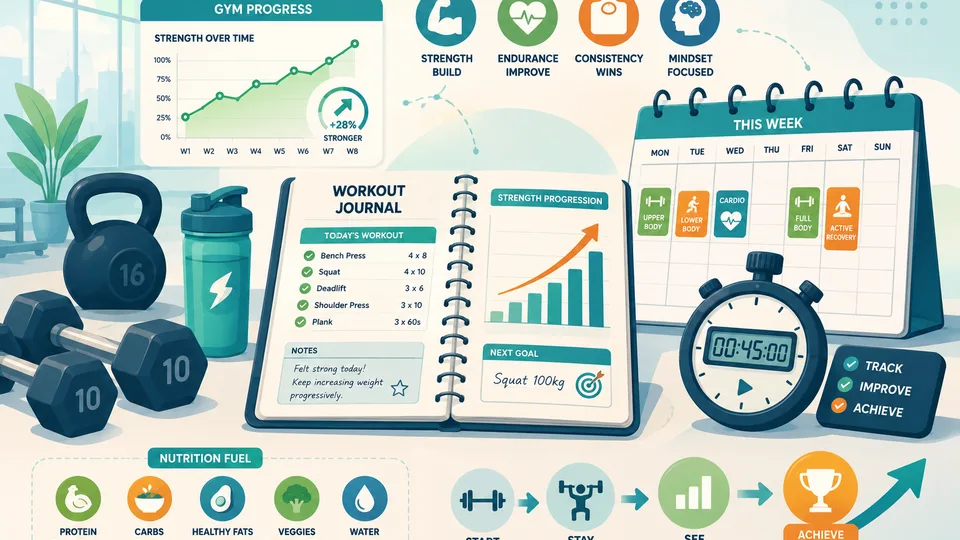
Workout Planning Is Less Complicated Than Fitness Culture Pretends
I've built training plans that worked and ones that collapsed in the first fortnight, and the difference usually came down to one thing: realism. A lot of fitness advice makes training sound far more complicated than it really is. One person says you need the perfect split. Another insists on advanced periodisation. Someone else claims you need six workouts per week, detailed macro tracking and a shelf full of supplements before you can make progress.
Most people do not fail because their workout plan is missing advanced optimisation. They fail because the plan is inconsistent, unrealistic or impossible to recover from long term.
A good workout plan should help you train consistently, recover properly and improve gradually over time. That matters far more than chasing the perfect routine.
What A Good Workout Plan Actually Does
A workout plan gives structure to your training. Instead of randomly exercising whenever motivation appears, you follow a repeatable system.
A solid plan should:
- match your current fitness level
- fit your schedule realistically
- allow recovery between sessions
- focus on progressive improvement
- support long-term consistency
That looks different for everyone. A beginner may improve quickly with three short full-body workouts each week. Someone more advanced may need a more specialised structure. Neither approach is automatically better.
Consistency Beats Extreme Motivation
One of the biggest mistakes in fitness is trying to do too much too quickly. Extremely aggressive plans often work for a few weeks before motivation crashes or recovery problems appear.
The best workout routine is usually the one you can still follow months from now.
Progress comes from repeating good habits often enough that they become normal. A moderate routine performed consistently usually beats a perfect routine abandoned after three weeks.
Progressive Overload Matters More Than Random Variety
Your body adapts to training stress over time. To continue improving, you generally need some form of progressive overload. That does not mean every workout must feel harder than the last one. It simply means your training gradually becomes more demanding over time.
You can progress by:
- lifting slightly heavier weights
- doing more repetitions
- improving exercise technique
- increasing training volume gradually
- improving conditioning or recovery capacity
Small improvements repeated consistently matter more than occasional extreme workouts.
Strength Training, Cardio and Recovery All Work Together
People often separate fitness into competing camps. Strength training versus cardio. Muscle building versus fat loss. Heavy lifting versus functional fitness.
In reality, most people benefit from a balanced approach.
Strength training helps maintain muscle, improve body composition and support long-term health. Cardio improves conditioning, endurance and calorie expenditure. Recovery allows your body to adapt instead of simply accumulating fatigue.
A smart workout plan usually combines all three in some form.
Nutrition Is Part Of The Plan
Training and nutrition work together. Even the best workout routine struggles if recovery and food intake are consistently poor.
Protein intake matters because it supports recovery and muscle maintenance. Calorie intake matters because it influences body weight and energy balance. Macronutrients influence energy levels and training performance.
This does not mean you need a perfect diet. It means your nutrition should support your actual goals.
Someone trying to gain strength may need a different calorie target than someone focused on fat loss. Someone training intensely several days per week usually needs more recovery support than someone exercising casually.
Tracking Progress Without Becoming Obsessed
Progress is rarely perfectly linear. Some weeks feel strong. Others feel flat. Sleep, stress, hydration, workload and recovery all influence performance.
Good progress tracking looks at trends rather than isolated days.
Useful things to track include:
- strength improvements
- body measurements
- body weight trends
- workout consistency
- energy and recovery
- exercise performance
The goal is not to micromanage every variable. The goal is to collect enough information to make reasonable adjustments over time.
Useful Fitness Calculators
- 1 Rep Max Calculator — estimate your one-rep max and training percentages.
- Macro Calculator — estimate protein, carbs and fat targets.
- Protein Intake Calculator — estimate daily protein requirements.
- Calorie Deficit Calculator — estimate a realistic calorie deficit for fat loss.
- Calorie Calculator — estimate daily calorie needs and energy balance.
Where To Start
If you are new to training, start smaller than you think you need to. Focus on building a routine you can repeat consistently.
You do not need a perfect split, expensive supplements or advanced optimisation to begin making progress. You need a realistic plan, enough recovery, sensible nutrition and patience.
Train consistently. Improve gradually. Recover properly. Adjust when necessary.
Most long-term fitness success comes from doing basic things well for a very long time.