
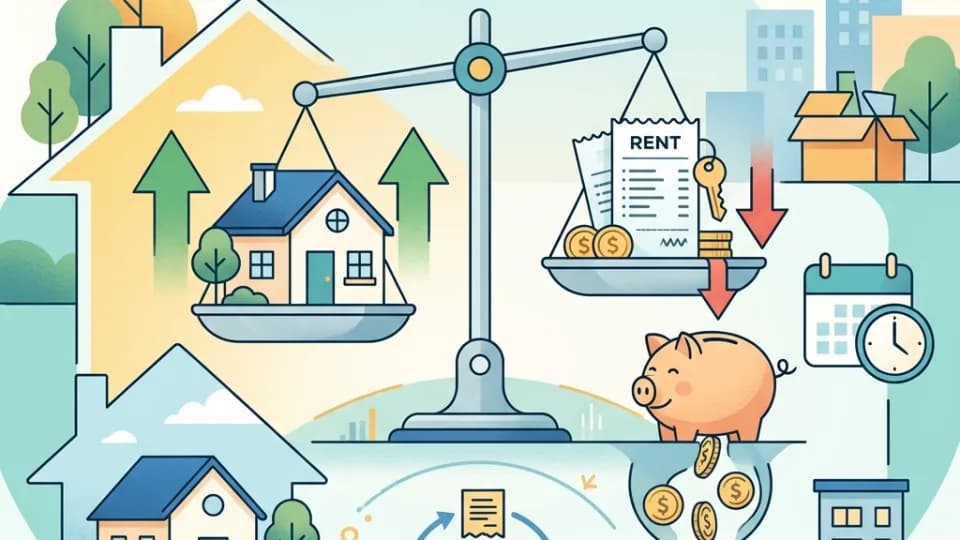
"Renting is throwing money away" is one of the most repeated pieces of financial advice in the UK — and one of the most misleading. It treats rent as pure loss while ignoring the significant costs of ownership that do not build equity either. A rigorous comparison of renting versus buying requires accounting for all costs on both sides, not just the mortgage payment versus the rent payment.
Why People Say Renting Is Wasted Money
The logic behind the phrase is intuitive: rent payments go to a landlord and leave you with nothing at the end of the tenancy. Mortgage payments, by contrast, reduce an outstanding balance and build equity in an asset you will eventually own outright. In this framing, renting is consumption and buying is saving.
The framing is incomplete in two important ways. First, it ignores the costs of ownership that also do not build equity — mortgage interest, which in the early years accounts for the majority of each payment; property maintenance and repairs; insurance; stamp duty and transaction costs; and the opportunity cost of the deposit and equity tied up in the property. Second, it ignores what a renter does with the financial difference — the deposit not paid, the transaction costs not incurred, the maintenance not funded — if those funds are invested rather than spent.
The Real Cost of Buying a Home
Buying a home involves costs beyond the mortgage payment that are often underweighted or ignored:
Transaction costs: Stamp duty (0% to 12% of purchase price depending on value and buyer status), legal fees (£1,000 to £3,000), surveyor (£400 to £1,500), mortgage arrangement fee (£0 to £2,000), removal costs. On a £350,000 purchase, these can total £15,000 to £25,000 — incurred upfront and not recovered until the property is sold.
Mortgage interest: In the early years of a repayment mortgage, the majority of each payment covers interest. On a £280,000 mortgage at 4.5%, monthly interest in year one is approximately £1,050 — approximately 70% of a typical monthly payment. This portion does not build equity any more than rent does.
Maintenance and repairs: A reasonable estimate for property maintenance is 1% to 2% of property value per year. On a £350,000 home, that is £3,500 to £7,000 per year — costs that renters do not bear directly.
Opportunity cost of deposit: A £50,000 deposit invested instead at 6% annual return grows by £3,000 in the first year. The cost of tying that capital in property is the foregone investment return — not zero, as the rent vs buy comparison typically treats it.
When Renting Can Be the Smarter Choice
Renting is often financially superior to buying in specific circumstances:
Short time horizons: Transaction costs of buying are fixed regardless of how long you stay. Stamp duty, legal fees, and selling costs typically total 5% to 8% of property value. On a property that appreciates at 3% per year, it takes approximately two to three years of ownership just to break even on transaction costs alone. If you plan to move within two to three years, renting is likely cheaper even if property prices are rising.
High price-to-rent ratios: In markets where purchase prices are very high relative to rental costs — central London being the extreme example — the annual cost of owning can significantly exceed the annual cost of renting an equivalent property. In these markets, renting and investing the financial difference can produce better long-term outcomes than buying.
Capital available for investment: A renter who would otherwise deploy a £60,000 deposit into a diversified investment portfolio, rather than into a property purchase, is not "throwing money away" — they are making a different investment decision. The comparison is not rent vs mortgage payment; it is the total financial outcome of each path over the relevant time horizon.
How to Use the Calculator
The Rent vs Buy Break-Even Calculator compares the total cost of renting against the total cost of buying over your expected tenure, accounting for all costs on both sides including opportunity cost of the deposit, mortgage interest, transaction costs, maintenance, and expected property appreciation. Enter your local property price, equivalent rent, deposit available, expected tenure, and assumed investment return for the deposit alternative. The output shows the break-even point — the tenure length at which buying becomes cheaper than renting — and the total financial position under each scenario.