
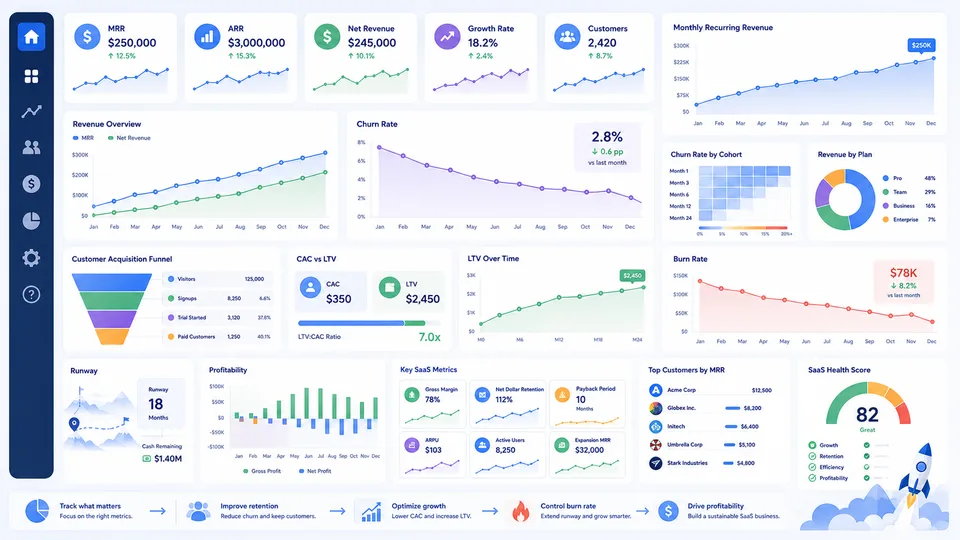
The most memorable board meeting I ever sat through involved a founder presenting what looked like strong growth metrics — MRR up, customer count up, trial conversion up — while the CFO was quietly circling the churn figure on a printout. The churn rate had crept from 3.2% to 5.8% monthly over twelve months. Nobody on the founding team had flagged it as a crisis because each month's number was only a little worse than the month before. The board member who finally asked about it pointed out that at 5.8% monthly churn, the average customer was staying less than 18 months. Every growth metric looked different once that context was on the table.
SaaS Growth Often Looks Healthier Than It Really Is
Subscription businesses can create a strange illusion of stability. Monthly recurring revenue grows steadily, dashboards look impressive and customer counts increase over time.
But underneath those numbers, many SaaS companies are balancing several fragile dynamics simultaneously:
- customer retention
- acquisition cost
- support burden
- infrastructure scaling
- pricing pressure
- cash runway
A product can appear successful on the surface while quietly losing money on every customer acquired.
That is why SaaS metrics matter so much. They are not just investor jargon or dashboard decoration. They help reveal whether growth is actually sustainable.
Churn Is Usually The Metric That Changes Everything
A lot of founders focus heavily on acquiring customers at the beginning because growth feels exciting and visible. Churn tends to receive less attention until it starts becoming painful.
The problem is that churn quietly compounds against growth.
Even strong acquisition numbers can become surprisingly weak if customers consistently leave after a short period.
This is why retention is often more important than people initially expect.
Reducing churn by even a relatively small amount can dramatically improve:
- customer lifetime value
- cash flow stability
- marketing efficiency
- profitability
- runway longevity
In practice, many SaaS companies discover that keeping existing customers happy is far cheaper than constantly replacing them.
Supporting article:
How To Reduce Churn & Increase Retention
Customer Lifetime Value Is Easy To Misunderstand
Lifetime value sounds simple in theory:
“How much revenue does a customer generate over time?”
But the reality becomes messy quickly.
Different businesses calculate LTV differently. Some ignore servicing costs entirely. Others assume unrealistic retention periods. Some focus on revenue while others focus on profit contribution.
I remember comparing SaaS dashboards years ago and being surprised at how confidently companies presented wildly different LTV assumptions as if they were directly comparable.
The useful part of LTV is not precision. It is understanding customer economics broadly enough to make better strategic decisions.
Related article:
How To Calculate Customer Lifetime Value
The LTV:CAC Ratio Is Helpful But Not Magical
The LTV:CAC ratio became one of the most repeated SaaS metrics because it provides a rough picture of acquisition efficiency.
In simple terms:
- LTV estimates customer value
- CAC estimates acquisition cost
Comparing them helps indicate whether growth is economically sensible.
But many people treat the ratio too mechanically.
A “good” ratio can still hide problems if:
- cash flow timing is weak
- payback periods are too long
- churn assumptions are unrealistic
- support costs are ignored
- pricing is unstable
Metrics become dangerous when they create false confidence rather than clearer understanding.
Supporting article:
Burn Rate Matters Long Before A Crisis Appears
Startups often think about burn rate mainly during fundraising pressure or financial difficulty. In reality, burn rate shapes strategic flexibility constantly.
A company with:
- healthy runway
- controlled spending
- predictable growth
can make calmer decisions than one operating close to financial exhaustion.
This becomes especially important during:
- market slowdowns
- advertising cost increases
- infrastructure scaling
- pricing experiments
- product pivots
One thing that catches many founders off guard is how gradually burn problems develop before suddenly feeling urgent.
Related article:
Profit Margin In SaaS Is Rarely As Simple As It Looks
Subscription businesses are sometimes described as “high margin” almost automatically. That can be true, but only under the right conditions.
Modern SaaS products often carry growing operational costs:
- cloud infrastructure
- AI APIs
- support teams
- compliance
- data storage
- payment processing
- sales operations
As products scale, complexity increases alongside revenue.
This is why understanding actual margins matters more than relying on simplified assumptions about SaaS economics.
Supporting article:
How To Calculate Profit Margin Correctly
Not Every Feature Improves The Business
A common SaaS trap is assuming that more features automatically create more value.
Sometimes new functionality improves retention and strengthens differentiation. Other times it increases:
- support complexity
- technical debt
- infrastructure cost
- onboarding friction
- maintenance burden
A lot of companies quietly become harder to operate long before they become meaningfully more valuable.
This is why product decisions should be connected to economics, not just feature velocity.
Supporting article:
Are Product Features Worth The Cost?
Useful Calculators For SaaS & Startup Finance
Practical calculators can help make startup metrics feel more grounded and less abstract.
- Churn Rate Calculator
- Customer Lifetime Value Calculator
- CAC Calculator
- LTV:CAC Ratio Calculator
- Startup Burn Rate Calculator
- Profit Margin Calculator
- Break-Even Calculator
The most useful approach is usually combining several metrics together rather than obsessing over one number in isolation.
SaaS Metrics Are Most Valuable When They Shape Decisions
One subtle problem with modern analytics dashboards is that companies sometimes track metrics because they are popular rather than useful.
Good metrics should help answer practical questions:
- Are customers staying?
- Is acquisition sustainable?
- Are margins improving?
- Can the business survive slower growth?
- Which customers are actually valuable?
If metrics do not influence real decisions, they often become decorative reporting rather than operational insight.
Where To Start
If you are trying to improve SaaS sustainability, begin with retention and visibility before chasing aggressive growth.
Understand:
- how long customers actually stay
- what acquisition truly costs
- which features increase operational burden
- how quickly runway is shrinking
- which customers generate the strongest long-term value
The supporting guides and calculators throughout this hub are designed to make those relationships easier to understand in practical terms rather than purely theoretical startup language.