
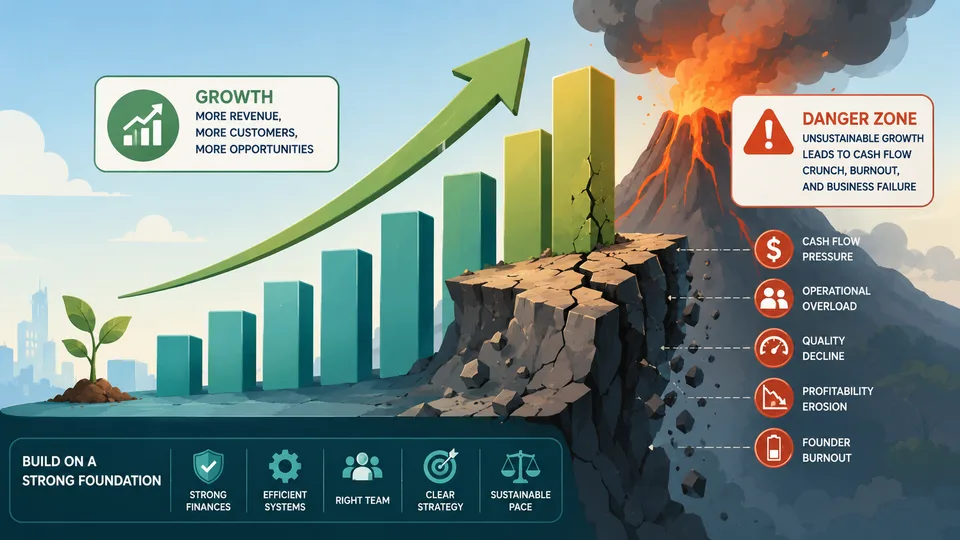
The most counterintuitive business conversation I have ever had was with a founder who was worried because the company was growing too fast. Revenue had doubled in twelve months. The team had grown from six to eighteen. They had moved into larger premises. On paper, everything was going right. In practice, they were running out of cash. Not because the business was unprofitable — it was marginally profitable — but because growth had stretched every part of the operation simultaneously. They were waiting on invoices while paying staff. Stock investment was ahead of revenue. New hire costs were landing months before the new hires were generating value. The business had outrun its working capital and was in genuine danger of failing at the moment it looked most successful.
Why Growth Consumes Cash Before It Creates It
Profitable growth is cash-flow negative in the short term because costs arrive before revenue does. Hiring a new sales person costs £4,000 in salary in month one, before they have closed a single deal. Buying stock to fill a new retail contract requires cash outlay before the contract generates invoices, and invoices must be paid before cash arrives. Moving to larger premises requires a deposit and the first month's rent before any additional capacity is monetised. Each of these investments is justified by the expected return — but the timing gap between investment and return creates a cash deficit that must be funded somehow. Fast-growing businesses that do not explicitly model this timing gap often discover they cannot fund growth out of operating cash flow, regardless of what the profit and loss account shows.
The Working Capital Trap
Working capital is the cash required to fund operations between the moment costs are incurred and the moment revenue is received. For product businesses, it is dominated by inventory: you buy materials or stock before you sell it. For service businesses, it is dominated by receivables: you deliver the work before the client pays. In both cases, faster growth means more working capital consumed. A business growing revenue by 50% per year needs 50% more working capital than it did at the start of the year — even if the profit margins are unchanged. If that working capital is not available through cash reserves, a credit facility, or equity investment, growth must be slowed or stopped. The business that is "successful" but cash-poor has a working capital problem that is as dangerous as any other kind of financial distress.
Margin Dilution: When Growth Happens at Lower Profitability
Rapid growth often comes with margin dilution. New clients acquired through aggressive pricing or discounting have lower margins than established clients. New team members are less efficient than experienced ones while in the onboarding period. New premises have higher costs than the previous arrangement. Expanded product lines include items with lower contribution margins. The P&L shows higher revenue while the margin percentages quietly fall. If revenue grows 40% while gross margin falls from 45% to 38%, gross profit in absolute terms grows only 25%. Meanwhile, fixed costs may have grown 35% to support the increased capacity. The resulting operating margin compression can turn a profitable business into a barely profitable one at precisely the point when it looks most successful from the outside. Tracking a burn rate calculator alongside a runway calculator makes these dynamics visible before they become a crisis.
The Capacity Constraint That Arrives Before You Notice It
Growth hits capacity constraints before it hits financial constraints in most service businesses. The team that could deliver excellent work at 80% utilisation becomes inconsistent at 110%. Customer satisfaction falls. Key people burn out. Quality control breaks down under volume. The instinct is to hire — but hiring takes time, new people need training, and during the transition period the business may be operating below the quality level its reputation was built on. The growth that was meant to generate profit creates a service quality crisis that erodes the client relationships that drove the growth in the first place. Managing growth rate to stay within the capacity of the team to deliver it well is a genuine competitive strategy, not a failure of ambition.
Indicators That Growth Is Becoming Dangerous
Cash balance declining despite profitable trading is the clearest signal. Other indicators include: debtor days increasing (clients taking longer to pay as the business is too busy to chase effectively), supplier payment terms tightening as cash availability falls, key staff attrition as workload exceeds sustainable levels, increasing error rates or customer complaints as quality control suffers under volume, and management attention spread so thin that decision quality deteriorates. None of these appear on a revenue chart. They require a different set of metrics — cash flow forecasts, utilisation rates, quality scores, staff tenure data — that fast-growing businesses often do not have in place because they were built for the business they were, not the business they are becoming.
The Founder Bottleneck: When Growth Outpaces Leadership Bandwidth
In the early stages of a business, the founder is often the primary decision-maker, relationship manager, quality controller, and cultural anchor simultaneously. This works at small scale because the founder's involvement in each domain is proportionate to its scope. As the business grows, each domain expands faster than one person's bandwidth can accommodate. Decisions pile up waiting for founder input. Client relationships that were personal become managed at arm's length without adequate transition. Quality control that was informal and direct becomes inconsistent as the team grows beyond direct oversight. Culture that was instinctive and visible becomes something that needs to be explicitly designed and maintained. The businesses that navigate rapid growth most successfully are those where the founder recognises this shift and builds leadership capacity in advance — by hiring experienced managers into key functions, by systematising decisions that were previously made instinctively, and by deliberately creating structures that allow the organisation to function without requiring founder involvement in every significant moment. The ones that struggle are those where the founder tries to maintain the same level of personal control that worked at a smaller scale, creating a bottleneck that limits both the speed and quality of everything downstream.
How to Slow Down Without Losing Momentum
Recognising that growth is becoming dangerous does not require stopping it — it requires managing its pace and ensuring that the infrastructure keeps up with the opportunity. Practical measures include: pausing new business development while the delivery team catches up to existing commitments; raising prices to dampen demand to manageable levels while simultaneously improving margin; being selective about which new clients or contracts to accept, prioritising those that fit the current capability rather than those that require the business to stretch immediately; investing in systems and processes that increase capacity without proportionate headcount growth. None of these feel comfortable in a growth phase, because growth has its own momentum and stopping or slowing it feels like falling behind. The alternative — continuing to grow faster than the business can sustainably support — risks the client relationships, staff retention, and reputation that made the growth possible in the first place. Managed deceleration is not failure; it is the foundation for growth that compounds rather than collapses.
Related calculator: Use our Profit Margin Calculator to check whether growth is improving or eroding profitability.
What to do next
Use the ideas above as a starting point — then connect them to your own numbers and related guides on Calc It Anything.
- Read the small business finance and growth guide for the wider cluster.
- Compare with How to Calculate Your True Hourly Rate as a Freelancer.
- Compare with How to Price Freelance Work Without Guessing.
- Run the relevant calculator on this site with your own inputs before making a decision.
Related reading
- small business finance and growth guide
- How to Calculate Your True Hourly Rate as a Freelancer
- How to Price Freelance Work Without Guessing
- Why You're Overestimating Your Freelance Income
Frequently asked questions
Should freelancers price hourly or on retainers?
Hourly work suits variable scope; retainers stabilise income when delivery is predictable. Many freelancers mix both — hourly for discovery, retainer for ongoing work once scope is clear.
How much buffer should irregular income earners hold?
A practical target is three to six months of essential expenses in cash, plus a separate tax pot if you are self-employed. Build the buffer before aggressive investing or lifestyle upgrades.
What is the biggest freelance pricing mistake?
Quoting from gut feel without annualising billable days, admin time, tax, and unpaid gaps. Use your effective hourly rate after all costs, not the number on the invoice.