
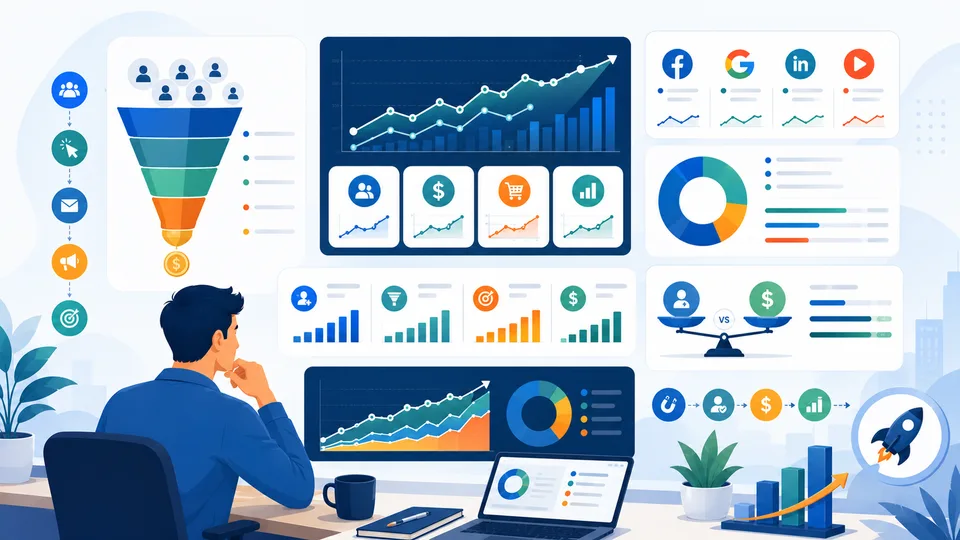
Marketing Growth Does Not Automatically Mean Business Growth
I've watched marketing budgets grow alongside customer numbers in ways that looked healthy until someone checked whether those customers were actually profitable. One of the easiest traps in marketing is assuming that more traffic, clicks or impressions automatically translate into healthier business performance.
Growth metrics can look impressive while profitability quietly weakens underneath. Customer acquisition costs rise, retention remains poor and campaigns become increasingly expensive just to maintain momentum.
I think this is why so many businesses eventually realise that marketing performance only becomes meaningful when connected to actual financial outcomes.
Customer Acquisition Always Has A Cost
Acquiring customers is rarely free, even when businesses rely heavily on organic channels.
Costs may include:
- advertising spend
- SEO investment
- content production
- sales teams
- software tools
- email systems
- creative production
- time and operational overhead
At smaller scales these costs sometimes feel manageable or invisible. But as competition increases, acquisition usually becomes more expensive over time.
This is why businesses eventually need to understand not just how to acquire customers, but whether acquisition remains financially sustainable.
Supporting article:
Cost Per Acquisition Explained
ROI Is More Complicated Than Simple Revenue Comparisons
Return on Investment calculations are useful because they connect spending decisions to outcomes.
But marketing ROI is rarely perfectly clean or immediate.
Some campaigns generate direct short-term revenue. Others influence:
- brand visibility
- future retention
- customer trust
- repeat purchases
- long-term search visibility
One thing that surprised me when comparing different marketing channels was how often the “best” channel changed depending on timeframe. Some strategies looked weak initially but became extremely valuable over longer periods because acquisition costs compounded differently.
Supporting article:
ROI Guide: What Counts As Return?
Cheap Leads Are Not Always Valuable Leads
A common marketing mistake is focusing too heavily on reducing acquisition costs without considering customer quality.
Lower-cost traffic may produce:
- weaker retention
- lower spending
- higher refund rates
- reduced engagement
- lower long-term value
This creates situations where apparently “cheap” growth becomes expensive once profitability is analysed properly.
Supporting article:
Why Cheap Leads Can Become Expensive
Customer Lifetime Value Changes Marketing Decisions
Customer Lifetime Value, often shortened to LTV or CLV, changes how businesses evaluate acquisition entirely.
A customer who stays engaged for years may justify far higher acquisition costs than a customer who disappears quickly after purchase.
This is why strong retention can make marketing systems dramatically more sustainable.
Businesses with healthy retention often gain more flexibility because:
- customer value compounds
- repeat purchases increase
- referrals become easier
- acquisition pressure decreases
Supporting articles:
Conversion Rates Usually Reveal Friction
Conversion rates help businesses understand how effectively interest becomes action.
Low conversion rates often indicate:
- poor messaging
- pricing hesitation
- weak user experience
- trust issues
- irrelevant traffic
- slow websites
- confusing offers
A lot of companies focus heavily on increasing traffic while ignoring the friction already present in their existing conversion path.
Sometimes improving conversion efficiency produces stronger business results than endlessly increasing visitor volume.
Supporting article:
Understanding Conversion Rates
Traffic Alone Can Be Misleading
Large traffic numbers often create psychological confidence because they are easy to measure and compare publicly.
But traffic itself is only useful when:
- the audience is relevant
- conversion pathways work
- retention exists
- acquisition costs remain sustainable
- the business model supports growth
I remember comparing websites where smaller, highly targeted traffic consistently outperformed larger generic audiences financially.
Supporting article:
Why High Traffic Doesn't Always Convert
LTV:CAC Relationships Matter More Than Isolated Numbers
Marketing metrics become far more useful when connected together instead of analysed individually.
The relationship between:
- customer acquisition cost
- customer lifetime value
- retention
- profit margin
usually reveals far more about business sustainability than isolated dashboard numbers.
This is one reason SaaS and subscription businesses focus heavily on LTV:CAC ratios.
Supporting article:
Marketing Metrics Should Support Decisions, Not Replace Judgment
Modern analytics platforms produce enormous amounts of data.
The challenge is no longer access to metrics. The challenge is understanding which metrics actually matter.
Some businesses become trapped endlessly optimising dashboards while losing sight of broader strategic questions:
- Is the product valuable?
- Are customers staying?
- Is pricing sustainable?
- Does growth improve profitability?
- Does acquisition remain scalable?
Supporting article:
Marketing Metrics That Actually Matter
Useful Calculators For Marketing & Customer Acquisition
Marketing performance becomes easier to evaluate realistically when acquisition and profitability metrics are measurable.
- ROI Calculator
- CAC Calculator
- Customer Lifetime Value Calculator
- Conversion Rate Calculator
- Revenue Growth Calculator
- Cost Per Lead Calculator
- Break-Even Calculator
These tools are most useful when combined with realistic retention and profitability assumptions instead of focusing purely on surface-level growth.
Healthy Marketing Systems Usually Become More Predictable
One interesting pattern in sustainable businesses is that customer acquisition gradually becomes more stable and measurable over time.
That does not mean growth becomes effortless. Competition still changes constantly. Costs still fluctuate. Platforms still evolve.
But stronger businesses usually develop:
- clearer acquisition economics
- better retention
- improved conversion efficiency
- stronger customer understanding
- more resilient growth systems
Marketing starts feeling less like random spikes and more like a system that can be understood and improved deliberately.
Where To Start
If you are trying to improve marketing performance and customer acquisition, start by connecting growth metrics to actual business outcomes.
Focus first on:
- customer acquisition cost
- conversion efficiency
- retention
- customer lifetime value
- profitability
- ROI realism
The supporting articles and calculators throughout this guide are designed to help make marketing metrics feel more practical, financially grounded and useful for long-term business decisions instead of turning analytics into endless vanity reporting.