
Muscle Growth Usually Takes Longer Than People Expect
I've had realistic and unrealistic periods of expecting muscle gain — and the turning point was understanding what the research actually says about timelines and process. One of the biggest misconceptions around muscle gain is how quickly progress is supposed to happen.
Transformation videos and aggressive marketing often make muscle building look rapid and dramatic, but real long-term progress usually feels much slower and less visually obvious at first.
That does not mean progress is impossible. It simply means the body adapts gradually.
I think this is one reason many people become frustrated early. They train hard for a few weeks expecting major visible changes, then assume something is wrong when the process feels slower and more repetitive than expected.
Muscle Gain Depends On More Than Just Training Hard
A lot of gym advice revolves around intensity alone. Train harder. Lift heavier. Push further.
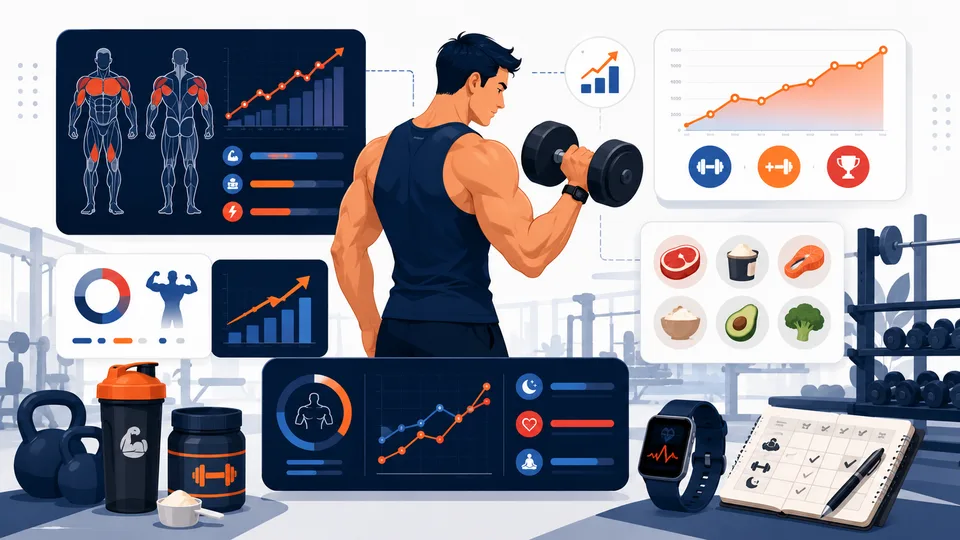
Effort matters, but muscle growth usually depends on several systems working together:
- consistent resistance training
- adequate recovery
- sufficient nutrition
- progressive overload
- sleep quality
- long-term consistency
Missing one of these areas repeatedly often limits progress more than people realise.
Progressive Overload Is The Foundation
Progressive overload simply means gradually increasing the demands placed on the body over time.
That does not always mean adding huge amounts of weight every session.
Progress can also come from:
- extra repetitions
- improved exercise control
- better technique
- higher training volume
- reduced rest times
- better workout consistency
A lot of newer lifters assume progression should feel dramatic constantly. In reality, sustainable improvement often happens through small repeated increases over long periods.
Supporting article:
Progressive Overload Explained
Bulking Is Often Misunderstood
Bulking is frequently treated like an excuse to eat excessively, but uncontrolled weight gain usually creates unnecessary problems later.
Large calorie surpluses may increase body weight quickly, yet much of that gain is not necessarily productive muscle tissue.
A more controlled surplus often produces:
- more manageable fat gain
- better long-term sustainability
- easier cutting phases later
- more stable energy levels
One thing that surprised me when comparing different approaches was how often moderate, consistent bulking outperformed extreme “dirty bulk” strategies over longer timeframes.
Supporting articles:
Protein Matters, But Context Matters Too
Protein is important for muscle repair and growth, but online fitness discussions sometimes exaggerate the need for extreme intake levels.
In practice, muscle growth depends on overall consistency more than endlessly increasing protein consumption.
Protein requirements vary depending on:
- body weight
- training volume
- activity levels
- calorie intake
- recovery quality
Once reasonable intake levels are reached, other factors often become more limiting than protein itself.
Supporting article:
How Much Protein Do You Really Need?
Strength And Hypertrophy Are Related But Not Identical
Strength training and hypertrophy training overlap heavily, but they are not exactly the same thing.
Strength-focused training usually prioritises:
- heavier loads
- lower repetitions
- neurological efficiency
- maximal force production
Hypertrophy-focused training often places more emphasis on:
- training volume
- muscle fatigue
- time under tension
- overall muscle stimulus
Most realistic gym programmes combine elements of both rather than treating them as completely separate systems.
Supporting article:
Strength vs Hypertrophy Training
Recovery Is Part Of The Growth Process
A lot of people think muscle growth happens primarily during training sessions, but recovery is where much of the adaptation actually occurs.
Without enough recovery:
- performance declines
- motivation drops
- injury risk increases
- progress stalls
- fatigue accumulates
Recovery includes more than just rest days too.
Sleep quality, stress management, hydration and nutrition all affect how effectively the body recovers from training stress.
Supporting article:
How Recovery Affects Muscle Growth
Strength Progress Is Rarely Linear
One thing that frustrates many lifters is that gym progress rarely follows a perfect upward trend.
Performance fluctuates depending on:
- sleep
- stress
- nutrition
- fatigue
- body weight changes
- recovery quality
Some weeks feel extremely productive. Others feel slower or heavier even when training is still moving in the right direction overall.
This is normal.
Supporting articles:
Useful Calculators For Muscle Gain & Strength Training
Training and nutrition decisions become easier to structure realistically when progress variables are measurable.
- Protein Intake Calculator
- Calorie Calculator
- Calorie Surplus Calculator
- One Rep Max Calculator
- Macro Calculator
- Workout Planner Calculator
- Body Fat Calculator
These tools are most useful when treated as practical guides rather than exact predictions.
Consistency Usually Beats Extreme Optimisation
A lot of fitness content focuses heavily on perfect routines, ideal supplements or highly specific optimisation strategies.
But in practice, consistent training over long periods usually matters more than constantly chasing the perfect programme.
The strongest long-term results often come from:
- manageable routines
- steady progression
- reasonable recovery
- sustainable nutrition
- avoiding repeated burnout cycles
The people who improve most consistently are often not the ones doing the most extreme training. They are usually the ones who can continue progressing steadily for years.
Where To Start
If you are trying to build muscle and strength, start by simplifying the process instead of overcomplicating every variable immediately.
Focus first on:
- consistent resistance training
- progressive overload
- adequate protein intake
- manageable calorie intake
- sleep and recovery
- long-term consistency
The supporting articles and calculators throughout this guide are designed to help make muscle gain and strength training feel more practical, sustainable and realistic instead of turning fitness into a constant cycle of extremes.