
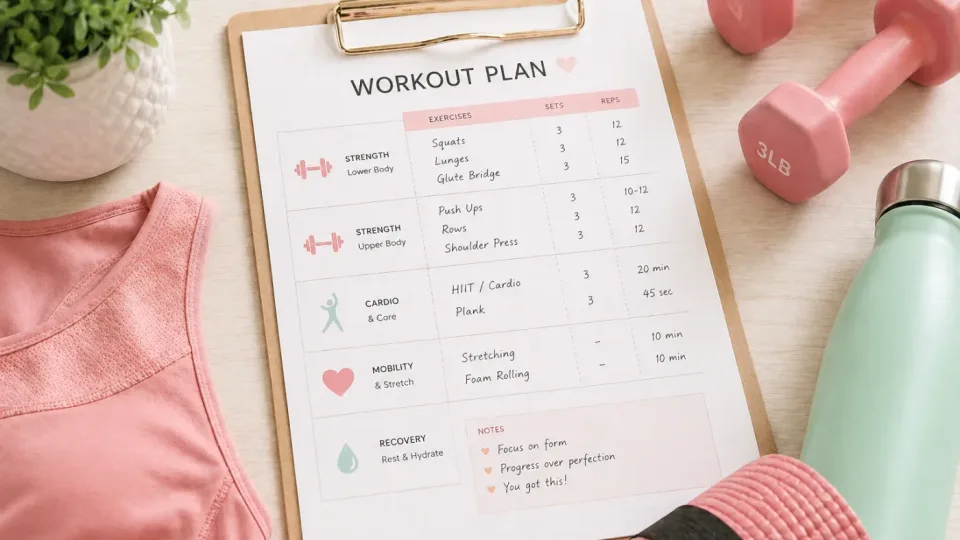
My workout planning improved significantly once I stopped copying plans designed for other people and started building something structured around my own schedule and goals.
How to Create a Workout Plan
A workout plan helps you stay consistent, track progress, and reach your fitness goals faster. Without a plan, it’s easy to waste time or lose motivation.
The best workout plan depends on your goals, experience level, and how many days you can train each week.
Step 1: Define Your Goal
Your goal determines how your workout plan is structured.
- Fat loss → focus on calorie burn and consistency
- Muscle gain → focus on strength training and progressive overload
- General fitness → balanced mix of strength and cardio
Be clear about what you want to achieve before building your plan.
Step 2: Choose Training Frequency
Decide how many days per week you can realistically train.
- 2–3 days → full body workouts
- 4 days → upper/lower split
- 5–6 days → more advanced split routines
Consistency is more important than intensity.
Step 3: Select Exercises
Focus on compound movements first:
- Squats
- Deadlifts
- Bench press
- Pull-ups or rows
Then add smaller exercises for specific muscles.
Step 4: Set Reps and Sets
Your rep range depends on your goal:
- Strength: 3–6 reps
- Muscle growth: 6–12 reps
- Endurance: 12+ reps
Most people benefit from 3–4 sets per exercise.
Step 5: Progress Over Time
Progressive overload is key to improvement.
- Increase weight gradually
- Add more reps or sets
- Improve technique
Without progression, results will slow down.
Example Workout Plan
3-Day Full Body Plan:
- Day 1: Squat, bench press, row
- Day 2: Deadlift, overhead press, pull-ups
- Day 3: Repeat with variation
This structure works well for beginners.
Common Mistakes to Avoid
No Clear Plan
Random workouts lead to slow progress.
Too Much Volume
More is not always better. Recovery matters.
Ignoring Recovery
Rest days are essential for muscle growth and performance.
Changing Plans Too Often
Stick with a plan long enough to see results.
Use the Workout Planner
To build a custom routine quickly, use the Workout Planner.
You can also estimate your timeline with the Fitness Goal Calculator and measure strength with the 1 Rep Max Calculator.
Frequently Asked Questions
How many days a week should I work out?
Most people benefit from 3–5 days per week depending on their goals and schedule.
What is the best workout split?
It depends on your experience level, but full body and upper/lower splits are common.
How long should a workout be?
Most effective workouts last between 45 and 75 minutes.
Can beginners follow advanced plans?
Beginners should start simple and gradually increase complexity.
How do I know if my plan is working?
Track strength, body changes, and consistency over time.
Conclusion
A good workout plan is simple, consistent, and built around your goals. Focus on progression, recovery, and realistic scheduling.
Use the Workout Planner to create a structured plan that fits your routine.
The Structure That Makes a Plan Actually Work
A workout plan that works in practice has three components that most generic plans skip. First, it's built around your actual available time, not idealised time — the plan that requires you to be in the gym six days a week fails not because it's too hard but because it doesn't fit your week. Second, it has a clear progression mechanic: each week should be slightly harder than the last in a measurable way, whether that's more reps, more weight, shorter rest periods, or more distance. Without progression, your body adapts and stops improving after a few weeks. Third, it accounts for recovery — training frequency and volume have to be balanced against your ability to recover, which varies based on sleep, stress, nutrition, and training age.
Choosing the Right Training Split
The training split — how you divide muscle groups or movement patterns across the week — has a large effect on whether your plan is sustainable. A full-body approach (training everything each session, three times a week) works well for beginners because it provides frequent practice of each movement and allows plenty of recovery between sessions. An upper/lower split trains the upper body and lower body on alternating days, typically across four sessions per week, and works well for intermediates who need more volume than full-body allows. A push/pull/legs split divides movements into pushing (chest, shoulders, triceps), pulling (back, biceps), and legs across six sessions, and is effective for experienced lifters who can recover from high volume. Matching the split to your training frequency is more important than picking the "optimal" split in theory.
Progressive Overload in Practical Terms
Progressive overload is the mechanism by which your body is given a reason to adapt. The simplest form is adding weight: if you squatted 60kg for 3 sets of 8 reps this week, try 62.5kg next week. But overload can also come from adding reps (staying at 60kg but increasing from 8 to 10 reps before adding weight), reducing rest periods, or adding sets. Linear progression — adding a small amount each session — works reliably for beginners. Intermediates typically use weekly progression. Advanced lifters may progress over training cycles of several weeks. Tracking your sessions is essential for this: without a log of what you did last time, you can't know whether you're progressing.
Adjusting Based on How the Plan Is Going
The plan you write on day one is not the plan you'll be following by week six, and that's correct. A good plan includes checkpoints — every four to six weeks — where you assess what's working and what isn't. If you're hitting all your targets comfortably, the progression needs to accelerate. If you're consistently missing reps or feeling run down, the volume or frequency needs to come down. Injuries and life events change what's possible. The habit of adjusting the plan intentionally rather than abandoning it when things don't go perfectly is what distinguishes people who sustain long-term progress from those who restart from the beginning every few months.