
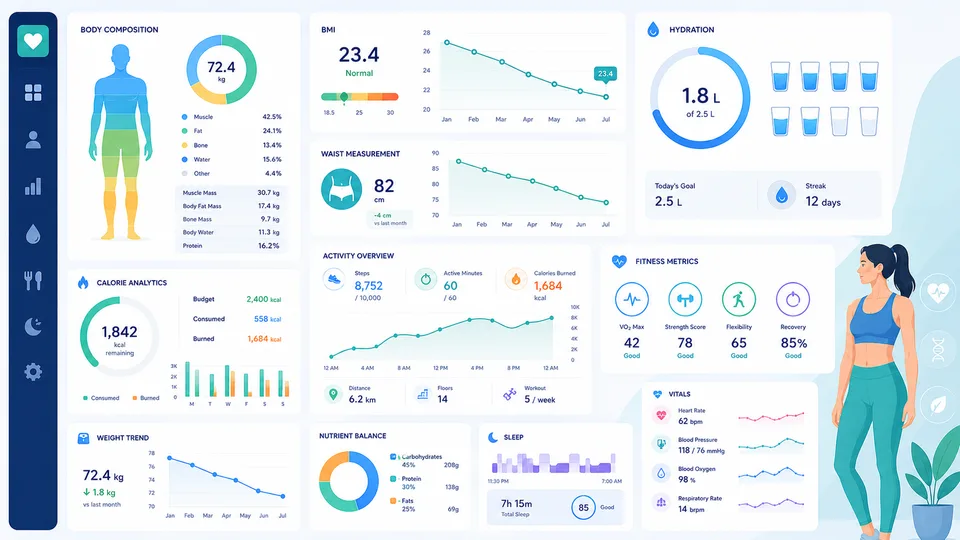
Health Metrics Are More Approximate Than Most People Realise
I've found that health metrics are most useful when you understand what they're measuring and, just as importantly, what they're not measuring. People often want health measurements to provide simple definitive answers:
- healthy or unhealthy
- fit or unfit
- overweight or normal
- good progress or bad progress
The reality is usually far less precise.
Most common health metrics are estimation tools rather than exact measurements of health itself. They can still be useful, but problems start appearing when people treat them as absolute truths instead of rough indicators.
BMI, calorie estimates, body fat calculations and waist measurements all have strengths and weaknesses that are rarely explained properly in simplified fitness content.
BMI Became Popular Because It Is Simple
BMI remains widely used largely because it is extremely easy to calculate. Height and weight are simple inputs, which makes BMI useful for large-scale population analysis and broad screening.
But the simplicity that makes BMI convenient is also what creates many of its limitations.
BMI cannot directly distinguish between:
- muscle mass
- fat distribution
- body composition
- fitness level
- bone structure
This is why athletic individuals sometimes appear “overweight” according to BMI despite being very healthy, while other people may fall into “normal” ranges despite carrying unhealthy body fat levels.
Supporting articles:
Body Fat Percentage Usually Tells A More Detailed Story
Body fat percentage attempts to estimate how much of the body consists of fat tissue compared to lean mass.
In practice, this often provides more useful context than weight alone.
Two people can weigh exactly the same while having very different:
- muscle mass
- fat distribution
- fitness levels
- metabolic health
The challenge is that body fat measurement itself is not perfectly straightforward either.
Different methods vary considerably in accuracy:
- DEXA scans
- bioelectrical impedance scales
- skinfold measurements
- visual estimates
- circumference formulas
One thing that surprises many people is how inconsistent body fat readings can become across different devices and methods.
Supporting articles:
Calorie Estimates Are Useful But Never Perfect
A lot of online calorie discussions create the impression that human metabolism works like a perfectly predictable machine.
In reality, calorie estimates are usually best treated as starting points rather than exact truths.
Factors like:
- activity level
- muscle mass
- genetics
- sleep quality
- stress
- hormonal differences
all influence energy expenditure in ways that calculators can only estimate approximately.
That does not make calculators useless. It simply means adjustment and observation still matter.
I noticed this myself years ago when calorie targets that looked mathematically “correct” felt completely different in practice depending on training intensity and daily routine.
Supporting articles:
Waist Measurements Often Reveal More Than People Expect
Weight alone does not explain where body fat is stored.
This matters because fat distribution can influence health risk differently. Central abdominal fat is often associated with higher long-term metabolic risk than fat stored elsewhere.
That is partly why waist-to-height ratio gained attention as an additional screening tool.
It is still imperfect, but many people find it easier to interpret practically than BMI alone.
Supporting article:
Waist-To-Height Ratio: The Health Check You Are Ignoring
Hydration, Recovery & Sleep Matter More Than Many Metrics Suggest
Health discussions often focus heavily on visible body measurements while underestimating recovery factors.
Poor sleep, chronic stress and dehydration can influence:
- energy levels
- exercise performance
- appetite regulation
- recovery quality
- body weight fluctuations
The difficulty is that these factors are harder to summarise neatly into one simple number.
Supporting article:
Daily Water Intake: How Much Do You Need?
Useful Calculators For Health Metrics
Health calculators are usually most valuable when used as estimation tools rather than rigid definitions of health.
- BMI Calculator
- Body Fat Percentage Calculator
- TDEE Calculator
- Calorie Calculator
- Waist-To-Height Ratio Calculator
- Ideal Weight Calculator
- Water Intake Calculator
The most useful approach is usually combining several indicators together instead of relying too heavily on any single measurement.
Progress Rarely Follows Perfectly Linear Numbers
One frustrating reality about health metrics is that progress often feels less tidy than people expect.
Weight fluctuates naturally. Water retention changes. Fitness improves before appearance changes. Strength increases without dramatic scale movement.
That inconsistency is normal.
A lot of discouragement comes from expecting perfectly smooth progress graphs that rarely exist in real life.
Where To Start
If you are trying to improve health metrics, begin by understanding what each measurement can and cannot tell you.
Focus on:
- longer-term trends
- multiple indicators together
- sustainable habits
- realistic calorie expectations
- consistent recovery and hydration
The supporting guides and calculators throughout this hub are designed to make those measurements feel more understandable and less intimidating without pretending the human body can be reduced to one perfect number.