
A commute becomes normal quickly. After a few weeks, the route can feel inevitable even if it quietly uses more money, more time, or more energy than another option. That is why the best moment to compare commute costs is before the routine locks in.
A useful commute comparison is not only a fare check or a fuel estimate. It separates money, time, frequency, parking, fuel, fares, maintenance, walking or cycling effort, and the friction of repeating the journey. The cheapest commute on paper may not be the best routine, and the fastest route may not be the best value.
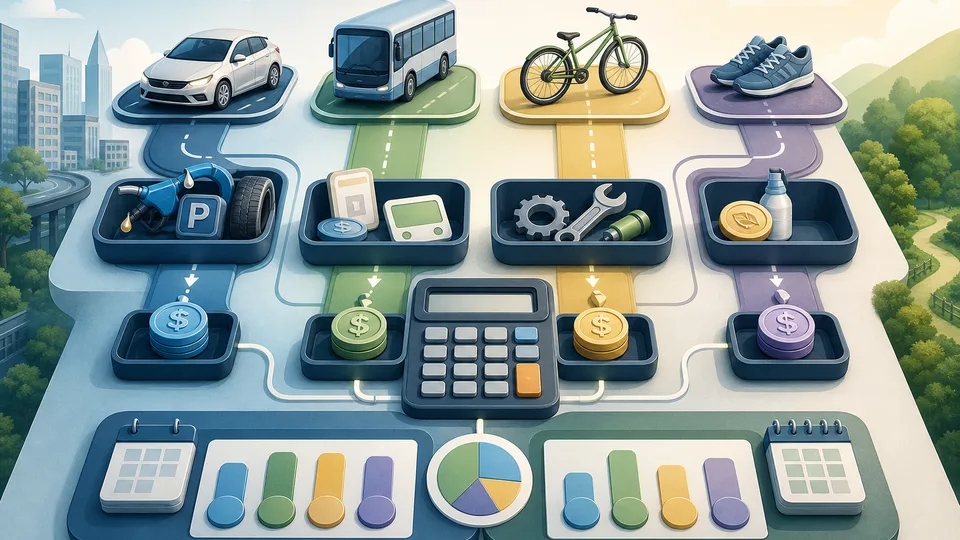
The Commute Cost Comparison Calculator helps compare car, public transport, bike, and walking options by entered assumptions. It pairs with the Fuel Cost Calculator for fuel-based journeys and the EV Charging Cost Calculator when an electric car is one of the options.
Frequency turns a trip into a budget item
A commute is not a single journey. It repeats. A difference that looks small for one day becomes larger across a week, month, or year. Five extra pounds a day, thirty minutes a day, or one extra parking charge can become meaningful because the pattern repeats.
Start by entering the number of commute days. A three-day hybrid routine and a five-day office routine can produce very different results even when the route is identical. Do not compare options only by one round trip if the decision is really about a repeated schedule.
Money cost needs categories
Car commuting may include fuel or charging, parking, tolls, mileage wear, tyres, servicing, and sometimes insurance context. Public transport may include fares, passes, transfer costs, parking at a station, or last-mile travel. Cycling and walking may have low direct cost but still involve equipment, maintenance, clothing, or storage.
Not every category needs to be perfect. The important step is to include the costs that change because of the commute. If a cost would exist anyway, decide whether it belongs in the comparison. If it changes with distance or frequency, it probably does.
Time cost is more than moving time
Commute time includes more than the minutes spent driving, sitting on a train, cycling, or walking. It can include finding parking, walking to the stop, waiting, transfers, delays, locking a bike, changing clothes, or recovering from a stressful journey.
Use the whole routine time rather than the ideal travel time. A public transport route with a short ride but a long wait may be less attractive than it first appears. A bike commute may take longer on the road but save gym time or parking time. The right comparison depends on the full routine.
Car comparisons need fuel or charging assumptions
For a petrol or diesel car, distance, fuel economy, and fuel price drive the running-cost estimate. For an electric car, distance, efficiency, electricity rate, and charging losses matter. Those assumptions should be calculated consistently before the commute comparison.
If the car option is one of several modes, calculate its running cost first. Then add parking, tolls, and any other commute-specific costs. This keeps the comparison from treating fuel or charging as a vague background expense.
Public transport needs the real fare pattern
Public transport cost can change depending on single tickets, returns, weekly passes, monthly passes, concessions, peak rules, and transfer patterns. A manual calculator should not claim live fare accuracy. It should let you enter the fare pattern that matches the decision.
If a pass covers other journeys too, decide whether the full pass cost belongs to the commute or whether only the commute share should be counted. The fair answer depends on how the pass is actually used.
Bike and walk options still deserve respect
Walking and cycling are sometimes treated as free. They may be low cost, but they are not zero-effort. They can require time, physical energy, route confidence, weather planning, safety equipment, secure storage, maintenance, and clothing.
Those factors do not make active travel worse. They simply make the comparison honest. A cycling commute may win because it is reliable, healthy, inexpensive, and predictable. It should win with its real assumptions visible, not because its hidden costs were ignored.
Routine friction can decide the outcome
Some commute costs do not fit neatly into a currency field. A route with frequent delays can make mornings harder. A parking search can make arrival unpredictable. A crowded train can be tiring. A pleasant walk may improve the day even if it takes longer.
Use the calculator for the numeric part, then add a judgement layer. The best routine is usually the one that balances money, time, reliability, and daily tolerance. A commute has to work on ordinary mornings, not only in a theoretical comparison.
Hybrid work changes the calculation
Hybrid schedules make commute comparison more interesting. A high-cost commute may be manageable twice a week and painful five times a week. A monthly pass may be excellent value for daily travel and poor value for occasional travel.
Run the calculation for the schedule you actually expect. If the schedule may change, compare two scenarios. That is more useful than building one average that hides the risk.
Parking can dominate the car option
Parking is often the cost that changes the car calculation. A journey with modest fuel cost can become expensive if parking is paid daily. Even when parking is free, it may have a time cost or reliability cost if spaces are scarce.
Include parking as a separate line. That makes it easier to see whether the car is expensive because of distance, fuel, charging, tolls, or parking. Different causes suggest different decisions.
A practical comparison workflow
Choose the commute options to compare. Enter round-trip distance or fare, total routine time, commute days, parking, tolls, equipment costs, and any other repeated costs. Convert each option into weekly and monthly cost. Then compare time separately instead of forcing every minute into money.
After the numeric comparison, add a short note about reliability and friction. If two options are close in cost, the one that is calmer, more reliable, or easier to repeat may be the better routine.
Compare the month you actually live
Commute decisions often fail because the comparison uses a perfect week. Real months include holidays, remote days, appointments, late finishes, bad weather, childcare changes, and occasional errands. These may not all belong in the calculator, but they should shape the assumptions.
If the commute is fragile whenever life is slightly messy, record that as friction. A slightly more expensive option may be better if it survives the real month more reliably.
Keep one fallback option visible
The main commute is not always the only commute. Many people need a fallback for days when the car is unavailable, the train is disrupted, the bike cannot be used, or the schedule changes. A comparison can include the backup option so its cost is not a surprise.
Knowing the fallback cost also reduces pressure. If the normal routine fails, the household already understands the money and time trade-off of the alternative.
Do not over-optimise away comfort
A commute is repeated enough that comfort has value. Seat availability, noise, walking conditions, weather exposure, storage, lighting, and arrival stress can all affect whether a route is sustainable. The lowest-cost option can become expensive in another way if it drains attention every day.
Use the numeric comparison to narrow the choices, then choose the routine that people can actually repeat without resentment.
What this should not claim
A commute comparison calculator does not fetch live traffic, live routes, current fares, parking availability, public transport timetables, weather, or official reimbursement rates. It compares the assumptions entered.
That makes it useful before a habit forms. Once a commute becomes automatic, it is harder to question. Comparing the money, time, and friction early gives the routine a chance to earn its place.