
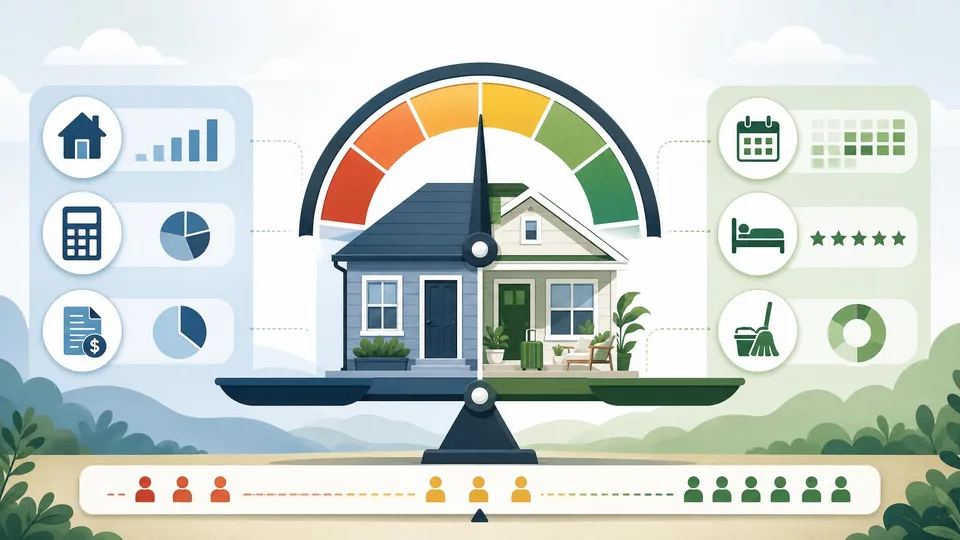
I've modelled the Airbnb versus long-term let comparison carefully and found that the assumptions behind the occupancy rate figure have a larger effect on the outcome than most comparisons acknowledge.
The occupancy rate is the single variable that most determines whether Airbnb beats long-term renting. Nightly rate matters, but nightly rate multiplied by occupancy is what generates gross income — and after costs, the break-even occupancy required for Airbnb to win is often higher than new hosts realise when they make the initial comparison.
Why Occupancy Rate Matters Most
Unlike long-term renting, where income is fixed regardless of how the property is used, Airbnb income is directly proportional to the number of nights booked. An empty night produces zero income but does not eliminate costs — the mortgage still needs paying, the mortgage interest accrues, insurance continues, and the time investment in property management continues regardless of occupancy.
This revenue-cost structure means that the occupancy rate creates a non-linear relationship between booking activity and profitability. At low occupancy, costs that are fixed regardless of bookings (mortgage, insurance, basic maintenance) dominate, and the result is often worse than long-term letting. At high occupancy, these costs are amortised across more nights and the higher nightly rate produces a clear premium.
Comparing Nightly Rate to Monthly Rent
The initial comparison most hosts make: multiply the target nightly rate by 30 and compare to monthly rent. A £95/night Airbnb rate × 30 = £2,850/month. A long-term rent for the same property of £1,100/month. The Airbnb appears to offer 2.6× the income of long-term letting.
This comparison assumes 100% occupancy, which no short-term rental achieves. At 70% occupancy: 30 × 0.70 × £95 = £1,995/month gross. At 50% occupancy: £1,425/month gross. The long-term rental income is fixed at £1,100; the Airbnb gross income ranges from £1,425 to £1,995 depending on occupancy.
After costs — cleaning, platform fees, maintenance, void nights — the Airbnb net income at 70% occupancy might be £1,200 to £1,400/month. Against long-term rental at £1,100/month, the premium is £100 to £300/month before the landlord's own time investment is accounted for. For many hosts, the additional effort of managing an Airbnb for £150/month net premium over long-term letting is not worthwhile.
Fees, Cleaning, and Management Costs
The fixed costs per turnover are the key variable in the break-even calculation. At higher cleaning and management costs, the break-even occupancy rises — more nights must be booked to cover the additional per-turnover expense.
A typical cost-per-night-booked on a one-bedroom property:
- Cleaning cost amortised per night (assuming 3-night average stay): £70 / 3 = £23/night
- Platform fee (3% of £95): £2.85/night
- Laundry provision: £5/night
- Consumables (toiletries, tea, coffee): £3/night
- Variable maintenance provision: £4/night
Total variable cost per booked night: approximately £38. Net revenue per booked night: £95 - £38 = £57. Fixed monthly costs (mortgage interest, insurance, fixed maintenance): suppose £850/month. Break-even booked nights per month: £850 / £57 = 14.9 nights. At 50% occupancy (15 nights/month), the property roughly covers its costs. At 60% occupancy (18 nights/month), monthly net surplus: (18 × £57) - £850 = £176. At 70% occupancy (21 nights): £347 monthly surplus — comparable to but not dramatically better than the simplicity of a long-term tenancy.
Break-Even Occupancy Examples
High-value market, low management cost: £150/night nightly rate, £50 cleaning cost, owner-managed. Break-even occupancy approximately 35%. At 60% occupancy, clear winner over long-term rental. This is the scenario where Airbnb is genuinely superior.
Mid-market, professional management: £95/night, 25% management fee plus cleaning. Net per night after management: £71, minus cleaning £70/3 = £23, minus platform 3% = £2.85, net: £45. At higher fixed costs, break-even occupancy rises to 50%+. At typical occupancies of 50% to 60%, the advantage over long-term letting is marginal.
Suburban market, self-managed: £70/night, self-cleaning. Net per night: £70 minus £3 platform fee minus £20 cleaning equivalent minus £5 consumables = £42. Break-even at approximately 40% occupancy. At 55% typical occupancy, modest monthly surplus — but requires active management for that modest premium.
Using the Calculator to Test Scenarios
The Airbnb vs Long-Term Rental Calculator runs the break-even occupancy calculation for your specific inputs. Enter your nightly rate, cleaning cost per turnover, average stay length, platform fee, management fee, and the equivalent long-term rent. The output shows the occupancy rate at which Airbnb exactly matches long-term rental income — and what occupancy is required to justify the additional effort. Most properties require 55% to 70% sustained annual occupancy for Airbnb to be clearly financially superior to long-term letting once all costs are included.