
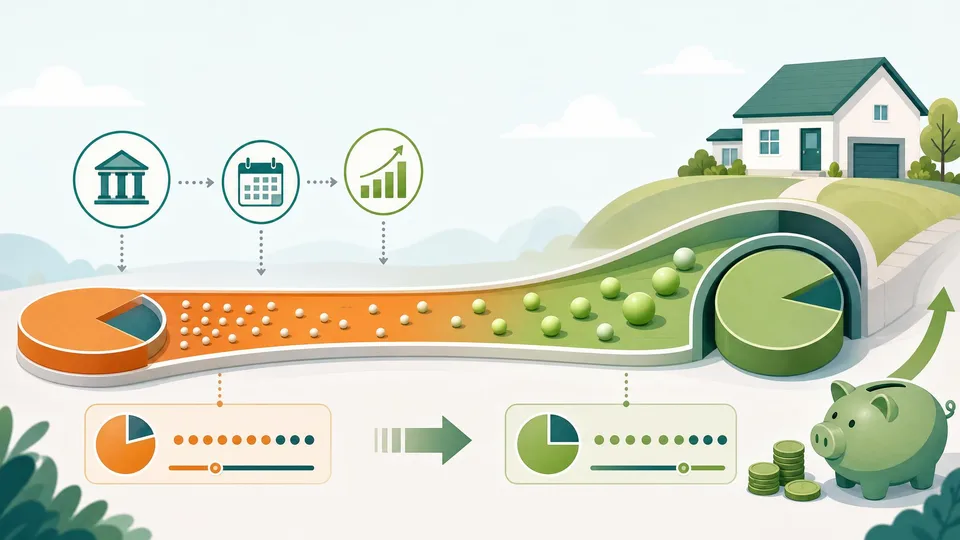
I found it genuinely surprising how slowly my mortgage balance fell in the early years — and understanding the amortisation structure made the experience less frustrating and the decision-making clearer.
New mortgage holders frequently expect their outstanding balance to fall meaningfully in the first year or two. It rarely does. Looking at a mortgage statement after 18 months of payments and seeing that the balance has reduced by a fraction of what was paid in is a common and disconcerting experience. The explanation is amortisation — the mathematical structure of how repayment mortgages distribute payments between interest and principal over time.
How Mortgage Amortisation Works
Amortisation is the process of spreading a loan repayment across a fixed number of equal monthly payments. Each payment is identical in amount, but the split between interest and principal changes every month. The lender calculates interest on the outstanding balance at the start of each month, deducts it from the monthly payment, and applies the remainder to principal reduction.
Because the balance is highest at the start of the mortgage, the interest charge is highest at the start — leaving the least amount for principal reduction. As the balance falls, slightly less interest accrues each month, and slightly more goes to principal. This self-reinforcing dynamic is why equity builds slowly at first and rapidly in the final years.
Interest vs Principal Repayments
The numbers make the dynamic concrete. On a £250,000 mortgage at 4.7% over 25 years, the monthly payment is approximately £1,392.
In year one, total payments are £16,704. Of this: approximately £11,550 is interest, and approximately £5,150 reduces the balance. The mortgage balance at the end of year one is approximately £244,850 — a reduction of £5,150, or just over 2% of the original loan.
In year 10, monthly interest has fallen to approximately £820, and principal repayment has risen to approximately £572. Annual principal reduction in year 10: approximately £6,900.
In year 20, monthly interest is approximately £450, and principal repayment is approximately £942. Annual principal reduction: approximately £11,300.
The rate of equity accumulation from repayments triples between year one and year 20, even though the monthly payment is identical throughout. The Equity Growth Timeline Calculator shows this acceleration visually — the equity curve is shallow early and steep late.
Why Equity Growth Speeds Up Over Time
The compounding mechanism works in two directions simultaneously. As the balance falls, interest charges fall, which means more of each payment reduces the balance, which causes the balance to fall faster, which causes interest to fall further. The dynamic compounds over the full term, producing the characteristic amortisation curve: gradual at the start, increasingly steep toward the end.
Property appreciation adds an independent boost that does not depend on this dynamic at all. A property worth £300,000 appreciating at 3% per year gains £9,000 of value in year one, £9,270 in year two, and so on — compounding independently of the mortgage repayment schedule. The combined effect of appreciation and accelerating repayment produces equity growth that is notably faster in years 15 to 25 than in years 1 to 10.
How Overpayments Change the Timeline
Overpayments reduce the outstanding balance directly, shifting the amortisation curve forward. A balance that would have been reached through normal repayments in year eight can be achieved in year five through consistent overpayments. The practical effect is that every overpayment moves more subsequent payments from interest-heavy to principal-heavy — the saving is multiplicative, not just additive.
On the £250,000 mortgage at 4.7%, a regular overpayment of £300/month from the start:
- Reduces total interest paid by approximately £38,000
- Cuts the mortgage term by approximately six years
- Accelerates the point at which 75% LTV is reached by approximately four years
The LTV acceleration effect is often the most practically valuable consequence of overpayments: reaching the 75% threshold four years earlier means four more years of access to the better rate tier at each remortgage — a compounding benefit that extends well beyond the term reduction.
Example Equity Growth Scenarios
No overpayment, 3% annual appreciation: After 10 years on the example mortgage, equity = approximately £210,000 (£70,000 principal reduction + £90,000 appreciation on original value, plus appreciation on appreciation).
£300/month overpayment, 3% annual appreciation: After 10 years, equity = approximately £246,000 — approximately £36,000 more, from the accelerated repayment and the interest saved.
No overpayment, 5% annual appreciation: After 10 years, equity = approximately £240,000 — demonstrating that appreciation assumptions dominate the outcome in most scenarios.