
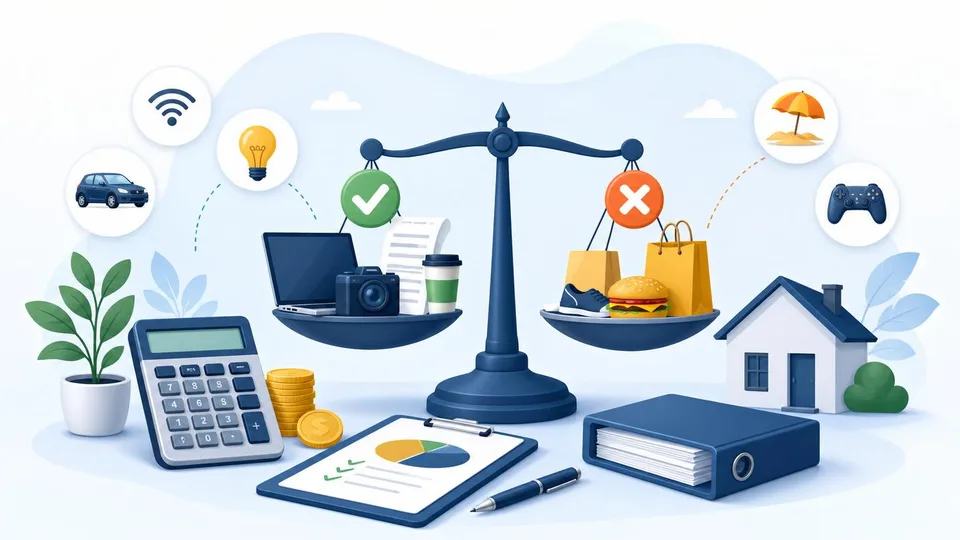
Every sole trader reaches the moment where they stare at a receipt and think: can I claim this? Sometimes the answer is obvious. Sometimes it really is not. And sometimes people claim things with complete confidence, only to find out later that HMRC sees it rather differently.
Allowable expenses matter because self-employed tax is based on profit, not income. The more legitimate business costs you can deduct, the lower your taxable profit — and the lower your tax bill. Getting this wrong in either direction costs you money: overclaim and you risk penalties; underclaim and you pay more tax than you need to.
What are allowable expenses?
Allowable expenses are business costs that can generally be deducted from your income before working out your taxable profit. HMRC's basic test is whether the cost was incurred wholly and exclusively for the purposes of your business.
That phrase — wholly and exclusively — does a lot of work. It is the reason you cannot simply run personal spending through your business. It is also why mixed-use costs, where something is used partly for work and partly for personal reasons, are genuinely complicated rather than a simple yes or no.
For a broader look at how self-employed tax works, our self-employed tax guide covers the full picture.
The simple test: is it genuinely for the business?
Before claiming anything, it is worth asking honestly: would I have bought this if I did not run a business? If the answer is no, it may be claimable. If the answer is yes, it gets murkier.
A laptop you use only for client work — straightforward. A coffee you bought while working from a café — almost certainly not, even if you were answering emails at the time. Smart clothes for a client meeting are a classic grey area: HMRC's longstanding position is that clothing has a dual purpose (you could wear it elsewhere), so it generally does not qualify unless it is genuinely a uniform or specialist protective wear.
I find the simplest mental model is this: the expense has to serve the business, not just happen near the business.
Common sole trader expense categories
These are the broad areas where most sole traders have legitimate claimable costs. This is not an exhaustive list, and the rules around each category can involve nuance — especially for mixed-use items.
- Tools and equipment — physical items used in your work, from a tradesperson's tools to a designer's drawing tablet.
- Business travel — mileage, train tickets, parking for genuine business journeys. Your commute to a regular place of work does not count.
- Phone and internet — the business-use proportion of your bills if they are used for both personal and work purposes.
- Home office costs — a portion of household running costs if you work from home, calculated by an appropriate method.
- Software subscriptions — tools you use for your business: project management apps, accounting software, design tools.
- Professional services — accountancy fees, legal advice relevant to your business.
- Marketing and advertising — website costs, ads, printed materials.
- Materials and stock — goods you buy in order to sell or use in client work.
The key word throughout is business. Each of these categories has a legitimate version and an overreaching version.
Mixed personal and business use
This is where a lot of sole traders quietly get it wrong — not through dishonesty, but through wishful thinking.
Take a mobile phone. Most people use their phone for both personal calls and business calls. You cannot claim the full bill as a business expense just because some of it is work-related. You can claim a reasonable proportion that reflects actual business use. What is reasonable? That depends on your situation, and you would need to be able to justify it if asked.
The same logic applies to a home broadband connection, a vehicle used for both business trips and personal errands, and a home office in a room that doubles as a spare bedroom. HMRC's simplified expenses system offers a flat-rate method for home working and vehicles, which some sole traders find easier to use than calculating exact proportions. It is worth checking whether that method suits your situation.
The temptation to round up the business-use proportion is understandable. But if HMRC investigates and your proportions look implausible, the conversation becomes unpleasant. Reasonable and defensible is better than optimistic and contested.
Common mistakes sole traders make
I have seen these come up repeatedly, and most of them are not deliberate — they are just what happens when nobody tells you the rules clearly enough at the start.
Claiming personal spending. Supermarket shops, personal subscriptions, gym memberships, and meals out with friends do not become business expenses because you occasionally discussed work during them.
Not keeping receipts. If you cannot evidence a cost, it becomes very difficult to defend in a dispute. A shoebox of receipts is better than nothing. A folder of scanned PDFs is better than a shoebox.
Claiming the full amount of mixed-use items. As above — business proportion only, not the whole bill.
Confusing cash flow with profit. Buying equipment does not automatically mean your tax bill drops by the cost of the equipment. Capital allowances and the annual investment allowance affect how large purchases are treated. This is worth checking with an accountant if you are making significant purchases.
Forgetting small recurring costs. Monthly software subscriptions, domain renewals, small tool replacements — these add up over a year and are easy to miss if you are not tracking regularly.
Assuming every work-adjacent purchase counts. Buying a book vaguely related to your industry, or attending a conference in a city you also used for a weekend away — these need more careful thought than people usually give them.
How expenses affect your tax bill
The important thing to understand here is that expenses reduce taxable profit, which reduces tax. They do not make purchases free.
If you spend £500 on software and your effective tax rate on that slice of profit would have been 20%, the tax saving is £100. The software still cost you £400 net. Buying things purely to reduce tax — especially things you would not otherwise need — is rarely a good financial decision dressed up as a sensible one.
The right framing is: claim everything you legitimately can, keep good records, and do not go looking for things to buy in order to bring your bill down. Use our calculator to estimate your self-employment tax based on your actual profit, and estimate your UK income tax to see the broader picture.
If you are also thinking about whether you need to register for VAT, our guide to VAT for small businesses and freelancers is worth a read once your turnover starts growing.
How to keep records without making life miserable
Nobody enjoys the admin side of being self-employed. But the cost of poor record-keeping shows up at the worst possible time — usually January, when you are trying to file and realise you have no idea what you spent in April.
A few things that genuinely help:
- A separate business bank account. Even a free one. It makes separating business and personal transactions dramatically easier.
- Save receipts immediately. A photo on your phone at the time beats trying to find the paper version three months later.
- A monthly review. Thirty minutes at the end of each month to categorise expenses and check everything is recorded. It sounds dull because it is dull, but it is far less dull than doing twelve months in one sitting.
- Simple categories. You do not need a system so detailed it becomes its own job. A handful of clear categories covers most sole trader businesses.
If your finances are getting more complicated — multiple income streams, significant equipment purchases, subcontractors — it is probably worth speaking to an accountant. The fee is itself an allowable expense, which at least softens the blow slightly.
For more on how income, expenses, and tax interact if you have income from more than one source, our guide on side hustle and second income tax covers the overlap.
What to do next
Start by making sure you are tracking your income and expenses consistently, not just at tax time. Once you have a realistic picture of your profit, you can estimate your self-employment tax and make sure you are setting aside enough each month.
If you are in your first year of trading and trying to get the whole system straight in your head, our self-employed tax guide is a good place to start before diving into the detail.
Frequently asked questions
What expenses can a sole trader claim?
Many costs that are wholly and exclusively for business purposes may be claimable, including equipment, business travel, phone and internet (business proportion), home office costs, software, professional fees, and marketing. Mixed-use costs can usually only be claimed in part.
Can I claim my phone bill as a sole trader?
You can claim the proportion of your phone bill that relates to business use. If you use your phone roughly half for work, you could claim around half. You should be able to justify the proportion you claim if HMRC asks.
Do allowable expenses reduce my tax bill?
They reduce your taxable profit, which in turn reduces your tax bill. But they do not make purchases free — the tax saving is only a fraction of the cost, depending on your tax rate.
Do I need receipts for every expense?
You need to be able to evidence your costs if HMRC ever asks. Receipts, bank statements, and invoices all help. The more organised your records, the easier any review becomes.
Can I claim working from home as a sole trader?
Yes, in most cases. You can either calculate a proportion of your actual household costs or use HMRC's simplified flat-rate method. The right approach depends on how much of your home you use for work and how often. Check current HMRC guidance for the rates and methods available.