
Technology Costs Usually Feel Tiny Right Before They Stop Feeling Tiny
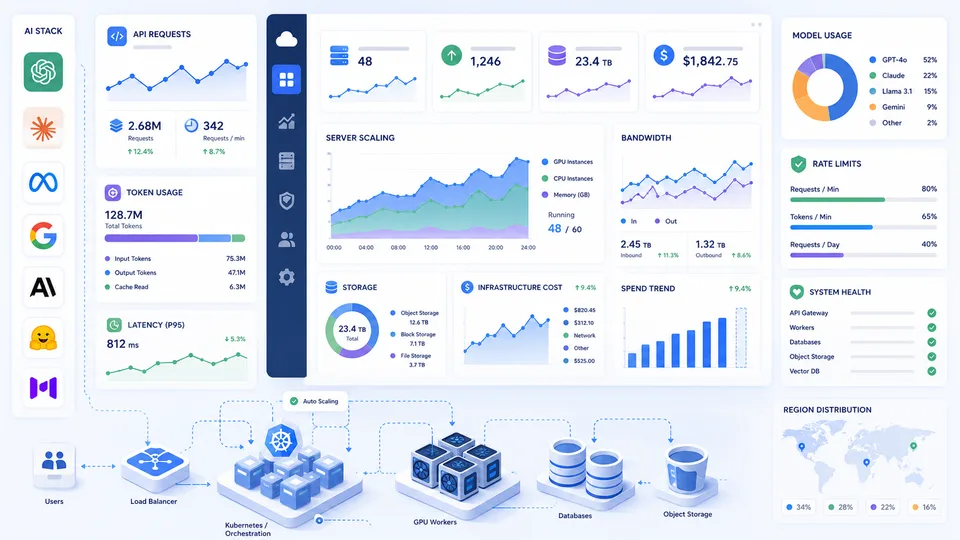
I've watched technology costs stay invisible until they suddenly weren't — which is why understanding the structure of API and cloud pricing before you need to matters. One of the strange things about modern software infrastructure is how easy it is to underestimate future cost growth.
A developer launches a side project using a few APIs, a small cloud instance and some object storage. At the beginning the pricing feels almost trivial. A few dollars here. A small monthly bill there. The entire system appears lightweight and inexpensive.
Then usage grows.
Suddenly:
- API requests multiply
- storage expands
- AI usage spikes
- bandwidth increases
- background jobs become expensive
- image delivery costs escalate
I think one reason this catches people off guard is that cloud pricing hides complexity extremely well at small scale. Infrastructure feels abstract until real traffic arrives.
This guide connects practical articles and calculators covering API pricing, AI costs, hosting infrastructure and cloud scaling decisions.
Why APIs Change Product Economics
APIs dramatically accelerate software development because they allow teams to outsource functionality instead of rebuilding everything internally.
Payments, authentication, AI, email delivery, analytics, maps, storage and media processing can all be integrated quickly through external services.
The trade-off is that infrastructure costs become usage-dependent.
A product serving:
- 100 users
- 10,000 users
- 1 million users
may technically run the same software while producing completely different operational costs.
This becomes especially important with AI APIs where token usage, image generation or inference requests can scale very aggressively under real-world traffic.
Supporting article:
AI Pricing Often Feels Abstract Until Bills Arrive
A lot of developers initially treat AI pricing as small experimental spending. Early testing rarely feels expensive because usage remains low.
The economics change once AI features become part of actual user workflows.
Large prompts, conversational memory, embeddings, image generation and repeated inference calls can all increase operational costs rapidly.
One thing that surprised me while comparing AI pricing models was how difficult it can be to estimate costs psychologically. Human intuition struggles with request-based pricing systems that scale continuously in the background.
This is why many AI-heavy products eventually introduce:
- rate limits
- usage quotas
- premium tiers
- fair usage policies
without originally expecting they would need them.
Cloud Infrastructure Creates Flexibility But Also Waste
Modern cloud systems are extremely good at removing operational friction.
Servers can scale quickly. Deployments become easier. Infrastructure becomes programmable. Teams can launch globally without buying physical hardware.
But flexibility can also encourage inefficiency.
A surprising amount of infrastructure waste comes from:
- oversized instances
- unused resources
- duplicate services
- inefficient caching
- unoptimised media delivery
- poor scaling assumptions
At small scale these issues barely matter. At larger scale they quietly become operational drag.
Related articles:
Bandwidth Costs Usually Arrive Gradually
Bandwidth usage often feels invisible because individual files appear small in isolation.
A single oversized image or video asset may not seem important. But once that same asset is loaded millions of times across devices and regions, the cumulative impact becomes significant.
This is especially relevant for:
- AI-generated media
- image-heavy websites
- video platforms
- SaaS dashboards
- mobile applications
- download platforms
Many teams focus heavily on server compute while underestimating media delivery costs entirely.
Supporting articles:
- File Size Calculator: Why Upload Limits Matter
- Optimising Images For The Web
- How To Calculate Download Time Accurately
Storage Growth Is Quiet But Persistent
Storage costs rarely explode dramatically overnight. They usually grow slowly and continuously.
Databases expand. Backups accumulate. Uploaded files increase. Logs grow larger. AI systems retain embeddings and datasets.
Nothing looks alarming initially because the increases happen incrementally.
Over time though, storage becomes one of the most persistent infrastructure costs many products carry.
Related article:
How Much Cloud Storage Do You Actually Need?
Scaling Problems Usually Begin Earlier Than Expected
A lot of people imagine scaling issues arriving after a sudden viral event or massive traffic spike.
In practice inefficiencies usually start much earlier.
Small technical compromises accumulate:
- inefficient queries
- duplicate API calls
- heavy frontend assets
- poor caching
- unnecessary background jobs
- bad media handling
At low traffic these problems feel harmless. At scale they become expensive multipliers.
I think this is one reason experienced infrastructure teams focus heavily on optimisation before systems become critically overloaded.
Internet Speed Still Shapes User Experience
Infrastructure discussions sometimes become overly server-focused while ignoring the actual experience users receive.
Connection quality still matters enormously.
Pages that feel fast on high-end fibre connections may feel frustrating on slower mobile networks or unstable broadband.
Supporting articles:
- Internet Speed Calculations: What Your ISP Doesn't Tell You
- How To Calculate Download Time Accurately
Useful Calculators For Infrastructure Planning
Practical calculators can help translate abstract infrastructure concepts into more realistic operational planning.
- API Cost Calculator
- Server Cost Calculator
- Download Time Calculator
- File Size Calculator
- Cloud Storage Calculator
- Data Storage Converter
The most useful calculations are usually the realistic scaling scenarios rather than optimistic launch assumptions.
Where To Start
If you are trying to understand or reduce infrastructure costs, start by identifying where usage actually scales.
Focus on:
- API request growth
- AI usage patterns
- storage expansion
- bandwidth-heavy assets
- background processing
- poor utilisation
Once those cost drivers become visible, optimisation decisions become much easier and far more strategic.
The supporting articles and calculators throughout this hub are designed to help make those infrastructure trade-offs easier to understand before costs become difficult to control.