
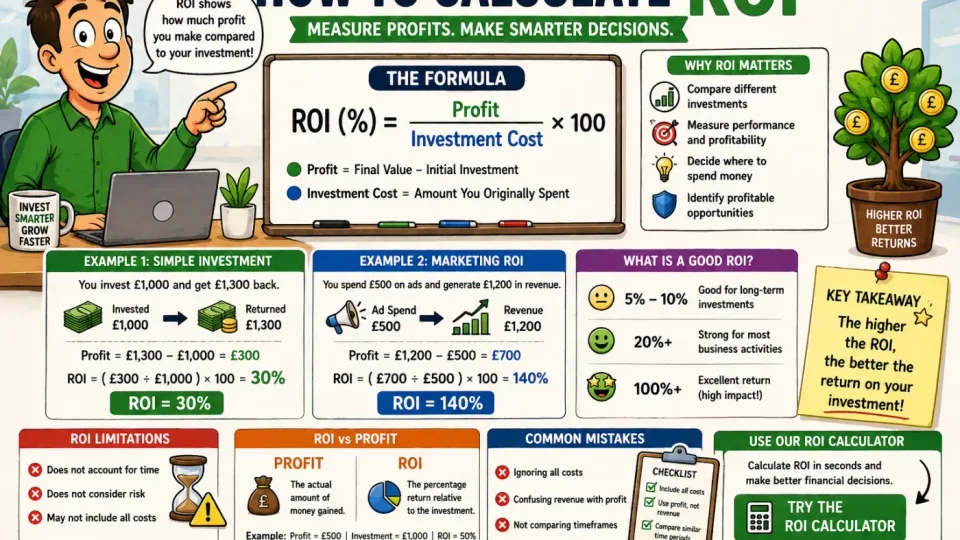
My ability to evaluate whether something was worth doing improved considerably once I got comfortable calculating return on investment properly rather than estimating it vaguely.
What Is ROI?
ROI (Return on Investment) is a simple way to measure how profitable an investment is. It shows how much profit you make compared to the amount you invested.
ROI is used in business, marketing, property, and personal finance to compare different opportunities and decide whether something is worth doing.
---ROI Formula
The basic ROI formula is:
ROI (%) = (Profit ÷ Investment Cost) × 100
Where:
- Profit = Final value − initial investment
- Investment cost = amount you originally spent
How to Calculate ROI Step by Step
Example 1: Simple ROI Calculation
You invest £1,000 in a project and earn £1,300 back.
Step 1: Calculate profit.
Profit = £1,300 − £1,000 = £300
Step 2: Apply the formula.
ROI = (300 ÷ 1,000) × 100 = 30%
Your ROI is 30%.
---Example 2: Marketing ROI
You spend £500 on ads and generate £1,200 in revenue.
Profit = £1,200 − £500 = £700
ROI = (700 ÷ 500) × 100 = 140%
This means your marketing campaign returned more than double your investment.
---What Is a Good ROI?
A “good” ROI depends on the type of investment:
- 5–10% may be good for long-term investments
- 20%+ is strong for business activities
- 100%+ can happen in high-risk or high-return scenarios
ROI should always be compared within the same type of investment.
---Why ROI Matters
ROI helps you:
- Compare different investments
- Measure business performance
- Decide where to spend money
- Identify profitable opportunities
- Avoid wasting resources
Limitations of ROI
ROI is useful, but it has limitations:
- It does not account for time
- It ignores risk
- It may not include all costs
For example, a 50% return over 5 years is very different from 50% in 1 year.
---ROI vs Profit
Profit is the amount of money gained.
ROI is the percentage return relative to the investment.
Example:
- Profit = £500
- Investment = £1,000
- ROI = 50%
Use the ROI Calculator
To calculate ROI instantly, use our ROI Calculator.
You can also use the Profit Margin Calculator to measure profitability, or the Percentage Calculator for quick percentage calculations.
---Common ROI Mistakes
Ignoring Costs
Always include all costs, not just the obvious ones.
Confusing Revenue with Profit
ROI is based on profit, not total revenue.
Not Comparing Timeframes
Returns should be compared over similar time periods.
---Frequently Asked Questions
What is ROI?
ROI measures how much profit you make compared to your investment.
What is the ROI formula?
ROI = (Profit ÷ Investment) × 100.
Why is ROI important?
It helps you compare investments and make better financial decisions.
Can ROI be negative?
Yes. If you lose money, ROI will be negative.
---Conclusion
ROI is one of the simplest and most useful financial metrics. It shows how efficiently your money is being used and helps guide better decisions.
Once you understand the formula, calculating ROI becomes quick and straightforward. For faster results, use the ROI Calculator.
What ROI Actually Measures and What It Doesn't
Return on investment is a ratio that expresses the gain from an investment relative to its cost. The formula is ((gain − cost) ÷ cost) × 100 to express it as a percentage. What makes it useful is also what makes it limited: it tells you proportional return but says nothing about time. An investment that doubles your money sounds better than one that returns 50% — until you learn the first took 20 years and the second took 18 months. This is why ROI is most useful for comparing options with similar time horizons, and why annualised ROI (which divides by the number of years to give a per-year figure) is often more meaningful for longer investments.
What to Include in the Cost and Gain Figures
The most common errors in ROI calculations come from using incomplete cost or gain figures. For a business investment, the cost should include not just the purchase price but ongoing expenses: staff time, maintenance, software licences, training, and any opportunity cost of capital tied up in the investment. For property, total cost includes purchase price, legal fees, stamp duty, renovation costs, ongoing maintenance, mortgage interest, and management fees — not just the headline purchase price. For marketing spend, the gain should be net profit on sales attributable to the campaign, not gross revenue. Underestimating costs and overestimating attributable gains are the two ways ROI calculations mislead, and both errors tend to make investments look better than they are.
Comparing ROI Across Different Types of Investment
ROI comparisons are only meaningful when the inputs are calculated consistently. Comparing the ROI on a stock portfolio against the ROI on a rental property requires using the same cost inclusions and the same time period for both. A rental property might show a 6% annual ROI when only rental income is considered, but a 3.5% ROI when you include purchase costs, maintenance, void periods, and management fees. A stock portfolio might show an 8% average annual return but with significantly higher variance year to year. Neither comparison is inherently wrong, but mixing calculation methods produces a meaningless comparison. The discipline of using ROI consistently — same inputs, same time frame — is what makes it a useful decision tool rather than a number that flatters whichever option you prefer.
ROI for Non-Financial Decisions
The ROI framework extends usefully beyond financial investments. Learning a new skill has a cost (time, course fees, opportunity cost) and a gain (salary increase, new income stream, productivity improvement). Gym membership has a cost and returns health benefits that can be quantified in avoided medical costs and productivity. Even decisions about how to spend time can be framed in ROI terms: an hour spent on a high-value task versus a low-value one has a measurable difference in return. Applying the ROI framework to non-financial decisions doesn't require exact numbers — rough estimates still help structure the comparison and reveal which choices are likely to deliver the best return for their cost.