
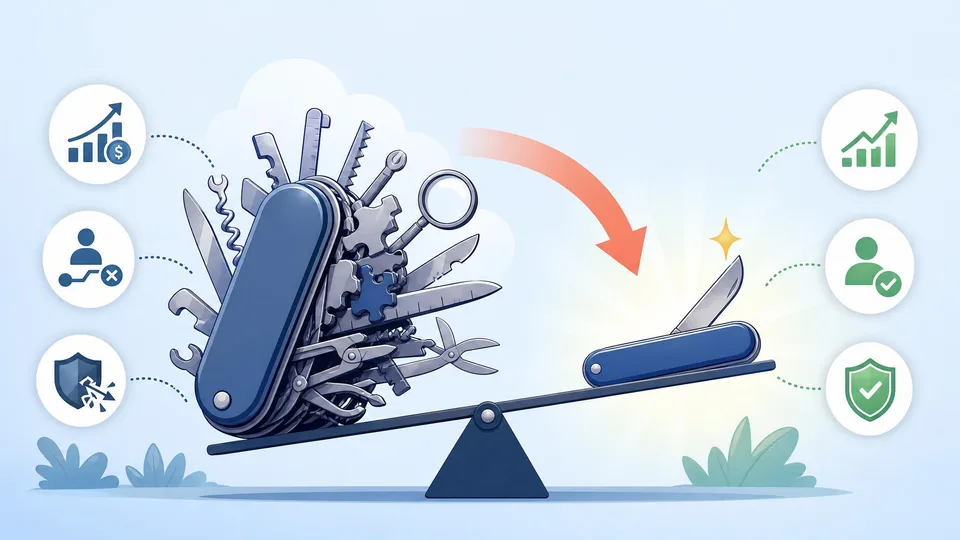
Every feature adds code, support surface, and onboarding load — often faster than it adds revenue.
Roadmaps default to additive. Without pruning, products become harder to learn, slower to ship, and easier for a focused competitor to replace.
It belongs in our small business finance growth guide, alongside how to prioritise revenue generating features and are product features worth the cost. Use the cost per feature calculator when you want to model your own numbers.
Overbuilding
Overbuilding is the pattern where a product accumulates features faster than the team can maintain them well or users can learn them meaningfully. It is not a failure of ambition — it is often the result of good intentions: listening to users, responding to competitive pressure, building the features that seemed important at the time. The problem is that features are rarely removed once added, and a product that has grown through years of additive development without corresponding pruning becomes genuinely harder to use than a more focused alternative.
The signal of overbuilding is not usually complaints about too many features. It is complaints about complexity, difficulty finding specific functionality, and onboarding friction. New users who encounter a product with 200 features have a worse first experience than those encountering one with 40 well-designed features that cover the core use cases. The cognitive effort of understanding a complex product delays time-to-value, which increases early churn.
The competitive dynamic of overbuilding is also counterproductive over time. A bloated product with many features is easier to disrupt by a focused competitor than a clean product with fewer, excellent features. "We do one thing and we do it extremely well" is a more defensible position against a well-funded new entrant than "we do everything adequately." The incumbent's feature count, built over years, becomes a liability rather than an asset when it is perceived as complexity rather than capability.
Complexity Costs
Every feature added to a product increases complexity in several specific ways:
Codebase complexity: Each new feature introduces code that must integrate with existing code, handle edge cases, and be maintained as the surrounding code evolves. Codebase complexity grows non-linearly with feature count — the interactions between features create more complexity than the features themselves. A product with 100 features is not twice as complex to maintain as one with 50 features; it is considerably more so.
Testing surface: Each feature must be tested in isolation and in combination with other features. The testing burden scales with the number of features and the number of potential interactions between them. Teams that have overbuit often find that regression testing takes disproportionately long because the surface area is enormous.
Design coherence: A product designed with 20 core features in mind and subsequently expanded to 80 features rarely has the same design coherence as one designed for 80 from the start. Retrofitted features create inconsistency in navigation, terminology, and interaction patterns that experienced users tolerate and new users find confusing.
Support volume: More features mean more support questions. Features that are rarely used generate support volume disproportionate to their usage because the users who do encounter them are less familiar with them and more likely to need help. The Cost per Feature Calculator allows you to include support cost in feature cost calculations — making the full cost of a low-usage feature visible alongside its development cost.
Focus Strategy
The antidote to overbuilding is a deliberate focus strategy — a clear statement of what the product does and does not do, used as a filter for feature investment decisions.
A focus strategy is not a refusal to build new features. It is a commitment to building features that deepen the product's value in its core use case rather than broadening its scope indefinitely. Features that make the core use case better are typically more valuable than features that add adjacent capabilities — because they improve the experience for the users who are already engaged, rather than trying to attract users with different needs.
Auditing the existing feature set is as important as prioritising new ones. Features with very low usage, high maintenance cost, and no measurable impact on conversion or retention are candidates for deprecation. Removing features is uncomfortable — someone always complains — but the benefits to codebase health, onboarding clarity, and ongoing maintenance cost are real and compound over time.
The companies with the highest NPS scores and the strongest product reputations are rarely the ones with the most features. They are the ones that have built the right features and declined to build the rest.
Worked example: cost of a low-usage feature
Team builds export-to-CSV for enterprise requests: 180 engineering hours at £90 loaded = £16,200. QA and docs: £3,500. Year-one maintenance: £2,400. Only 4% of monthly active users run an export; support tickets add £1,200 per year.
Attributed expansion revenue from the feature: £6,000 ARR. Payback exceeds three years — negative ROI. Deprecating it would free maintenance and shrink regression test time by 8% each release.
Meanwhile, onboarding completion rose 11% when they removed two rarely used settings screens — revenue impact from faster activation beat another niche feature.
Check results in the burn rate calculator and see should you build or buy software for related guidance.
What to do next
- List features by MAU and support ticket volume.
- Estimate full cost per feature in the cost per feature calculator.
- Freeze low-ROI builds for one quarter; measure activation and churn.
- Define a kill criteria for features below usage threshold.
- Align roadmap to conversion and retention drivers, not vote count.
This article is for general planning and education — not professional financial, tax, or legal advice. Figures are illustrative; check current terms and your own numbers before acting.
Frequently asked questions
When should we still add features?
When measurable revenue, retention, or strategic differentiation exceeds full lifecycle cost.
Will customers leave if we remove features?
Some power users may complain. Track usage first; sunset with notice and alternatives.
Does more features help SEO or sales?
Checklists help shortlists; cluttered products hurt activation. Balance matters.
How do small teams avoid bloat?
Strict intake, impact scoring, and periodic deprecation reviews.
Is technical debt the same as feature bloat?
Related. Unused features are debt with ongoing interest in maintenance and cognitive load.