
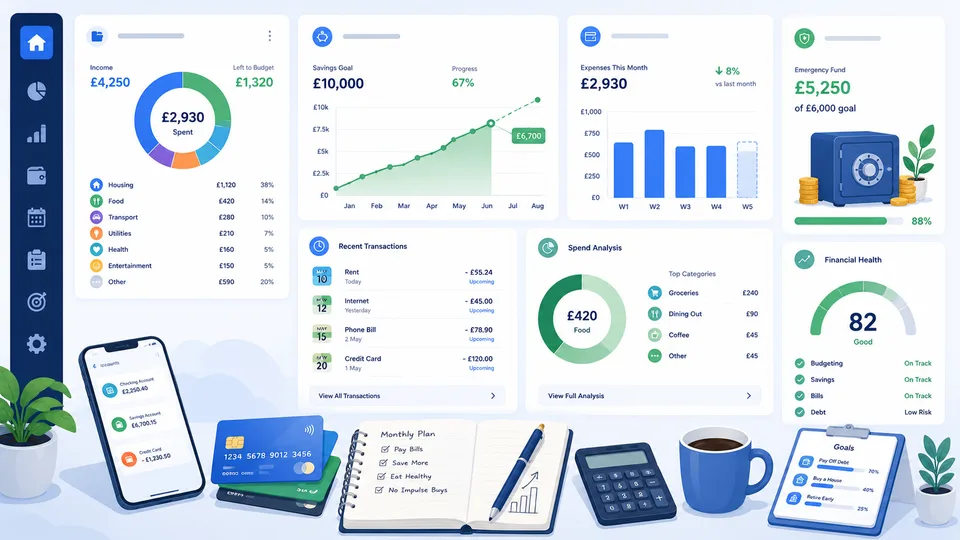
Most Financial Stress Comes From Ordinary Things Repeating
I've built budgets that lasted and budgets that fell apart within days, and the ones that worked had one thing in common: they started from honest numbers rather than aspirational ones. People sometimes imagine financial problems arriving through dramatic moments: losing a job, a major recession, a failed investment.
Those things certainly happen. But in everyday life, a surprising amount of financial pressure comes from smaller patterns repeating quietly over time.
Monthly subscriptions that barely get used. Gradual lifestyle inflation. Car costs that turn out to be larger than expected. Savings delayed for “later”. Tiny spending habits repeated hundreds of times.
The strange part is that these decisions rarely feel significant individually. They become significant collectively.
That is why personal finance works best when treated less like a strict optimisation exercise and more like a long-term system that needs to remain sustainable in real life.
Budgeting Is Really About Visibility
A lot of people dislike budgeting because they associate it with restriction. In practice, good budgeting is usually more about clarity than punishment.
Without visibility, it becomes surprisingly easy for spending to drift without fully noticing:
- small recurring subscriptions
- food delivery habits
- fuel costs
- interest payments
- shopping impulses
- irregular annual expenses
One thing that surprises many people is how different their assumptions feel once the actual numbers are written down properly.
Supporting article:
Saving Money Usually Feels Slower Than Expected
Saving is often discussed as if it is purely a discipline problem. Sometimes it is. But income pressure, housing costs and inflation also matter enormously.
Many people are not failing because they are irresponsible. They are operating with very little margin for error.
Still, small improvements compound more than people realise.
Reducing unnecessary recurring costs by modest amounts can quietly free up significant money over several years. The effect rarely feels dramatic in a single month, which is partly why consistency matters so much.
I remember comparing old bank statements once and realising how many “small” purchases had become invisible through repetition alone.
Emergency Funds Create More Than Financial Protection
Emergency funds are usually described as safety nets, but psychologically they often provide something equally valuable: breathing room.
Without savings, unexpected costs can immediately become stressful:
- car repairs
- medical bills
- moving costs
- job disruption
- appliance replacement
The goal is not perfection. Very few people suddenly build large emergency funds overnight. The important part is gradually reducing vulnerability to financial shocks.
Supporting article:
How Much Emergency Fund Do I Need?
Lifestyle Inflation Often Happens Quietly
One of the more subtle financial traps is lifestyle inflation.
Income increases slightly, but spending quietly rises alongside it:
- larger subscriptions
- more expensive habits
- higher housing expectations
- car upgrades
- frequent convenience spending
The difficult part is that none of these changes necessarily feel unreasonable individually.
A lot of people expect pay rises to create major financial relief, only to discover the improvement feels surprisingly temporary.
Supporting articles:
Cars Are Usually More Expensive Than People Expect
Car affordability calculations often focus too heavily on monthly payments alone.
But ownership costs usually include:
- insurance
- fuel
- maintenance
- repairs
- depreciation
- taxes
- financing costs
A vehicle that appears affordable initially can create surprisingly persistent financial pressure once all secondary costs are included.
Supporting articles:
Impulse Spending Is Usually Emotional Before It Is Financial
People often discuss impulse spending as if it is purely irrational behaviour. In reality, it is frequently connected to stress, boredom, convenience or short-term emotional relief.
Modern online systems are also designed to reduce friction:
- one-click checkout
- instant financing
- targeted recommendations
- constant promotions
That environment makes spending feel psychologically easier than it once did.
The goal is not becoming obsessively restrictive. It is becoming more conscious about repeated patterns that gradually erode financial stability.
Supporting articles:
Useful Calculators For Budgeting & Saving
Financial calculators are often most useful when they help make long-term consequences feel more visible.
- Budget Calculator
- Emergency Fund Calculator
- Savings Calculator
- Debt Payoff Calculator
- Pay Rise Calculator
- Car Affordability Calculator
- Compound Interest Calculator
The numbers themselves are not magic solutions, but they can make trade-offs easier to understand realistically.
Financial Progress Usually Looks Boring In Real Time
One thing personal finance content sometimes gets wrong is making progress appear dramatic and fast.
In reality, healthy financial improvement is often repetitive and fairly unexciting:
- saving consistently
- avoiding unnecessary debt
- keeping costs manageable
- building small buffers gradually
- making fewer impulsive decisions
That lack of excitement is partly why consistency becomes difficult. Slow progress rarely feels emotionally rewarding in the short term.
But over several years, relatively ordinary habits can create surprisingly meaningful stability.
Where To Start
If personal finances feel overwhelming, begin with visibility rather than perfection.
Understand:
- where money is actually going
- which recurring costs matter most
- which habits create stress later
- how much emergency margin exists
- what realistic saving progress looks like
The supporting guides and calculators throughout this hub are designed to make those decisions feel clearer, calmer and more practical rather than overly technical or unrealistic.