
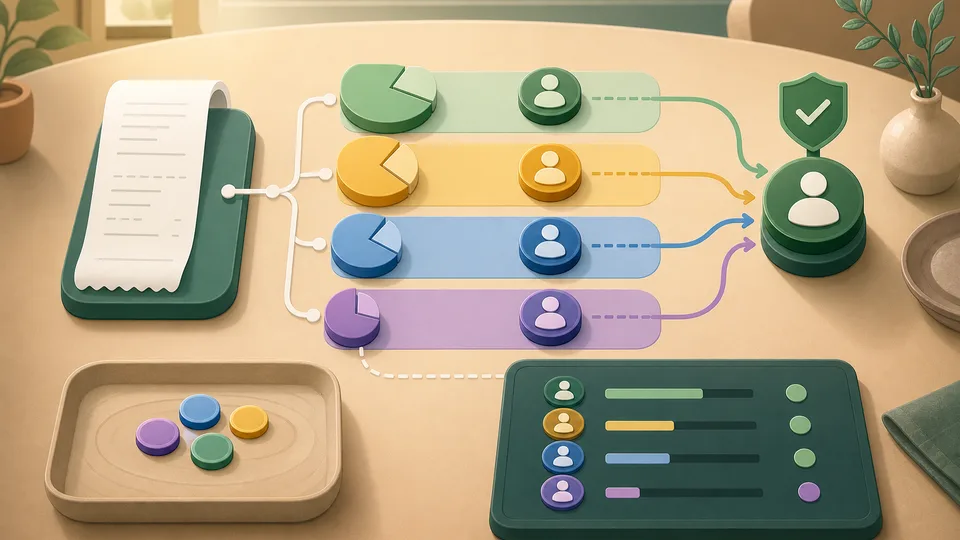
Splitting a bill evenly is easy when everyone used the shared cost equally. Real life often does not work that way. One person may have ordered less, one may be covering a child, one may only owe part of the booking, or one person may have paid upfront for everyone.
An uneven split needs more than a quick division. It needs clear shares, a payer, reimbursement amounts, and a rounding rule that everyone understands.
The Split Expenses Unevenly Calculator helps split one shared bill using custom percentages and shows who owes what when one person paid upfront. It pairs with the Group Expense Settlement Calculator when several people paid different expenses, and the Tip Calculator for restaurant totals.
Start with one shared bill
This kind of calculator is best when there is one total to split. The total might be a restaurant bill, hotel booking, grocery run, gift, taxi, activity, or household purchase.
If there are many bills and several people paid at different times, that becomes a settlement problem. Keep the calculator matched to the situation.
Shares should be agreed before paying
Unequal shares are easiest when they are agreed before one person pays. If the shares are decided afterward, people may remember the arrangement differently.
Percentages are useful because they force the total to be divided intentionally. They also reveal whether the shares add up to the whole bill.
The upfront payer needs a separate view
If one person pays the whole amount, the split is not finished when shares are calculated. The payer needs reimbursement from the others, unless their own share equals the whole bill.
That is why the payer should be shown separately from the share percentages. Paying upfront is a cash-flow role, not necessarily a larger share of the cost.
Rounding can create small leftovers
Currency does not divide perfectly forever. Rounding to cents or pence can create tiny leftovers. Those leftovers should be handled consistently.
For small informal bills, a small rounding difference may not matter. For recurring household costs, it is better to be consistent so the same person does not always absorb the leftover.
Do not hide what is included
Before splitting, decide whether tax, tip, delivery, service charge, booking fees, or extras are included in the total. If one person only owes for part of the bill, make that explicit.
The clearest split is the one where the total and the included items are visible before percentages are applied.
A practical uneven-split workflow
Start with the total. Decide who paid upfront. Agree each person's percentage or share. Check that shares add to the full bill. Calculate each person's owed amount. Then calculate reimbursements to the payer.
If the bill is sensitive, share the assumptions, not only the final request for money. That makes the reimbursement feel less arbitrary.
Worked example: three unequal shares
Suppose one person pays a 120 shared bill. Person A owes 50%, person B owes 30%, and person C owes 20%. The shares are 60, 36, and 24. If person A paid upfront, B reimburses 36 and C reimburses 24.
If person B paid upfront instead, A reimburses 60 and C reimburses 24. The shares stayed the same, but the reimbursement path changed because the payer changed.
Percentages should add to the whole bill
Unequal shares are clearer when they add to 100%. If they do not, someone has to decide where the leftover goes. That can become awkward if the difference is not noticed until after payment.
For informal groups, it is often enough to adjust the largest share or split the leftover. The important thing is to make the adjustment visible.
Fixed contributions can be converted
Sometimes one person agrees to pay a fixed amount and the rest is split by percentage. In that case, calculate the fixed part first, then split the remainder.
This is common when one person only joined part of an activity, used a smaller room, or should not share a particular add-on.
Tips and service charges should be agreed
If a restaurant bill includes tip, service charge, tax, or delivery, decide whether those are split in the same proportions as the main bill. Often they are, but not always.
For example, if one person's share is lower because they did not eat the main meal, the group may still decide to split delivery evenly. State that before calculating.
Keep the conversation neutral
Uneven splits can feel personal if the final number appears without explanation. Sharing the total, shares, and payer makes the result feel like arithmetic rather than accusation.
That is the quiet benefit of a calculator: it lets the group discuss assumptions instead of mental maths.
When uneven splitting is better than equal splitting
Uneven splitting is useful when usage, benefit, or agreement is genuinely uneven. It can be fairer for shared rooms, different meal choices, partial attendance, family shares, or one-off contributions.
It is less useful when the group wants simplicity more than precision. Sometimes an even split plus a small adjustment is enough. The right level of detail depends on the relationship and the amount involved.
One bill is not a full settlement system
If several people paid for different things, the reimbursement view can become misleading. One person may owe money on this bill while being owed money on another. That is when group settlement is the better tool.
Use the uneven split for one shared bill. Use settlement when there are several paid expenses and multiple payers.
Checklist before requesting reimbursement
Before sending payment requests, check the total, included items, excluded items, payer, percentage shares, rounding, tip, delivery, service charge, and whether everyone agreed the split method.
Then share the result in a calm format. A message that includes the method is easier to accept than a bare number.
Use names or labels consistently
If the group uses names, initials, room labels, or family labels, keep them consistent from the calculation to the payment request. Confusing labels can make a correct split look wrong.
This matters when people have similar names, when a couple is counted as one share, or when one person is paying on behalf of someone else.
Small bills may not need perfect precision
For a tiny shared cost, exact percentages may be more effort than the bill deserves. For a large booking or recurring shared cost, precision matters more.
Use the calculator when the amount or fairness concern justifies it. The goal is clarity, not making every casual purchase feel like accounting.
When to move to group settlement
If the shared cost has several receipts, several payers, or several reimbursement paths, move to a group settlement workflow. Uneven bill splitting is strongest when the situation is one total and one upfront payer.
That distinction keeps a simple bill simple and prevents a multi-payer situation from being squeezed into the wrong model.
What this should not claim
An uneven split calculator does not track many receipts, sync payment apps, enforce agreements, apply legal debt rules, manage recurring household accounts, or know who consumed what. It calculates from the entered total, shares, and payer.
Use it to make one shared bill fairer and clearer before one person is left translating the whole thing in their head.