
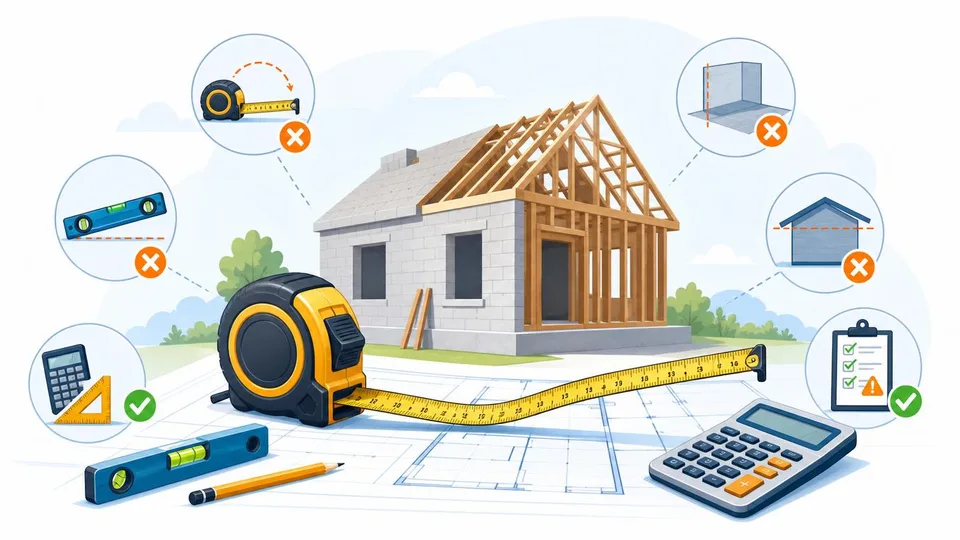
Construction measurement errors are uniquely expensive mistakes. Unlike a typo in a document or a bug in a spreadsheet, they turn into physical consequences: materials that don't fit, structures that can't be built, and costs that multiply before anyone notices where the error originated. I've seen a bathroom tiling job fail because a contractor calculated the floor area in square feet but ordered tiles quoted in square metres. The tiles covered barely two-thirds of the floor. Here are the measurement mistakes that occur most often and how to avoid them.
Mixing Metric and Imperial
The UK construction industry has never fully committed to metric. Timber is sold in metric lengths but specified in imperial dimensions. Room heights are described in imperial in conversation but measured and drawn in metric. Older properties have imperial-spaced structural members that don't align with metric sheet materials. This ambiguity creates real conversion errors when someone switches systems mid-calculation without a formal conversion step.
The rule: pick one system at the start of every job and stay in it. If your floor plan is in millimetres, take all your measurements in millimetres. Convert supplier dimensions from imperial to metric before entering them into any calculation. Never cross between systems in the middle of a string of arithmetic.
Forgetting to Square or Cube Conversion Factors
If you know that 1 foot = 0.3048 metres, you cannot simply multiply a square footage by 0.3048 to get square metres. Area is two-dimensional, so the conversion factor must be squared: 1 sq ft = 0.3048² = 0.0929 m². Volume is three-dimensional: 1 cubic foot = 0.3048³ = 0.0283 m³. This mistake is extraordinarily common when contractors switch between unit systems for material ordering.
Our area calculator handles unit conversion internally — calculate in metres, feet, or inches, and it converts the result. Our volume calculator does the same for cubic dimensions including litres, cubic metres, US gallons, and UK gallons.
Calculating Gross Area Instead of Net Area
Wall area calculations often use the perimeter length multiplied by the wall height — this gives gross wall area including all openings. For paint, tiles, or wall insulation, you need net area after subtracting windows and doors. A standard UK door is about 1.5 m²; a typical window is 1.0–1.5 m². In a small bathroom with two doors and two windows, the gross-to-net difference can be 6–8 m² — significant when you're tiling at £40–£80 per m².
Not Accounting for Waste and Pattern Matching
Ordering exactly the calculated area of tiles, flooring, or carpet is almost always a mistake. Cuts produce offcuts that cannot be reused. Tiles crack during installation. Pattern-matched flooring loses material at each seam. Standard practice: add 10% to the calculated area for straightforward layouts, 15% for diagonal or herringbone patterns, and 20% for complex pattern-matched materials. For natural stone with significant colour variation, some installers recommend 25%.
Measuring Once, Ordering Twice
The carpenters' maxim "measure twice, cut once" applies equally to material ordering. Have two people measure independently and compare results. If there's a discrepancy of more than a few millimetres on a structural dimension or more than 1–2% on an area calculation, measure again. The cost of the time taken to re-measure is trivial compared to the cost of ordering the wrong quantity or dimension.
Ignoring Tolerance and Clearance
A door that's exactly 762 mm wide will not fit in an opening that's exactly 762 mm — it needs clearance for the frame, the hinge movement, and the planing tolerance of the door itself. Windows need reveals. Pipes need sleeves through walls. Structural beams need bearing lengths on the walls at each end. Each of these requires a clearance measurement that adds to the nominal dimension. Getting the nominal measurement right but ignoring the clearances produces fittings that physically cannot be installed.
Rounding at the Wrong Stage
Round only the final result of a calculation, not the intermediate values. If a room is 3.83 m × 2.97 m, calculating 3.8 × 3.0 for ease introduces a 2.7% error in area — small for paint, but potentially significant for a large floor covering order. Keep full decimal precision through every intermediate step and round only the litre or square metre total at the end when placing the order.
The Habit That Prevents Most Errors
Write everything down in a consistent format before you need it. Measurements taken on site, entered into a phone note with units explicitly stated, cross-referenced against the drawing or floor plan, and then calculated are far less likely to produce an error than measurements held in memory and converted mentally. Construction errors are almost never caused by incompetence — they're caused by reasonable people relying on their memory for one step too many.
What the Drawing Doesn't Show You
Architectural drawings represent intention. The site represents reality. The gap between the two is where experienced contractors spend a significant portion of their time, and where measurement errors born from relying too literally on drawings tend to occur. A drawing might show a wall at 3,600 mm. The actual wall, once formed, might be 3,585 mm — because the blockwork coursed out differently, or the plaster was applied thicker than specified, or the floor screed gained 5 mm in one corner. These deviations are normal in construction. What's not normal is failing to account for them before cutting or ordering materials to drawing dimensions.
The rule for anything where fit matters — joinery, fitted furniture, bespoke metalwork — is to measure the actual opening, not the drawing dimension. Template directly from the site where possible. Where a drawing dimension is the only reference available (for items manufactured off-site before installation), build tolerance into the specification explicitly and agree with the manufacturer which party is responsible for adjustment if the site dimension differs from the drawing on delivery. Discovering this question at the point of installation, rather than at the point of order, is the construction equivalent of running out of paint three walls from the finish.