
Everyday Maths Usually Feels Harder In Real Situations
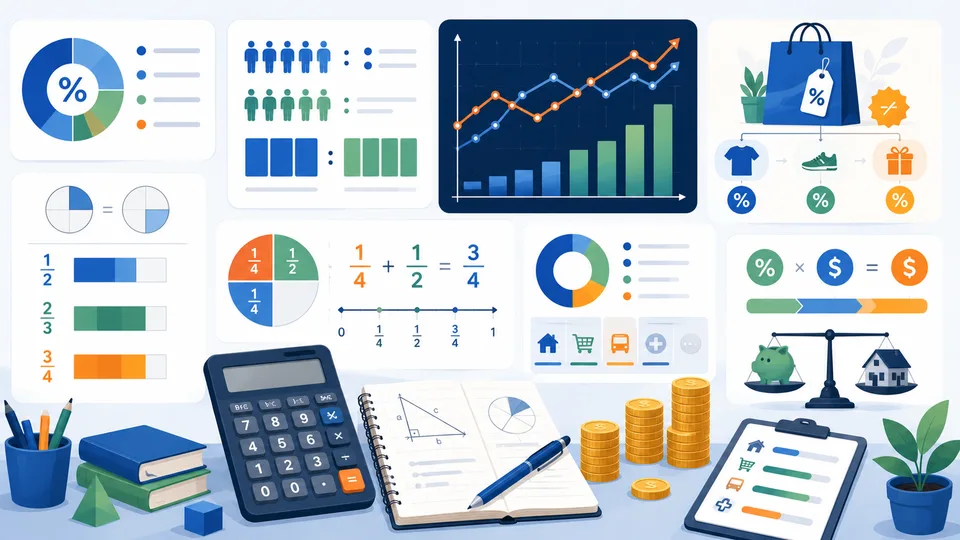
I've found that percentages and ratios appear constantly in everyday decisions — and most of the confusion around them disappears once the core formulas feel familiar. A lot of people are comfortable with basic maths in isolation but become uncertain once numbers appear in practical real-world situations.
Percentages, ratios and comparisons often look simple on paper, yet quickly become confusing once:
- multiple steps are involved
- values change over time
- discounts stack together
- growth compounds
- different units interact
I think this is partly because everyday maths is less about memorising formulas and more about understanding relationships between numbers.
Percentages Are Really About Relative Change
Percentages help describe proportions relative to a whole.
That sounds straightforward, but many misunderstandings happen because people focus on the percentage itself rather than the starting value behind it.
For example:
- a 50% increase on a small number may still remain small
- a 5% change on a very large number can be enormous
- a percentage decrease followed by an increase does not necessarily return to the original value
Supporting article:
Why Percentages Confuse People
Percentage Increase And Percentage Points Are Different
One common source of confusion is the difference between percentage increase and percentage points.
If something rises from:
- 10% to 15%
that is:
- a rise of 5 percentage points
- but a 50% increase relative to the original value
This distinction appears constantly in:
- finance
- economics
- news reporting
- interest rates
- polling data
Supporting article:
Percentage Increase vs Percentage Points
Ratios Describe Relationships Between Quantities
Ratios are essentially comparisons between amounts.
They help explain how quantities relate to one another rather than simply measuring totals individually.
Ratios appear constantly in everyday life:
- recipes
- finance
- probability
- construction
- fitness tracking
- maps and scaling
One thing that surprised me when helping people with ratio problems is how often confusion came from wording rather than the maths itself.
Supporting articles:
Discounts And Sales Often Create Confusion
Shopping discounts look simple at first glance, but layered percentage changes frequently mislead people.
For example:
- a 50% discount followed by another 20% discount is not a 70% reduction
- a price increase after a discount does not always return to the original value
- large “percentage off” labels can feel more dramatic than the actual savings involved
Retail pricing often relies heavily on how humans perceive percentages emotionally rather than purely mathematically.
Supporting article:
Common Discount Calculation Mistakes
Compound Growth Changes How Percentages Behave
One reason percentages become unintuitive is that compound growth changes how increases accumulate over time.
Small recurring percentage increases can eventually create surprisingly large long-term changes because each increase builds on previous growth.
This principle appears in:
- investing
- inflation
- population growth
- debt interest
- business growth
Supporting article:
How Compound Growth Changes Percentages
Fractions, Decimals And Percentages Are Closely Connected
A lot of maths confusion disappears once people realise fractions, decimals and percentages are simply different ways of expressing the same relationships.
For example:
- 1/2
- 0.5
- 50%
all represent the same proportion.
Understanding how these formats convert into one another makes many practical calculations easier.
Supporting article:
Fractions, Percentages & Decimals Explained
Small Percentages Can Still Matter A Lot
Another common misunderstanding is assuming small percentages are automatically insignificant.
A small percentage applied repeatedly or applied to large totals can still create major real-world effects.
This is especially important in:
- investment fees
- mortgage rates
- business margins
- population trends
- inflation
Supporting article:
Why Small Percentages Can Be Misleading
Everyday Maths Is Often About Estimation
In practice, a lot of useful maths is not about perfect precision. It is about making fast reasonable estimates.
People use everyday maths constantly without fully noticing:
- splitting bills
- estimating discounts
- comparing prices
- budgeting spending
- adjusting recipes
- understanding statistics
Supporting article:
Everyday Maths You Use Without Realising
Useful Calculators For Percentages & Ratios
Practical maths becomes much easier once relationships between numbers can be visualised clearly.
- Percentage Calculator
- Percentage Increase Calculator
- Percentage Decrease Calculator
- Ratio Calculator
- Fraction Calculator
- Markup Calculator
- Compound Interest Calculator
These tools are most useful when combined with conceptual understanding rather than treating maths as pure memorisation.
Good Maths Understanding Usually Feels More Intuitive Over Time
One interesting thing about practical maths is that confidence usually grows through repeated exposure rather than complicated theory.
Once people begin understanding:
- relative change
- proportions
- compounding
- ratios
- comparisons
many calculations that once looked intimidating start feeling much more intuitive.
The goal is not becoming a mathematician. It is becoming more comfortable interpreting numbers in everyday situations.
Where To Start
If percentages and ratios feel confusing, start by focusing on relationships between quantities rather than memorising isolated formulas.
Focus first on:
- understanding proportions
- relative change
- percentage increases and decreases
- ratio comparisons
- compound effects over time
- practical estimation skills
The supporting articles and calculators throughout this guide are designed to help make everyday maths feel more practical, understandable and useful instead of unnecessarily intimidating or overly academic.