
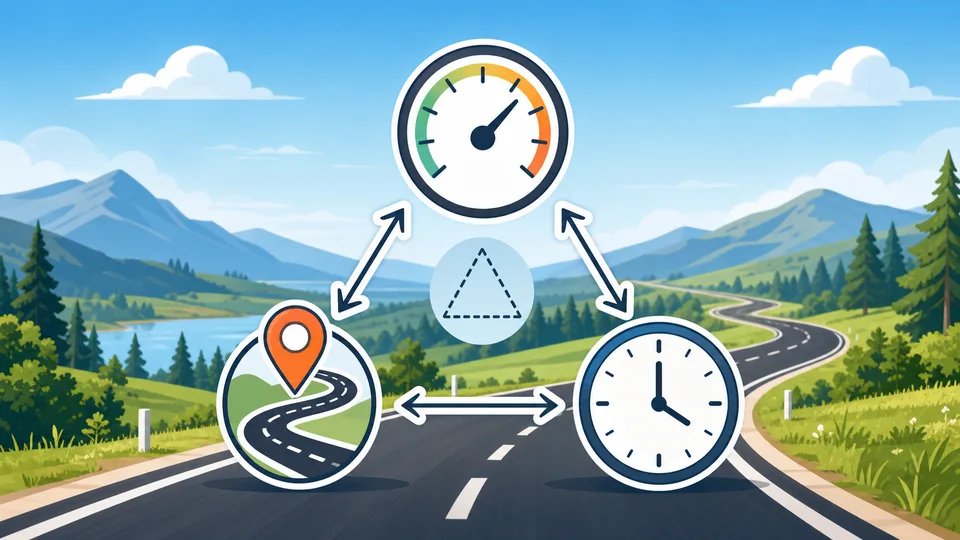
'We're doing 60 mph — how long to get there?' 'My train covered 200 miles in 2 hours 20 minutes — what was the speed?' 'I need to run 5km in under 30 minutes — what pace is that?' All answered by the same equation. Possibly the most practically useful formula in everyday maths.
The Three Forms
Speed = Distance ÷ Time | Distance = Speed × Time | Time = Distance ÷ Speed
The SDT triangle memory aid: Speed at top, Distance bottom-left, Time bottom-right. Cover the variable you want to find — side-by-side means multiply, top-over-bottom means divide. Our speed converter handles mph↔km/h and m/s↔km/h conversions. Our time duration calculator converts 2h 37m to decimal hours before you plug it in.
Example 1: Finding Time
240 miles at 60 mph: Time = 240 ÷ 60 = 4 hours. Note: "average speed" is theoretical — real driving includes stops and traffic.
Example 2: Finding Speed — The Key Mistake
350 km in 2 hours 20 minutes. Critical: convert time to decimal hours first. 2h 20m = 2 + (20/60) = 2.333 hours. Speed = 350 ÷ 2.333 = 150 km/h. This time conversion is the most common source of errors — 2h 30m = 2.5 hours (not 2.30 treated as a decimal).
Example 3: Finding Distance
Cycling at 15 km/h for 1 hour 45 minutes (1.75 hrs): Distance = 15 × 1.75 = 26.25 km.
Units Must Be Consistent
Speed in km/h → distance in km and time in hours. Speed in m/s → distance in metres and time in seconds. Mixing units produces nonsense. Quick conversions: km/h ÷ 3.6 = m/s | mph × 1.609 = km/h.
Average vs Instantaneous Speed
This formula calculates average speed (total distance ÷ total time). A speedometer shows instantaneous speed. For journey planning, race pacing, and most physics problems, average speed is what you need.
Relative Speed
Two cars heading toward each other at 70 mph and 60 mph: relative speed = 130 mph (they close the gap at that rate). Same direction: relative speed = 10 mph (faster gaining on slower). Apply the formula to relative speed for meeting-point calculations.
Further reading: BBC Bitesize has clear speed, distance and time worked examples for GCSE students. Practice speed, distance and time at BBC Bitesize.
The Three Variations of the Formula
The base relationship is: speed = distance ÷ time. Rearranging gives you the other two: distance = speed × time, and time = distance ÷ speed. To find time, you divide distance by speed. To find distance, you multiply speed by time. The triangle method makes this easy to remember: write S at the top, D and T at the base. Cover the one you want to find, and the relationship between the other two tells you whether to multiply or divide.
Getting the Units Right
The most common error is mixing units. Speed in miles per hour works with distance in miles and time in hours. Speed in km/h works with distance in kilometres and time in hours. If your time is in minutes rather than hours, convert it first — divide by 60. If your distance is in metres rather than kilometres, divide by 1,000. Applying the formula before converting units produces a wrong answer that looks plausible, which is the worst kind of error to catch.
Practical Examples
How long will a journey take? A 210-mile trip at an average speed of 60 mph: time = 210 ÷ 60 = 3.5 hours, or 3 hours 30 minutes.
What average speed am I travelling at? Covering 450 km in 4.5 hours: speed = 450 ÷ 4.5 = 100 km/h.
How far can I go in a given time? Cycling at 18 km/h for 2 hours 15 minutes: convert time to hours (2.25), then distance = 18 × 2.25 = 40.5 km.
Average Speed vs Instantaneous Speed
The formula calculates average speed over a journey — total distance divided by total time including stops. This is different from the speed at any given moment during the journey. A trip that takes 3 hours but involves a 20-minute stop means the actual driving time was 2 hours 40 minutes, but the average speed for the whole journey is calculated using the full 3 hours. If you want driving average speed only, subtract the stop time from the total time before dividing.