
I've watched server cost assumptions fall apart under real traffic, and the gap between expected and actual scaling costs is one of the most consistent surprises in early-stage product growth.
Server costs are not a fixed overhead — they are a function of user traffic, application architecture, and the efficiency with which infrastructure is provisioned. Understanding how costs scale with user growth changes how products are designed, how infrastructure decisions are made, and how unit economics are modelled. A product that is profitable at 1,000 users may not be at 100,000 if the scaling relationship is not understood in advance.
Growth Patterns
Infrastructure costs scale with users in one of three patterns depending on the application architecture:
Linear scaling: Cost grows in direct proportion to user count. Every additional user costs roughly the same to serve as the previous one. This is common for stateless applications with simple horizontal scaling — adding another server instance to handle more traffic. At 1,000 users: £200/month. At 10,000: £2,000/month. At 100,000: £20,000/month. Predictable, but expensive at scale if the baseline per-user cost is not managed.
Sub-linear scaling: Cost grows, but more slowly than user count — each additional user costs less to serve than the previous one due to economies of scale in infrastructure utilisation, more efficient use of shared resources, or better caching. Well-architected applications with high cache hit rates and efficient database queries often achieve sub-linear scaling. The infrastructure cost curve flattens as scale increases.
Super-linear scaling: Cost grows faster than user count — each additional user costs more to serve than the previous one. This indicates architectural inefficiency: queries that become slower as the database grows, infrastructure that is not horizontally scalable, or bottlenecks that require expensive vertical scaling. Super-linear scaling is a warning signal that requires architectural attention before it becomes commercially problematic.
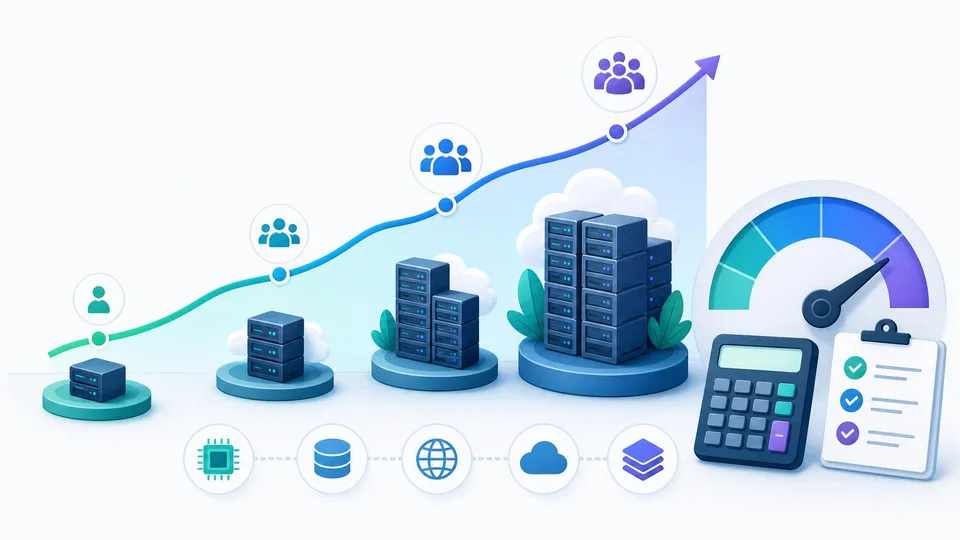
The Server Cost vs User Growth Calculator models your cost trajectory at different user growth rates, allowing you to see projected infrastructure costs at 6-month, 12-month, and 24-month milestones. Enter current cost, current user count, expected growth rate, and your estimated scaling pattern to project forward costs.
Cost Drivers
Server costs for web applications are driven by several distinct resource categories:
Compute: CPU and memory required to process requests. The dominant cost for compute-intensive applications — video processing, machine learning inference, complex calculations. Scales directly with request volume and processing intensity per request.
Database: Storage, compute, and read/write operations for the application database. Often the primary scaling bottleneck for data-intensive applications. Database costs scale with both storage volume and query frequency — an application with poorly optimised queries pays more per user than one with efficient query patterns.
Storage: File storage for user-generated content, media, backups, and logs. Scales with the amount of data stored, which may grow faster than user count if each user generates ongoing data. Storage costs are typically lower per GB than compute but can accumulate significantly over time if old data is not archived or deleted.
Bandwidth and egress: Data transferred out of the cloud provider's network. Often a surprisingly large cost component for media-heavy applications or APIs returning large responses. Major cloud providers charge $0.08 to $0.15 per GB of egress beyond a free tier.
Scaling Challenges
The technical challenges that create disproportionate cost increases at scale:
Database bottlenecks: Relational databases do not scale horizontally as easily as application servers. As query volume and data volume increase, a single database instance becomes a bottleneck that requires either vertical scaling (larger, more expensive instance) or architectural change (read replicas, database sharding, caching layer). These transitions are time-consuming and the cost curve can step up suddenly at the transition point.
Session and state management: Applications that store user session state on individual servers cannot scale horizontally without additional infrastructure for shared session storage. The architectural debt of not designing for statelessness from the start creates scaling friction that is expensive to address at growth stage.
Search infrastructure: Full-text search at scale typically requires dedicated search infrastructure (Elasticsearch, Algolia, Typesense). A product using basic database queries for search that adds a dedicated search layer at 100,000 users faces a step-change in infrastructure cost that should be planned for, not discovered.