
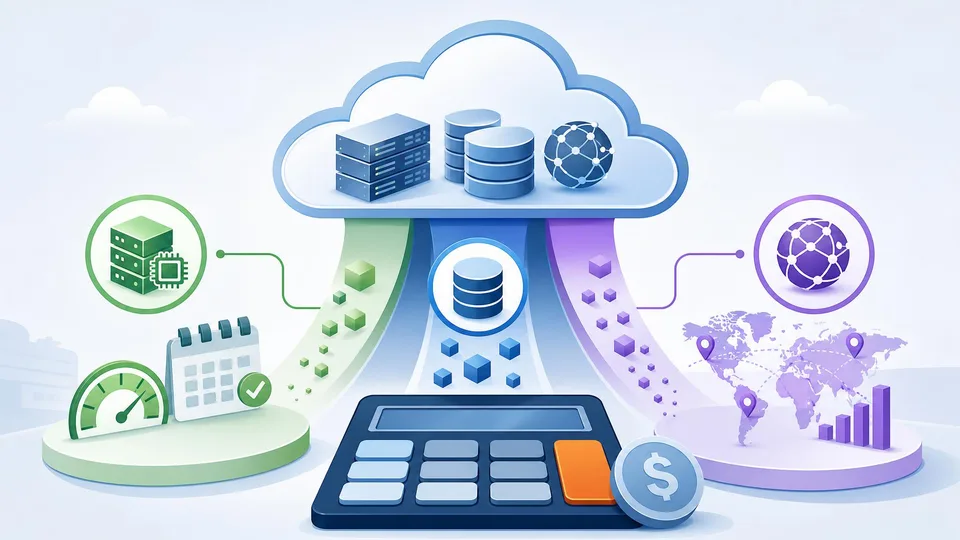
I've spent time untangling cloud cost breakdowns and found that the largest bills are almost always driven by a small number of services — and the explanation is usually simpler than the invoice suggests.
Cloud infrastructure costs come from a finite set of resource categories, and understanding which categories dominate your specific bill is the starting point for any cost management effort. The same application can have dramatically different cost profiles depending on what it does — a media streaming service is bandwidth-dominated; a machine learning platform is compute-dominated; a data analytics product is storage-dominated. Knowing which category drives your costs tells you where to focus optimisation effort.
Compute
Compute — the CPU and memory required to run your application — is the most visible cloud cost category and often the largest. It is charged per instance-hour for traditional virtual machines (EC2, Compute Engine, Azure VMs), per execution for serverless functions (Lambda, Cloud Functions), or per container-hour for managed container services (ECS, Cloud Run, Azure Container Instances).
Instance type selection has a large impact on compute cost. Cloud providers offer dozens of instance families optimised for different workloads: general purpose, compute-optimised, memory-optimised, storage-optimised, and GPU instances. Running a memory-optimised instance for a workload that requires little memory pays for memory you are not using. Running a general-purpose instance for a CPU-intensive workload may provide insufficient performance, requiring a larger and more expensive instance than a compute-optimised one of equivalent performance.
The ratio of compute cost to workload output — requests per dollar of compute spend — is the infrastructure efficiency metric for compute-bound applications. Benchmarking different instance types for your specific workload and choosing the most cost-efficient configuration (rather than defaulting to a familiar instance type) can reduce compute costs by 20% to 40% without any application code changes.
Pricing model selection compounds the instance type decision. On-demand pricing is the default — you pay per hour with no commitment. Reserved instances (1 or 3-year commitment) reduce the on-demand price by 30% to 60% for the same instance. Spot instances (using spare cloud capacity at up to 90% discount) are appropriate for fault-tolerant batch workloads. For any workload running consistently for more than a few months, comparing the reserved instance price against on-demand and factoring in commitment risk is worth the analysis time.
Storage
Cloud storage costs come from two sources: the volume stored and the operations performed on that volume. Object storage (S3, GCS, Azure Blob) charges per GB per month for storage and per-request for read and write operations. Block storage (EBS, Persistent Disk) charges per GB provisioned regardless of usage — a 500GB volume attached to a server costs for 500GB even if only 100GB is used.
Storage costs grow over time independently of active user growth because data accumulated in the past continues to incur storage charges. An application that has been running for three years may have 80% of its stored data from users who are no longer active — data that continues to cost money to store. Lifecycle policies that archive or delete old data can significantly reduce storage costs with no impact on active users.
The Cloud Cost Estimator Calculator includes storage cost modelling with data growth projection — particularly useful for estimating future storage costs as user-generated data accumulates.
Bandwidth
Bandwidth costs — specifically egress, the transfer of data from the cloud provider's network to the internet or to other providers — are the most commonly underestimated cloud cost category. Providers charge nothing for ingress (data coming in) but charge meaningfully for egress (data going out). AWS charges $0.09 per GB for the first 10TB of egress per month from most regions. Google Cloud charges $0.08 per GB. Azure charges $0.087 per GB.
For applications serving large files, images, video, or high-volume API responses, egress can easily represent 30% to 50% of total cloud spend. A video streaming application serving 50TB of content per month pays approximately $4,500 in egress charges alone. A CDN reduces origin egress costs significantly by caching content at edge nodes and serving it from there, reducing the number of requests that must reach the origin server and generate full egress charges.
Cross-region and cross-provider data transfer also incurs charges. Data transferred between AWS regions costs $0.02 per GB. Data transferred from AWS to another cloud provider or on-premises system costs standard internet egress rates. Multi-cloud architectures that involve frequent large data transfers between providers can generate bandwidth costs that dwarf the compute costs driving the architecture decision in the first place.