
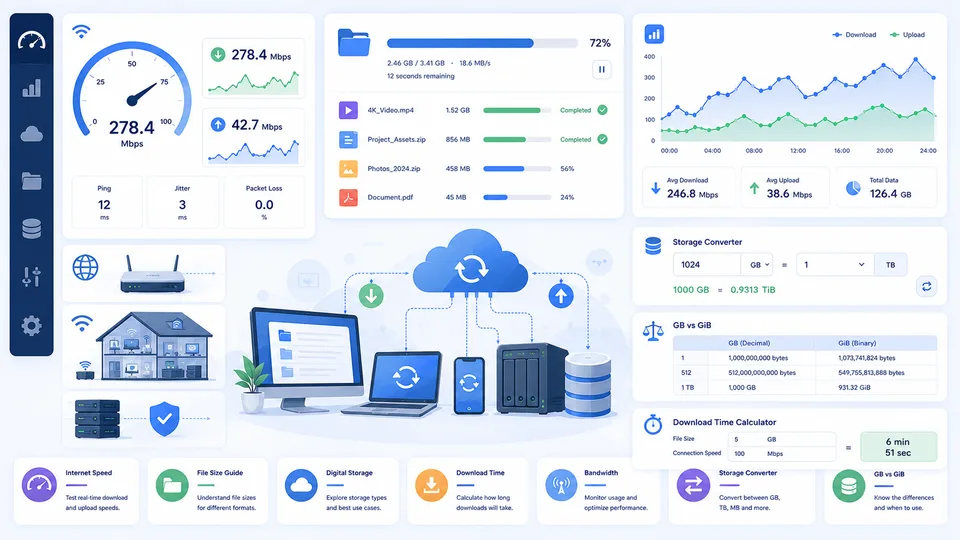
Most People Only Think About File Sizes When Something Stops Working
I've spent time confused by broadband speeds and file size figures that seemed not to match what I was experiencing, and sorting that confusion out was genuinely useful. For a long time, digital storage and internet speed felt almost invisible. Websites loaded quickly enough, cloud storage seemed endless and broadband speeds improved steadily in the background.
Then suddenly you try uploading a large video, backing up a phone, downloading a game update or sharing files over weak Wi-Fi and everything becomes very noticeable again.
A lot of people assume internet speed problems are purely about having “bad broadband”, but in practice there are usually several things interacting at once:
- file size
- download speed
- upload speed
- storage limits
- network congestion
- compression efficiency
- device limitations
Understanding how these pieces fit together makes technology feel far less random and frustrating.
Internet Speed Is Not Quite As Straightforward As Advertisements Suggest
Internet providers often advertise large headline speeds, but real-world performance rarely behaves in such a clean predictable way.
One thing that surprises people is how differently various online activities use bandwidth. Browsing websites requires relatively little data compared to cloud gaming, 4K streaming or large file syncing.
Connection quality also matters as much as raw speed in many situations. A stable moderate connection can feel faster than an unstable high-speed one.
Latency, congestion and Wi-Fi interference often affect perceived speed more than people expect.
This becomes especially noticeable during:
- video calls
- large downloads
- remote work
- cloud backups
- multiplayer gaming
- multiple-device households
Related article:
Internet Speed Calculations: What Your ISP Doesn't Tell You
File Sizes Have Quietly Become Enormous
A few decades ago, storage limitations forced software and media to remain relatively compact. Today the opposite is often true.
Modern devices capture extremely high-resolution photos and videos automatically. Applications update constantly. Games regularly exceed 100GB. AI-generated media and cloud backups multiply storage usage even further.
The result is that many people underestimate how quickly storage consumption scales.
I noticed this myself after moving large media archives between drives. Files that seemed manageable individually became surprisingly awkward once thousands accumulated together.
This is also why upload limits and transfer times suddenly become important when dealing with:
- video editing
- podcasts
- design assets
- cloud storage
- backup systems
- website media libraries
Supporting article:
File Size Calculator: Why Upload Limits Matter
Download Time Depends On More Than Speed Alone
People often assume download time is simply:
“larger speed = instant download”
In reality, file size still matters enormously.
A huge modern game update, large operating system patch or cloud backup can consume vast amounts of bandwidth even on relatively fast connections.
And many households now have multiple devices competing for bandwidth simultaneously:
- streaming televisions
- phones syncing photos
- cloud backups
- gaming downloads
- video calls
- smart home devices
In practice this usually feels very different from idealised broadband speed tests.
Supporting article:
How To Calculate Download Time Accurately
Storage Measurements Confuse Almost Everyone At Some Point
Digital storage terminology is oddly inconsistent.
Many people assume:
- GB always means the same thing
- 1TB is exactly what the box promises
- storage loss means something is broken
But storage manufacturers and operating systems sometimes calculate capacity differently.
This is where concepts like:
- GB vs GiB
- decimal vs binary storage
- usable storage capacity
start becoming relevant.
The differences are not usually dangerous, but they do explain why available storage often appears smaller than expected after formatting or installation.
Supporting article:
Data Storage Converter: GB vs GiB Explained
Cloud Storage Feels Infinite Until It Doesn't
Cloud systems changed how people think about storage. Instead of carefully managing local drives, many users now assume files can simply live online forever.
Sometimes that works perfectly well. Sometimes it creates sprawling collections of duplicate backups, unused uploads and forgotten media libraries quietly consuming space month after month.
The convenience is real, but cloud storage still has:
- costs
- transfer limits
- syncing overhead
- backup complexity
- privacy considerations
One thing people rarely anticipate is how difficult large cloud migrations become once data volumes scale significantly.
Related article:
How Much Cloud Storage Do You Actually Need?
Website Performance Is Closely Connected To File Optimisation
Large files do not only affect downloads. They also shape how websites feel to use.
Oversized images, inefficient assets and poor compression can quietly damage:
- mobile browsing
- SEO performance
- page load speed
- bounce rates
- hosting costs
- user experience
This becomes particularly noticeable on slower mobile connections where unnecessarily heavy pages feel frustrating almost immediately.
Supporting article:
Useful Calculators For Internet Speed & Storage Planning
Practical calculators can make digital storage and bandwidth decisions much easier to visualise.
- Download Time Calculator
- Internet Speed Calculator
- File Size Calculator
- Data Storage Converter
- Cloud Storage Calculator
These tools are often more useful when estimating real-world usage patterns instead of relying on idealised maximum speeds.
Technology Expectations Have Changed Faster Than Infrastructure
One interesting shift over the last decade is how dramatically expectations increased.
People now expect:
- instant streaming
- fast cloud syncing
- large game downloads
- high-resolution video calls
- always-available backups
- multi-device connectivity
all at the same time.
The underlying infrastructure has improved enormously, but modern digital habits also consume vastly more bandwidth and storage than they once did.
That tension explains why internet speed and storage management still matter despite technological progress.
Where To Start
If you are trying to improve internet performance or manage storage more effectively, begin with visibility rather than assumptions.
Check:
- how large your files actually are
- how much bandwidth different tasks consume
- whether upload speed is the real bottleneck
- how quickly cloud storage is growing
- whether assets are properly compressed
Most digital storage and internet frustrations become easier to solve once the underlying numbers are understood properly.
The supporting guides and calculators throughout this hub are designed to help make those numbers feel practical instead of abstract.