
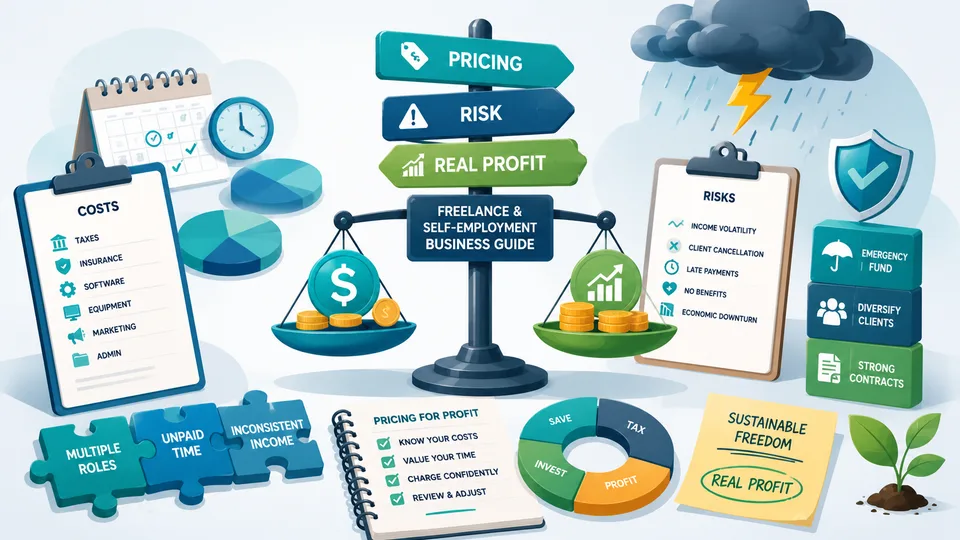
When I went freelance I treated it primarily as a question of doing good work and getting paid for it. Everything else — registering with HMRC, setting rates, managing cash flow, finding clients during quiet periods — I assumed would sort itself out. It did not sort itself out. Six months in, I had a January tax bill I had not prepared for, a rate I had set too low based on a misunderstanding of billable hours, and a client list entirely composed of three people, one of whom paid late consistently. None of these problems were unusual. They are the standard first-year freelance experience because nobody tells you what the job actually involves before you start doing it.
The First 30 Days: What Actually Needs Doing
Registering as self-employed with HMRC is required by law and must be done by 5 October in the second tax year of trading — so if you start freelancing in any month of the 2024/25 tax year, you need to register by 5 October 2025. Registration is done online through the government gateway and takes about 20 minutes. You will receive a Unique Taxpayer Reference (UTR) number in the post within a few weeks. You will also need to set up a separate business bank account — not legally required for sole traders, but practically essential for tracking income and expenses separately from personal finances. Open one before money starts moving. Separating finances from day one saves considerable effort at tax time and makes it much easier to see whether the business is actually profitable.
How Self-Assessment Tax Works and Why January Is Dangerous
As a self-employed person, income tax and National Insurance are not deducted at source. You pay them yourself via self-assessment, with the annual return due 31 January following the end of the tax year. The first payment is a shock for most people: HMRC asks not only for tax on last year's earnings, but for a Payment on Account — a 50% advance on the estimated current year's tax bill. This means the first January tax payment can be 150% of the expected annual liability. The only reliable defence is to set aside a percentage of every invoice from the first day. The right percentage depends on your income level, but 25–30% of gross income is a workable rule of thumb for most freelancers in the basic rate tax band. Put it in a separate savings account and do not touch it.
Setting a Rate That Actually Works
Most new freelancers set their rate by looking at what competitors charge and picking a number in that range. The problem is that competitors' rates are not public, so the "research" usually means asking a few people or looking at platforms that skew toward entry-level pricing. A better approach is to calculate backwards from the income you need. Start with your target annual take-home. Add business costs (software, equipment, insurance, professional development). Add expected tax and NI. That total is your required gross revenue. Divide by realistic billable hours — not total working hours. A full-time freelancer working 40 hours per week typically bills 1,000–1,200 hours per year after accounting for admin, proposals, holidays, and quiet periods. A billable days calculator helps you estimate this accurately, and a day rate take-home calculator shows what a given rate actually produces after tax.
Finding Clients When You Have No Clients
The hardest period in any freelance career is the beginning, when the track record is thin and the network is small. The most reliable early-stage strategy is also the least exciting: direct outreach to people and organisations you already have some connection to. Former employers, former colleagues, suppliers and clients from previous jobs, people you know through professional associations — these warm contacts convert at a much higher rate than cold outreach because there is pre-existing trust. Many early freelance engagements are effectively the previous employer outsourcing work they used to get done internally. Starting with the people who already know what you can do is faster than trying to establish credibility from scratch with strangers.
Client Concentration: The Risk Nobody Talks About Enough
One client making up more than 40–50% of your income is not a client relationship — it is an employer relationship without the employment protections. If that client reduces work, changes supplier, or goes under, your income collapses immediately. Most new freelancers accept this risk because the early priority is getting income at all. But managing it proactively means using any stable client relationship to buy time to develop the next one, rather than relaxing because the near-term pipeline looks healthy. A practical target for a stable freelance business is no single client representing more than 30% of income. Getting there takes time, but the direction of travel matters as much as the destination.
The Invisible Costs of Running a Freelance Business
Professional indemnity insurance, public liability insurance (if you work at client premises), accounting software, project management tools, video conferencing subscriptions, a portion of your home broadband and phone costs, professional development, trade memberships, and the cost of your own equipment depreciation — these are all legitimate business expenses and all reduce your taxable profit when claimed correctly. They are also costs that do not appear if you naively divide gross income by hours worked and call it your rate. Tracking them properly from the first month is worth the effort: not just for tax purposes but because understanding your real operating costs is the foundation of setting rates that sustain the business rather than just covering surface-level costs.
Contracts and Late Payment: Protecting Yourself Before You Start
Freelancers who do not use written contracts are betting on goodwill. Most of the time that bet pays off — most clients are reasonable and pay eventually. But the situations where it does not pay off are expensive. A client who disputes the scope after the work is delivered, a project cancelled mid-way without agreed kill fees, an invoice unpaid for four months because there was no agreed payment term in writing: these are the scenarios that a basic contract prevents. A freelance contract does not need to be a lengthy legal document. A short statement of scope, deliverables, payment terms, kill fee provisions, and intellectual property transfer is enough for most engagements. Several freelance associations provide template contracts, and the investment in getting one reviewed by a solicitor once — around £200–300 — pays for itself the first time you need to reference it. Set payment terms explicitly: 14 or 30 days from invoice date, not "on completion" which is ambiguous. Include a clause allowing you to charge statutory interest on late payments — you may never use it, but its presence encourages timely payment.
One thing nobody tells you before going freelance is that the financial and administrative skills matter almost as much as the professional skills. The best work in the world, poorly priced, badly contracted, and tracked through a shoebox of receipts, produces a difficult business. Developing the financial fluency — understanding tax, setting rates correctly, managing cash flow, protecting yourself through contracts — is not a distraction from the work; it is what makes the work sustainable. Most freelancers who leave full-time employment take the technical skills with them. The ones who build lasting independent businesses add the business skills over time, usually through hard experience. Acquiring them proactively, before the problems arrive, is considerably more comfortable.
Related calculator: Use our Hourly Rate Calculator and Day Rate Take-Home Calculator to price freelance work more realistically.