
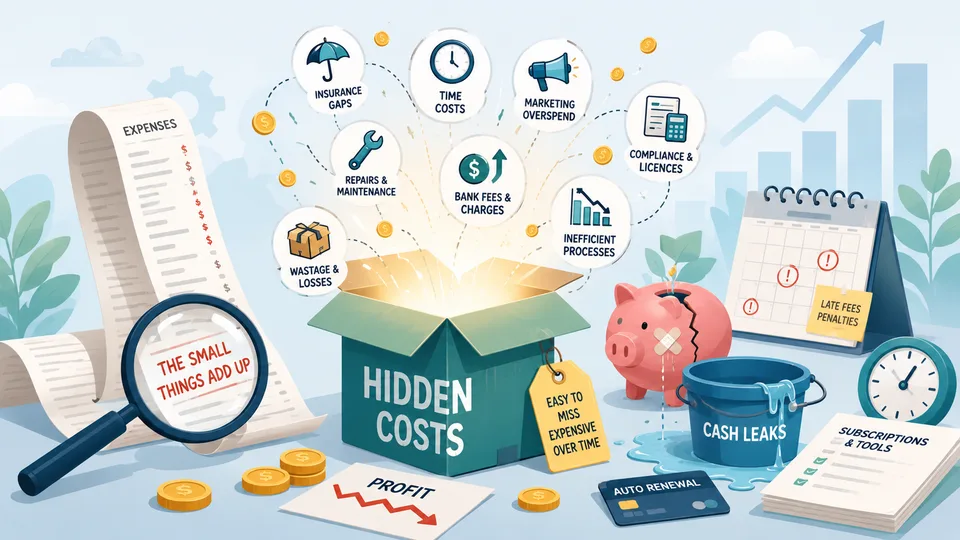
I spent two years reviewing the accounts of a small retail business as part of an advisory role, and one of the most consistent findings was that the owner's mental model of her costs bore only a loose relationship to reality. She knew her rent, her stock costs, and her staff wages. She had a rough sense of her utility bills. Everything else — transaction fees, packaging, wastage, the cost of processing returns, the accountant's annual bill, the software subscriptions that had quietly auto-renewed for three years — lived in a vague mental category called "overheads" that she estimated at around £800 per month. The actual figure, once we traced every recurring cost, was £2,100. That gap of £1,300 per month explained why the business always felt tighter than the revenue suggested it should.
Transaction Fees: The Tax on Every Sale You Probably Undercount
Payment processing fees are charged as a percentage of every transaction. Stripe, Square, and similar providers charge around 1.4–2.9% plus a fixed amount per transaction depending on card type and plan. On a £50 sale, that might be £1.20 — which sounds small. Across £20,000 in monthly card sales, it is £2,400 per year. Many business owners know this cost exists but do not include it explicitly in their margin calculations. They price products based on cost-plus-target-margin and forget that the margin is further eroded at the point of sale. For businesses with thin margins — food, retail, budget services — transaction fees can represent the difference between a profitable and unprofitable product line. Include them in your cost per sale, not in a general overhead pot that gets approximated.
Software Subscriptions: The Cost That Grows Invisibly
Software subscriptions accumulate over time in a way that no single decision causes but that collectively becomes significant. Project management tools, accounting software, CRM systems, email marketing platforms, scheduling tools, cloud storage, design tools, website hosting, domain renewals, antivirus, video conferencing, and customer support platforms — most small businesses are running 8–15 active software subscriptions at any given time. Annual costs of £3,000–£6,000 are common and often go unreviewed because each individual subscription seemed reasonable when it was adopted. A quarterly audit of active subscriptions against actual usage identifies tools being paid for but barely used. Cancelling or downgrading unused software is one of the fastest ways to reduce costs without affecting operations.
Wastage, Refunds, and the Cost of Getting Things Wrong
In a product business, wastage is the cost of materials, stock, or finished goods that cannot be sold at full price. Spoilage in food businesses, rejected production in manufacturing, obsolete inventory in retail — these costs are real but tend to get absorbed into general cost-of-goods figures rather than tracked specifically. Refund rates in e-commerce businesses typically run at 5–30% depending on product category, and each refund costs not just the refunded sale but also the original fulfilment cost and the processing cost of the return. A 15% refund rate on a product with a 35% gross margin effectively reduces that margin to around 20% once refund costs are fully accounted for. Tracking these costs explicitly, rather than letting them disappear into blended margin figures, surfaces which product lines are genuinely profitable.
The Time Cost That Never Appears on Any Invoice
The owner's time has a cost even when no invoice is raised for it. Every hour spent on administration, bookkeeping, responding to supplier queries, managing returns, attending meetings that generate no revenue, and doing work that could have been delegated is an hour not available for income-generating activity. In a business where the owner is also the primary revenue driver, this is not an abstract concern — it directly limits growth. The practical way to account for it is to set an internal hourly rate for your own time (based on what you would need to pay someone else to do equivalent work) and track where time goes. Activities that consume significant owner time without generating proportionate revenue are candidates for automation, delegation, or elimination. A profit margin calculator that includes owner time as a cost often produces a sobering revision of the apparent margin.
Late Payment: The Working Capital Cost Nobody Budgets For
In B2B businesses, late payment is endemic. The UK government's own data shows that small businesses are owed billions in late payments at any given time. A client on 30-day payment terms who consistently pays at 60 days is effectively borrowing 30 days of working capital from you at 0% interest. If you have £40,000 outstanding in invoices and typical payment is 45 days rather than 30, the working capital tied up in that timing gap is roughly £20,000 — money that cannot be used to pay suppliers, invest in stock, or cover operating costs. Businesses that run tight on cash often find the problem is not insufficient revenue but insufficient collection. Improving payment terms, following up invoices promptly, and offering small early payment incentives can release cash that the P&L says should already be available.
Insurance, Compliance, and the Annual Costs That Arrive in One Hit
Annual costs create a psychological illusion of affordability. Paying £1,200 per year for professional indemnity insurance feels less significant than paying £100 per month, even though the amount is identical. Businesses that do not divide annual costs by 12 and include them in their monthly cost model consistently underestimate their true cost base. The list of annual costs in a small business typically includes: business insurance (employers' liability, public liability, professional indemnity), accountancy fees, annual software licences, domain renewals, vehicle licence and inspection if company vehicles are used, certification renewals for regulated activities, and Companies House filing fees for limited companies. Adding these up and dividing by 12 gives a monthly figure that belongs in the operating cost model, not as a lump sum that arrives as a surprise.
Building a Complete Cost Map: Where to Start
The most reliable way to identify hidden costs is to build a cost map — a comprehensive list of every recurring expense, organised by category and frequency, with annual equivalents for everything. Start by exporting twelve months of transactions from the business bank account and business credit cards. Categorise every outgoing: rent, utilities, wages, stock, software, insurance, professional fees, subscriptions, equipment, travel, marketing, and everything that does not fit those categories as a temporary "miscellaneous" bucket. The miscellaneous bucket usually contains costs that need their own category. Once mapped, the total annual cost figure can be compared against what the owner believed the cost base to be. The gap between expected and actual is the starting point for cost management. Update the map quarterly — new costs are added throughout the year, and the annual review misses the drift that happens between reviews. For an accurate view of what the business actually costs to run at any given moment, a current cost map is more reliable than any P&L report produced by accounting software that does not categorise correctly.
Building an accurate cost map is not a one-time exercise. It is a habit that keeps the business's understanding of its own economics current as costs drift, new commitments are added, and the scale of operations changes. The businesses that have the clearest view of their true cost base tend to be the ones that are most in control of their profitability — not because they spend less, but because they know exactly what they are spending and why.
What to do next
Use the ideas above as a starting point — then connect them to your own numbers and related guides on Calc It Anything.
- Read the small business finance and growth guide for the wider cluster.
- Compare with How Small Costs Destroy Profitability.
- Compare with The Hidden Costs of Building Software.
- Run the relevant calculator on this site with your own inputs before making a decision.
Related reading
- small business finance and growth guide
- How Small Costs Destroy Profitability
- The Hidden Costs of Building Software
- Markup vs Margin: The Difference That Trips Up Business Owners
Frequently asked questions
Why do small costs hurt profitable businesses?
Fixed overheads and low-margin revenue mean recurring £50–£200 leaks compound across dozens of line items. Margin looks fine on paper until you aggregate subscriptions, fees, and unused seats.
How often should I review business running costs?
A lightweight quarterly pass on software, payment fees, and contractor spend catches drift early. Tie the review to one metric — gross margin or monthly burn — so it stays actionable.
Is cutting costs always the right response?
No. Cut spend that does not protect revenue or retention first. Protect customer-facing delivery and anything with measurable ROI before across-the-board austerity.