
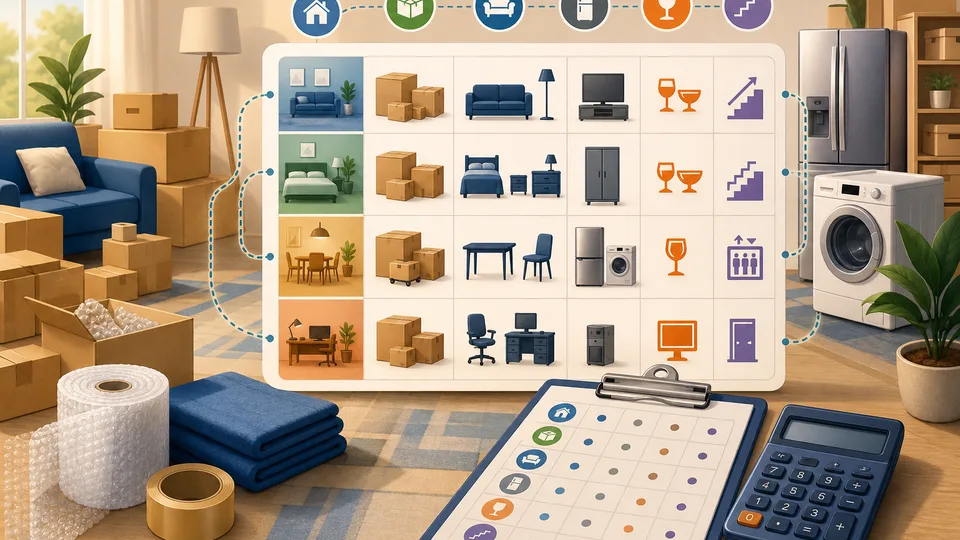
Moving quotes are only as useful as the inventory behind them. If the list of items is vague, the estimate is vague too. A two-bedroom flat with twenty boxes is a different job from a two-bedroom flat with eighty boxes, a piano, awkward stairs, fragile artwork, and a long carry to the van.
A moving inventory is the bridge between “we are moving house” and a plan someone can actually price, schedule, or organise. It does not need to be perfect down to every teaspoon. It does need to capture the things that change labour, packing materials, vehicle space, access difficulty, and contingency.
The Moving Inventory Calculator helps turn room counts, boxes, furniture, appliances, fragile items, access difficulty, distance, manual labour rates, mileage, packing supplies, and buffers into a rough moving plan. This guide explains how to build the inventory before you rely on the numbers.
Why inventory comes before price
A move has two kinds of unknowns: the route and the contents. Distance affects mileage and travel time, but the inventory affects almost everything else. More items mean more packing, loading, unloading, handling, and potential delays.
If you ask for a quote without a clear inventory, the quote may be based on assumptions. Those assumptions can turn into extra charges, rushed packing, too small a vehicle, or a move that takes longer than planned. A good inventory makes the conversation more concrete.
For a broader house-moving cost view, the Moving Cost Calculator is still useful. The inventory calculator is more focused on the item and handling side of the move.
Start room by room
The easiest way to inventory a home is room by room. Start with the big categories in each space: boxes, furniture, appliances, fragile items, awkward items, and items that may need disassembly. Do not start with a single whole-home box count unless you already have everything packed.
Room-by-room counting catches the hidden work. A spare room may contain stored boxes. A loft or garage may hold tools, garden equipment, sports kit, paint tins, or half-forgotten items that still need decisions. A kitchen can contain more small packing work than a bedroom with large furniture.
Use consistent categories. If one room says “small boxes” and another says “boxes”, the total becomes harder to interpret. It is better to use broad but repeated labels than very detailed labels that you abandon halfway through.
Separate boxes from furniture
Boxes and furniture create different moving work. Boxes are usually stackable, countable, and easier to estimate. Furniture affects lifting, space, disassembly, protection, and access. Ten boxes and one wardrobe are not interchangeable just because both are items.
For furniture, note the pieces that are large, heavy, awkward, fragile, or difficult to carry through doorways. Sofas, wardrobes, dining tables, mattresses, desks, bookcases, exercise equipment, and garden furniture deserve separate attention.
If a piece needs to be dismantled, say so. Disassembly and reassembly can add real time. It also changes what tools, bags, labels, and hardware storage you need on the day.
List appliances and heavy items clearly
Appliances can change the move because they may be heavy, awkward, or sensitive to handling. Washing machines, tumble dryers, fridges, freezers, ovens, large televisions, and desktop computers should not be buried inside a general “furniture” total.
Heavy items also affect access planning. A large appliance on the ground floor with parking outside is one job. The same appliance up two flights of stairs with a tight landing is another.
The inventory does not replace professional handling advice. It simply makes the difficulty visible before the quote or self-move plan is built around a false average.
Fragile items need their own line
Fragile items are not just “more boxes”. They need more packing material, more careful loading, and sometimes more time. Glassware, mirrors, framed artwork, lamps, ceramics, instruments, monitors, and sentimental items all deserve a separate count or note.
This matters for a self-move too. If you underestimate fragile packing, the final day becomes a scramble of towels, old newspaper, and rushed decisions. The packing material line exists so you can prepare before the room is full of open boxes.
Do not use the inventory as an insurance valuation. It is a planning list, not a legal record of value or liability. If insurance, liability, or specialist handling matters, that is a separate conversation with the provider.
Access difficulty changes labour
Access is one of the easiest things to forget because it is not an item. Stairs, lifts, parking distance, narrow doors, long carries, shared entrances, loading restrictions, and awkward turns can all increase time.
Two homes with the same inventory can require very different effort if one has easy driveway access and the other requires carrying every item down a stairwell and along a pavement to a loading bay.
When in doubt, describe the access difficulty honestly. It is better to plan for a harder move and finish smoothly than to plan for an easy move that the building does not allow.
Estimate packing materials before packing starts
Boxes are only part of the supply list. Tape, labels, marker pens, bubble wrap, paper, mattress bags, furniture blankets, wardrobe boxes, cable bags, and protective corners may all matter depending on what you own.
The inventory helps because it links materials to item types. More fragile items mean more wrapping. More books mean stronger boxes. More disassembled furniture means labelled hardware bags. More electronics mean cable organisation.
For a wider project-material mindset, the Material Take-Off Calculator is a useful comparison point. A move is not a construction job, but the discipline is similar: count line items, add waste or buffer, and avoid relying on memory.
Add contingency without hiding bad inputs
A contingency buffer is useful because moves contain surprises. But it should not be used to cover a lazy inventory. Add the obvious items first, then add a reasonable buffer for forgotten boxes, extra packing, slower loading, or access delays.
If the buffer is doing too much work, the inventory probably needs another pass. Walk through storage areas, cupboards, lofts, sheds, garages, and utility spaces before assuming the list is complete.
A simple workflow
Start with one room. Count packed boxes if they already exist. If not, estimate boxes by storage volume and item density. Add large furniture and appliances. Add fragile or awkward items. Add access notes. Repeat for each room, then add whole-home materials and contingency.
Once the list is built, enter the totals into the Moving Inventory Calculator. Use the result to sense-check labour time, packing cost, mileage, and buffer before asking for quotes or planning a self-move.
FAQ
Do I need to count every single item?
No. Count the categories that affect moving effort: boxes, furniture, appliances, fragile items, awkward items, rooms, access, packing materials, and distance.
Can this replace a mover quote?
No. It helps you prepare better information. It does not provide live mover prices, supplier availability, insurance cover, legal liability, or booking confirmation.
Should I include items I might sell or donate?
Keep them separate. If they may not move, do not mix them into the core inventory without a note. Otherwise you may overestimate the job.
What should I do after making the inventory?
Use it to compare self-move effort, ask clearer quote questions, prepare packing materials, and spot rooms that need decluttering before moving day.