
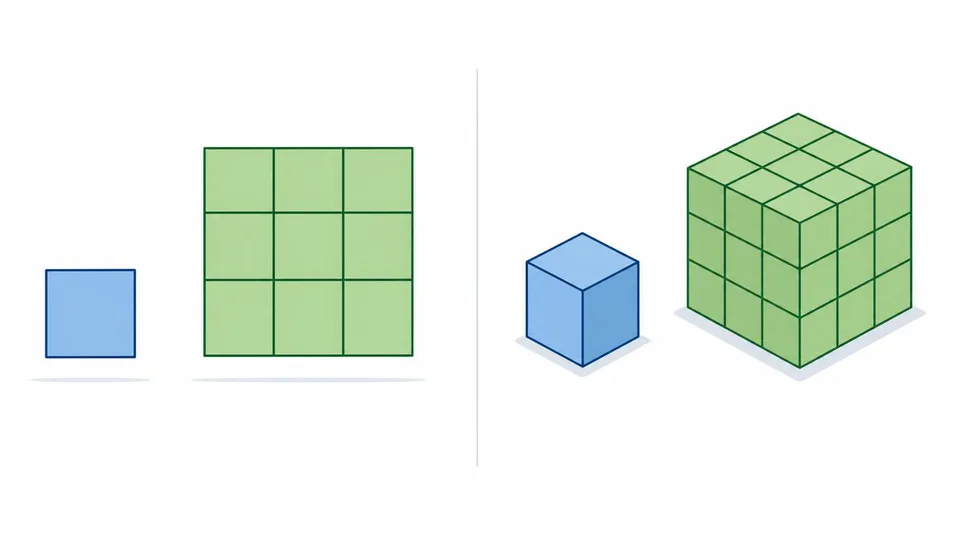
A few years ago I helped a friend plan a garden renovation. He needed to order topsoil for a raised bed and paving slabs for the path alongside it. He had measured the space carefully, written the numbers down, and confidently placed both orders. The paving slabs arrived in exactly the right quantity. The topsoil arrived in a volume that would have filled the raised bed to a depth of about four centimetres — roughly enough to grow cress, not vegetables.
He had calculated the area of the bed correctly. He had then ordered topsoil as if area and volume were the same thing. They are not, and that single confusion cost him a second delivery charge and a week's delay. It is probably the most common practical maths mistake I come across, and it is entirely understandable because area and volume feel related — they are both about size — but they measure fundamentally different things.
What Area Actually Is
Area is a two-dimensional measurement. It tells you how much flat surface a shape covers. When you tile a kitchen floor, paint a wall, or lay turf in a garden, you are dealing with area. The result is always in squared units — square metres, square feet, square centimetres — because you are multiplying two lengths together.
The simplest example is a rectangle. If a room is 5 metres wide and 4 metres long, its floor area is 5 × 4 = 20 m². That is the number you give to the flooring supplier. It is not 20 metres (that would be a length) and it is not 20 cubic metres (that would be a volume). It is 20 square metres: a flat surface measurement.
Different shapes use different formulas, but the logic is the same in each case. For a circle, area = π × r², where r is the radius. A circular patio with a 3 metre radius covers π × 9 ≈ 28.3 m². For a triangle, area = (base × height) ÷ 2 — a triangular flower bed with a 4 metre base and 3 metre height covers (4 × 3) ÷ 2 = 6 m². The formula changes, but the output is always a flat surface quantity measured in squared units.
If you are working out area for a project right now, the area calculator handles rectangles, circles, triangles, trapezoids, parallelograms, and ellipses, and converts the result into nine different area units automatically.
What Volume Actually Is
Volume is a three-dimensional measurement. It tells you how much space a shape occupies — or how much it can hold. When you fill a bath, mix concrete, or order topsoil, you are dealing with volume. The result is always in cubed units — cubic metres, cubic centimetres, litres — because you are multiplying three lengths together.
The simplest example is a box (mathematically, a cuboid). If a raised garden bed is 2 metres long, 1 metre wide, and 0.4 metres deep, its volume is 2 × 1 × 0.4 = 0.8 m³. That is how much topsoil you need to fill it completely. Not 0.8 square metres — that is the floor area of the base. Not 0.8 metres — that makes no sense at all. It is 0.8 cubic metres: a three-dimensional capacity measurement.
For a cylinder — a water butt, a storage tank, a concrete column — volume = π × r² × height. A cylindrical water butt with a 0.3 metre radius and a 1 metre height holds π × 0.09 × 1 ≈ 0.283 m³, which is 283 litres. For a sphere, volume = (4/3) × π × r³. For a cone or pyramid, the formula is one-third of the equivalent prism — which is why cones feel surprisingly small compared to cylinders of the same dimensions.
The volume calculator covers all six common 3D shapes and converts the result directly into litres, gallons, cubic feet, and more — which is particularly useful when you are ordering materials quoted in one unit but measuring in another.
Where the Confusion Actually Starts
The core of the confusion is that calculating volume usually starts with an area calculation. To find the volume of a box, you find the area of the base (length × width) and then multiply by the height. Because the first step looks identical to finding the area of a rectangle, it is easy to stop one step too early and assume the job is done.
Units are the clearest signal that something has gone wrong, but they are easy to ignore when you are focused on the numbers. Area answers end in ² (m², ft², cm²). Volume answers end in ³ (m³, ft³, cm³). If you are ordering topsoil and your answer does not have a ³ on it, you have calculated area, not volume.
The other common trigger is language. People talk about the size of a room in square metres when they mean its floor area, and the size of a container in litres when they mean its volume. Both feel like measures of bigness, so the brain files them together. But paint coverage is quoted in m² per litre (area), while concrete is quoted in m³ (volume). Mixing those up at the ordering stage leads to either a very thin layer of concrete or an enormous pile of leftover paint.
A Practical Example: The Swimming Pool Problem
Swimming pools are probably the scenario where I see this mistake most vividly. Someone is replacing a pool liner and simultaneously trying to work out how long the pool will take to fill with a hose.
These are two completely separate calculations. The liner covers the inside surface of the pool — the floor, the walls, the curved corners — so you need the surface area of the pool's interior in square metres to size the liner correctly. The water fills the interior space, so you need the volume of the pool in cubic metres (or litres) to calculate fill time.
A rectangular pool that is 8 metres long, 4 metres wide, and 1.5 metres deep has a floor area of 32 m² — but that is only the floor. The total interior surface area, including the walls, is 32 + 2(8 × 1.5) + 2(4 × 1.5) = 32 + 24 + 12 = 68 m². The volume is 8 × 4 × 1.5 = 48 m³, which is 48,000 litres. At a standard garden hose flow rate of around 1,000 litres per hour, filling it takes roughly 48 hours. These two numbers — 68 m² and 48 m³ — look completely different and serve completely different purposes, yet they describe the same physical object.
Why the Units Tell You Everything
I find that the fastest way to catch a mixed-up calculation is to track the units through the problem rather than just the numbers. If you are multiplying metres by metres, your answer is in m². If you then multiply by another metres measurement, it becomes m³. The moment you see m³ in a context where you expected m² (or vice versa), something has gone wrong.
This sounds pedantic, but it is genuinely the most reliable error-checking method available without a calculator. Physicists and engineers call it dimensional analysis, but the underlying idea is simple: the units have to make sense. You cannot add m² to m³ any more than you can add apples to square apples.
It also helps to sanity-check the scale of the answer. A room that is 5 × 4 metres has an area of 20 m². If you calculated 2,000 m², something is obviously wrong. A fish tank that is 60 cm × 30 cm × 30 cm has a volume of 0.054 m³ or 54 litres. If your answer came out as 54 m³, that would be larger than a shipping container — also obviously wrong.
Getting the Calculation Right First Time
The practical habit that prevents most area-volume confusion is asking a simple question before you start: am I covering a surface, or am I filling a space? Covering a surface (flooring, paint, turf, liner) means area. Filling a space (topsoil, concrete, water, gravel) means volume.
Once you know which you need, the formulas are not complicated. For most everyday shapes — rooms, tanks, beds, paths — the rectangle and cuboid formulas (length × width for area; length × width × height for volume) will get you there. For circular or irregular shapes, the formulas require a little more care, but the principle is the same.
Both the area calculator and the volume calculator are worth bookmarking if you do any practical measuring work. They handle the formula selection and unit conversion, which removes two of the most common sources of error — using the wrong formula for the shape, and converting between unit systems manually at the end.
My friend with the raised bed has since ordered topsoil correctly twice. He told me the second time that he just imagined the soil sitting in the bed and asked himself whether he needed to know how big the bottom was or how much stuff he was putting in it. Area or volume. Two-dimensional or three-dimensional. That one question was enough.