
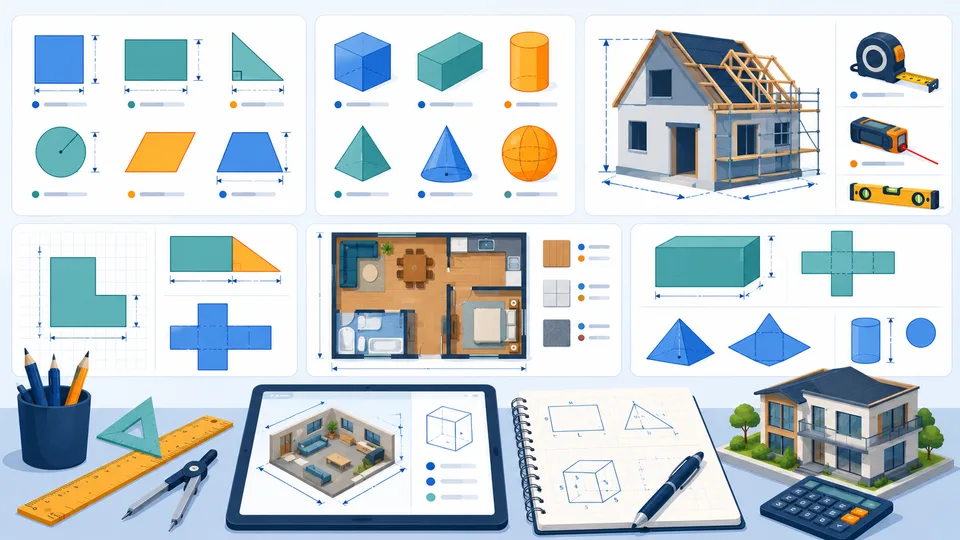
Geometry Usually Becomes Useful Once Measurements Become Real
I've needed geometry more in real life than I expected — measuring spaces, ordering materials, planning layouts — and every time it comes up I'm glad I understand how the calculations actually work. A lot of people remember geometry as abstract formulas from school, but practical measurement problems appear constantly in everyday life.
Area, perimeter and volume calculations influence:
- construction projects
- DIY planning
- property layouts
- packaging
- storage planning
- paint coverage
- material estimation
I think geometry starts making much more sense once shapes stop feeling theoretical and begin representing real physical space.
Area And Volume Are Frequently Confused
One of the most common geometry mistakes is mixing up area and volume.
Area measures two-dimensional space:
- flooring
- walls
- surfaces
- land size
Volume measures three-dimensional space:
- containers
- rooms
- liquids
- storage capacity
This confusion becomes surprisingly expensive in practical situations like construction or material ordering.
Supporting article:
How Area And Volume Get Confused
Small Measurement Errors Can Create Large Problems
Geometry calculations often appear straightforward until measurement errors start compounding.
Even small mistakes in:
- dimensions
- unit conversions
- scale interpretation
- surface calculations
can produce surprisingly large financial or practical consequences.
One thing that surprised me when looking at renovation and construction examples was how often relatively small measuring mistakes created material shortages, waste or layout problems later.
Supporting articles:
Area Calculations Appear Constantly In Everyday Life
Area calculations are used far more often than many people realise.
Examples include:
- flooring installation
- paint estimation
- gardening layouts
- property sizing
- fabric cutting
- roofing work
Rectangles are usually straightforward, but irregular spaces often require splitting areas into smaller shapes before combining totals together.
Supporting article:
How To Calculate Room Area Correctly
Volume Changes Faster Than People Expect
One interesting thing about volume is how quickly it grows when dimensions increase.
Doubling dimensions does not simply double volume.
Because volume operates in three dimensions, increases compound much faster than many people intuitively expect.
This matters in:
- storage planning
- shipping
- construction
- water tanks
- packaging
- material estimation
Supporting article:
Surface Area vs Volume Explained
Unit Conversions Quietly Cause Many Mistakes
A lot of geometry problems are not caused by formulas themselves but by inconsistent units.
Confusion between:
- metres and centimetres
- square units and cubic units
- metric and imperial systems
- litres and cubic measurements
creates many avoidable errors.
Supporting article:
Why Unit Conversions Cause Mistakes
Paint, Flooring And Materials Depend On Geometry
Many DIY and renovation projects are essentially geometry problems in disguise.
Estimating:
- paint coverage
- tile quantities
- flooring materials
- wallpaper
- concrete volume
all rely on measurement accuracy.
One thing that becomes obvious quickly in practical projects is that underestimating materials creates delays while overestimating creates unnecessary waste and cost.
Supporting article:
How Much Paint Do You Really Need?
Scale And Proportion Affect Real-World Design
Scale and proportion are important because dimensions do not always behave intuitively once objects become much larger or smaller.
This affects:
- architecture
- engineering
- maps
- model building
- 3D design
- space planning
Supporting article:
Why Scale And Proportion Matter
Useful Calculators For Geometry & Measurement
Geometry becomes much easier to apply once measurements can be visualised and calculated consistently.
- Area Calculator
- Volume Calculator
- Surface Area Calculator
- Perimeter Calculator
- Paint Coverage Calculator
- Concrete Calculator
- Unit Conversion Calculator
These tools are most useful when paired with careful measurement and realistic practical assumptions.
Practical Geometry Is Mostly About Understanding Space
One interesting thing about geometry is that confidence usually grows once people begin thinking visually about shapes and dimensions rather than memorising formulas mechanically.
Most real-world geometry problems come down to understanding:
- space
- scale
- proportion
- measurement relationships
- dimensional change
The formulas themselves often become easier once the physical meaning behind them feels intuitive.
Where To Start
If geometry and measurement calculations feel confusing, start with simple real-world examples before worrying about more advanced formulas.
Focus first on:
- basic shapes
- area vs volume
- measurement accuracy
- unit consistency
- scale and proportion
- practical estimation
The supporting articles and calculators throughout this guide are designed to help make geometry and measurement feel more practical, visual and useful instead of purely academic.