
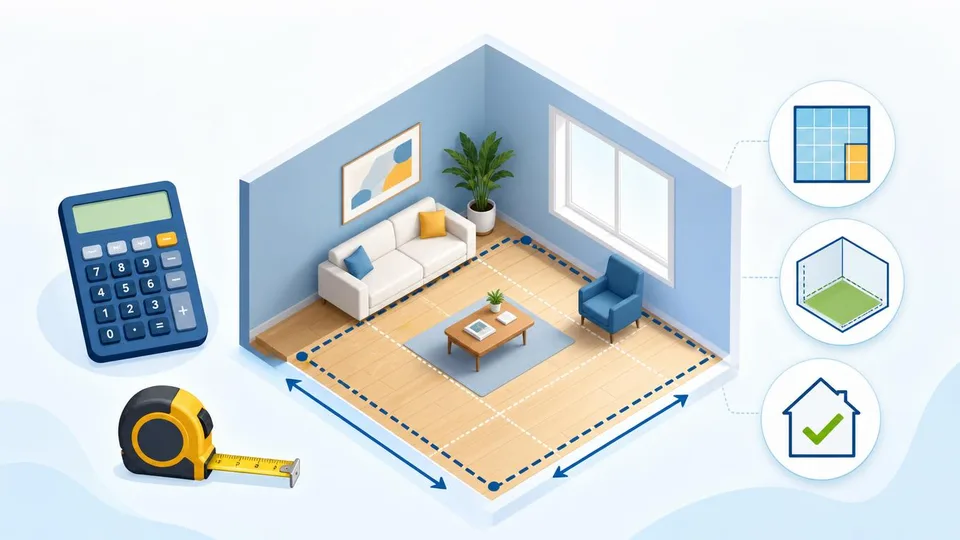
Measuring room area correctly is one of those tasks that looks simple until you're actually doing it. I've been caught out before: I ordered carpet for a bedroom, picked up the wrong measurement from my notes, and ended up two square metres short. That error cost me a second trip to the shop, a week's delay, and a batch number mismatch between orders. Getting room area right before buying any material is worth taking seriously.
The Basic Formula
For a simple rectangular room, floor area is length × width. A room measuring 4.5 metres long and 3.8 metres wide has an area of 17.1 m². That's the figure you need for carpet, hard flooring, underfloor heating, and floor tiles. Wall area requires more calculation because you're working with four separate rectangles and then subtracting the openings.
Always measure in a single unit throughout — mixing metres and centimetres is the most common cause of errors. For floor area, measure the longest straight dimension parallel to one wall, then the perpendicular dimension. Do this twice from different starting points and take the average if the room isn't perfectly square. Old houses rarely are.
Measuring Wall Area
For each wall, multiply its width by the ceiling height to get the gross wall area. Then subtract the openings. A standard UK internal door is typically 0.76 m wide by 1.98 m high — about 1.5 m². A typical double window might be 1.2 m × 1.0 m = 1.2 m². Subtract these from the gross total to get the net paintable or wallpaperable surface.
Example: living room 5 m × 4 m, 2.4 m ceilings, one door (1.5 m²), two windows (2.4 m² total).
- Two 5 m walls: 2 × (5 × 2.4) = 24.0 m²
- Two 4 m walls: 2 × (4 × 2.4) = 19.2 m²
- Gross wall area: 43.2 m²
- Minus openings: 43.2 − 1.5 − 2.4 = 39.3 m²
For two coats of paint at 10 m² per litre: 39.3 × 2 ÷ 10 ≈ 7.9 litres. A 5-litre and a 2.5-litre tin covers this comfortably.
L-Shaped and Irregular Rooms
An L-shaped room is just two rectangles joined together. Divide it mentally at the internal corner, calculate each rectangle separately, then add them. Our area calculator handles all standard shapes and lets you add or subtract sections to work out complex room layouts. For a room with a bay window that extends outward, add the bay's floor area to the main rectangle. For a chimney breast that intrudes into the room, subtract its footprint from the floor area.
For irregular rooms — those with angled walls or odd corners — break the floor plan into standard shapes: rectangles, right-angled triangles, and quarter-circles. Calculate each piece separately, add all the pieces together, and you have the total floor area.
Flooring Calculations
For hard flooring — tiles, laminate, engineered wood — add 10% to the calculated floor area to account for cuts, waste, and the inevitable tile that cracks during installation. A 17.1 m² room needs about 18.8 m² of flooring material. For pattern-matched flooring or herringbone layouts, increase the waste allowance to 15%.
For tiles specifically, work out how many tiles you need: divide the adjusted floor area by the tile area. A 60 cm × 60 cm tile covers 0.36 m². For 18.8 m²: 18.8 ÷ 0.36 = 52 tiles, round up to 58 including waste. Always order in full boxes and verify the box quantity before placing the order — you cannot always return opened boxes.
Ceiling Area
For a flat ceiling in a rectangular room, ceiling area equals floor area. If the ceiling has a coffer, beam, or slope, the surface area is greater — measure the actual ceiling surface directly rather than assuming it matches the floor plan. A vaulted ceiling over a 4 m × 5 m room can have 30–50% more surface area than the floor, depending on the pitch.
Converting Between Units
Property floor plans may use square feet; builders may work in metres; tile catalogues often specify dimensions in millimetres. The conversion: 1 m² = 10.764 sq ft. A 17.1 m² room is about 184 sq ft. Convert everything to a single unit before doing any arithmetic. This takes thirty seconds and prevents the kind of mistake that only becomes visible when a delivery arrives and the quantities don't add up.
The Margin That Saves Trips
Whatever material you're ordering, build in a margin. Round paint up to the next full tin size. Add 10% for most flooring and 15% for complex patterns. For tiles, add 10–15% depending on layout complexity and always keep a few spare tiles in the same batch for future repairs. The cost of surplus material is small compared to the cost of running short mid-project — waiting for a reorder, dealing with batch colour variation, or paying express delivery charges.
Why Old Houses Resist Neat Measurements
Modern new-builds are typically built to tight tolerances — walls are plumb, corners are square, and a room described as 4.2 m × 3.6 m is genuinely close to those dimensions. Older properties, particularly Victorian and Edwardian terraces, are a different story. Walls settle over decades, floors are rarely level, and what looks like a right-angle corner might be 88 or 92 degrees. These deviations are usually small, but they compound across a room.
A useful check for any room where you're suspicious of the squareness: measure both diagonals. In a truly rectangular room, both diagonals are equal. If one diagonal is longer than the other by more than a centimetre or two, the room is out of square, and materials cut to a straight line won't fit cleanly against the wall at both ends. For flooring and tiling, this matters significantly — the installer will need to scribe or cut at an angle to account for the deviation, which increases waste and affects the final appearance. Flagging this before materials are ordered rather than after the first row is laid prevents a common and frustrating mid-job surprise.