
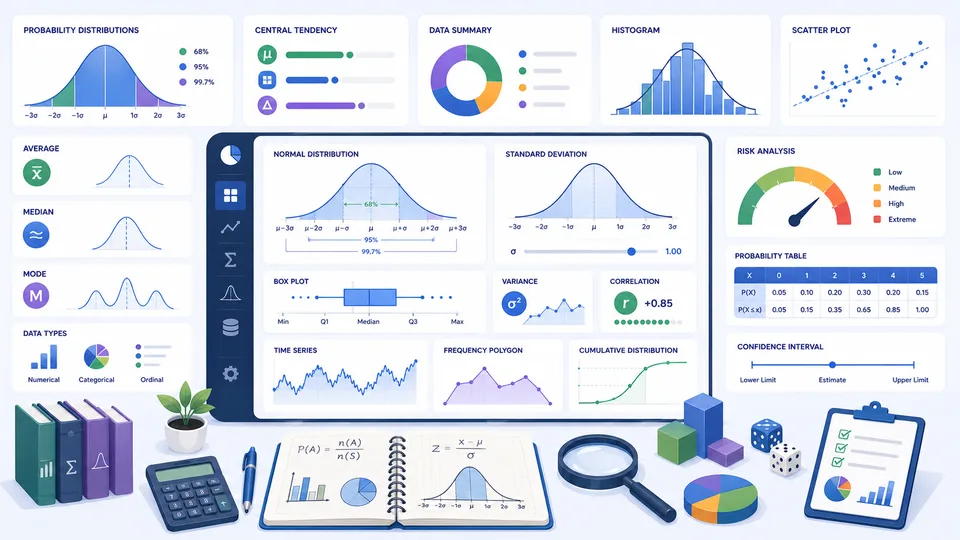
Statistics Often Feel More Certain Than They Really Are
I've always thought statistics feel more intimidating than they really are — the underlying logic is usually straightforward once you stop treating the numbers as the point. One reason statistics can feel intimidating is that numbers appear objective. Percentages, averages and charts look precise, which creates the impression that the conclusions behind them must also be precise.
But interpretation matters just as much as calculation.
Two people can look at the same dataset and walk away with very different conclusions depending on:
- which averages are used
- which comparisons are highlighted
- how graphs are presented
- which context gets omitted
- how probability is framed
I think this is why statistics can sometimes feel strangely persuasive even when the underlying information is incomplete or misleading.
This guide connects practical articles and calculators covering averages, probability, risk and data interpretation in a more grounded and understandable way.
Why Averages Can Quietly Distort Reality
Averages are useful, but they also hide variation extremely well.
For example, an “average salary” or “average score” may technically be correct while describing very few real people accurately.
Different types of averages can produce completely different impressions:
- mean
- median
- mode
One thing that surprised me when first comparing statistical summaries was how easily large outliers could distort the mean while the median stayed relatively stable.
Supporting articles:
Probability Is Often Confused With Certainty
A lot of people interpret probability emotionally rather than mathematically.
Events with low probability still happen regularly across large populations. Meanwhile high-probability outcomes can still fail unexpectedly in individual cases.
This is one reason risk discussions become difficult in areas like:
- health
- finance
- weather
- sports
- investing
- AI forecasting
Probability is really about likelihood rather than guarantees.
Supporting articles:
- Probability Vs Possibility
- Understanding Risk, Probability & Uncertainty
- How To Calculate Probability
Small Sample Sizes Create Surprisingly Bad Conclusions
One of the most common statistical problems online is drawing strong conclusions from tiny datasets.
A few examples, reviews or observations can easily create patterns that feel convincing without actually representing broader reality.
I think social media amplifies this problem because emotionally memorable examples spread faster than careful statistical reasoning.
Related article:
Why Small Sample Sizes Create Bad Conclusions
Graphs Can Change Perception Without Changing Data
Charts and graphs look neutral, but presentation choices strongly influence interpretation.
The same data can appear:
- dramatic
- stable
- threatening
- encouraging
depending on:
- axis scaling
- time range
- visual emphasis
- comparison choices
- truncated baselines
Once you notice this, it becomes difficult to look at graphs the same way again.
Supporting article:
How Misleading Graphs Change Perception
Correlation Does Not Automatically Mean Causation
This phrase gets repeated constantly in statistics discussions, but it remains one of the most important concepts to understand.
Two variables moving together does not automatically prove one causes the other.
Sometimes:
- both variables are influenced by something else
- the relationship is coincidence
- the data sample is too small
- the trend disappears over time
This becomes especially important when interpreting headlines, online studies and viral statistics claims.
Supporting article:
Correlation Does Not Mean Causation
Standard Deviation Explains Why “Average” Is Incomplete
Averages alone rarely describe how spread out or consistent a dataset actually is.
Two groups may share the same average while behaving completely differently in practice.
Standard deviation helps explain:
- consistency
- variation
- volatility
- distribution spread
This is one reason standard deviation appears so frequently in:
- finance
- science
- sports analytics
- quality control
- risk analysis
Supporting article:
Standard Deviation Explained Simply
Percentages Often Feel More Dramatic Than Raw Numbers
Percentages are extremely useful, but they can also distort emotional perception.
A “100% increase” sounds dramatic even if the underlying numbers are tiny. Meanwhile large absolute changes can sound modest when expressed differently.
I noticed this myself while comparing financial and media headlines. The framing of percentages often influences emotional reactions more than the underlying scale itself.
Supporting article:
How Percentages Distort Perception
Useful Calculators For Statistics And Probability
Practical calculators can help make statistical concepts feel less abstract and easier to visualise.
- Standard Deviation Calculator
- Probability Calculator
- Mean Median Mode Calculator
- Percentage Calculator
- Variance Calculator
- Ratio Calculator
The most useful calculations are usually the ones that improve understanding rather than simply producing numbers faster.
Where To Start
If statistics currently feel confusing or intimidating, start by focusing on interpretation rather than memorising formulas.
Ask:
- what is actually being measured?
- how large is the sample?
- which average is being used?
- what context might be missing?
- does the graph exaggerate perception?
- is probability being confused with certainty?
Those questions alone improve statistical understanding more than many people realise.
The supporting articles and calculators throughout this hub are designed to help make probability, averages and data interpretation feel more practical and less intimidating over time.