
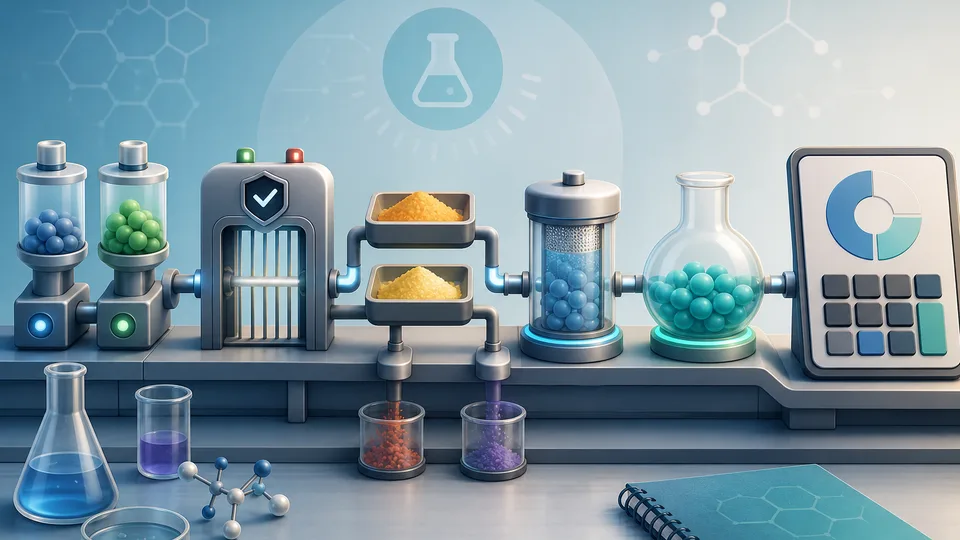
Reaction yield is the gap between what chemistry predicts and what a real reaction actually produces. It is one of the most useful checks in stoichiometry because it forces you to compare the theoretical product amount with the actual amount collected.
The calculation sounds simple, but mistakes build quickly when limiting reagents, unit conversions, purity, losses, and percent yield are mixed together. A good yield calculation starts before the final percentage.
If you already know theoretical and actual yield, use the reaction yield calculator. This guide explains what those inputs mean, how limiting reagent thinking fits in, and why a yield result should be read as a practical comparison rather than a perfect measure of lab skill.
The short version
Percent yield compares actual yield with theoretical yield. Divide actual yield by theoretical yield, then multiply by 100. If the actual yield is lower than theoretical yield, the percent yield is below 100%. If it appears above 100%, something needs checking.
Theoretical yield is the maximum product predicted from the balanced reaction and available reactants. Actual yield is what was obtained or measured. Percent yield shows how close the actual result came to the theoretical maximum.
Theoretical yield comes first
You cannot interpret actual yield without a theoretical comparison. Theoretical yield depends on stoichiometry, molar amounts, molar masses, and the limiting reagent. It is not just the amount of reactant you started with.
Start from the balanced chemical equation. Convert reactant masses to moles if needed. Use mole ratios from the equation to work out how much product could form. Then convert product moles to the unit needed for comparison, usually grams.
If the theoretical yield is wrong, the percent yield will also be wrong. The final percentage can look tidy while hiding an earlier stoichiometry mistake.
Limiting reagent controls the maximum
In many reactions, one reactant runs out first. That reactant is the limiting reagent. It controls how much product can form, even if other reactants remain unused.
For yield calculations, this matters because theoretical yield must be based on the limiting reagent, not the most convenient or largest starting amount. If you base the theoretical yield on an excess reagent, you overstate what the reaction could realistically produce.
That error makes the percent yield look artificially low. The lab result may not be poor; the theoretical comparison may simply be based on the wrong reactant.
Actual yield is a measured result
Actual yield is the amount of product obtained after the reaction and any workup steps. It reflects the real process: incomplete reaction, side reactions, transfer losses, filtration losses, evaporation, measurement uncertainty, and product purity.
Because actual yield is measured, it can include practical issues that the theoretical calculation ignores. That is the point. Yield compares an ideal prediction with a real outcome.
Use the same unit basis for actual and theoretical yield. Do not compare grams with moles unless one has been converted. Do not compare wet product mass with dry theoretical mass without considering moisture or solvent.
Why yields can be below 100%
Most real reactions produce less than the theoretical maximum. Some reactant may not react. Some product may be lost during transfer, washing, drying, or separation. Some material may form side products. Some product may remain dissolved or mixed with impurities.
A low yield does not identify the cause by itself. It is a signal to inspect the reaction conditions and measurement process. The calculation tells you the size of the gap, not the whole story behind it.
Why yields above 100% need checking
A percent yield above 100% usually means the measured product contains extra mass or the theoretical yield was underestimated. Moisture, solvent, impurities, weighing errors, incorrect molar mass, and limiting reagent mistakes are common causes.
There are rare contexts where apparent yields need special interpretation, but for ordinary stoichiometry work, above 100% should trigger a check rather than celebration.
Where molar mass and molarity fit
Yield calculations often need supporting chemistry tools. Use the molar mass calculator when converting between grams and moles. Use the molarity calculator when solution concentration is part of the setup. Those calculations usually happen before the final reaction yield comparison.
Keeping each step separate helps. Molar mass converts substance amount. Stoichiometry predicts theoretical yield. The yield calculator compares theoretical and actual outcomes.
Common mistakes
The first mistake is using the wrong limiting reagent. The second is mixing grams and moles. The third is rounding too early in a multi-step calculation. Keep intermediate values with enough precision, then round the final result appropriately.
Another mistake is treating percent yield as a purity test. Yield and purity are related in practice, but they are not identical. A large mass of impure product can produce a misleadingly high apparent yield.
A worked way to organise the calculation
Think of the yield calculation as three separate benches. The first bench converts the starting materials into moles and identifies the limiting reagent. The second bench uses the balanced equation to predict the theoretical product amount. The third bench compares that theoretical amount with the actual product collected.
Keeping those benches separate prevents a common shortcut mistake: taking the product mass from the experiment and dividing it by a reactant mass from the start. That ratio may be interesting in another context, but it is not percent yield unless the denominator is the theoretical product yield.
The calculator belongs at the comparison bench. It works best when the theoretical yield has already been calculated on the correct stoichiometric basis and the actual yield has been cleaned up into the same unit.
Purity and drying affect interpretation
A product that is still wet, contaminated, or mixed with unreacted material can weigh more than the pure dry product. That extra mass can push the apparent yield upward and make the reaction look better than it was.
On the other hand, aggressive washing, transfer losses, or incomplete collection can reduce measured actual yield even when the chemical conversion was reasonable. Percent yield is therefore a useful diagnostic number, but it should be read alongside notes about collection, drying, and purity.
A final sense-check is to compare the result with ordinary expectations. A very low yield should make you review limiting reagent, product loss, and whether the reaction completed. A value near or above 100% should make you review moisture, impurities, and the theoretical yield basis.
It is also worth recording where each number came from. Theoretical yield comes from stoichiometry. Actual yield comes from measurement. If those sources are blurred, later review becomes difficult and the final percentage is harder to trust.
That record also makes the calculator result easier to defend. Instead of presenting a percentage alone, you can show the chain of assumptions that produced the theoretical yield and the measurement that produced the actual yield.
A reliable workflow
Balance the equation. Convert reactants to moles. Identify the limiting reagent. Calculate theoretical product amount. Convert theoretical yield to the same unit as the actual yield. Measure or enter actual yield. Then calculate percent yield and interpret whether the result is plausible.
That order keeps the chemistry honest. Percent yield is only the final comparison. The meaningful work is making sure the theoretical and actual quantities are describing the same product on the same basis.