
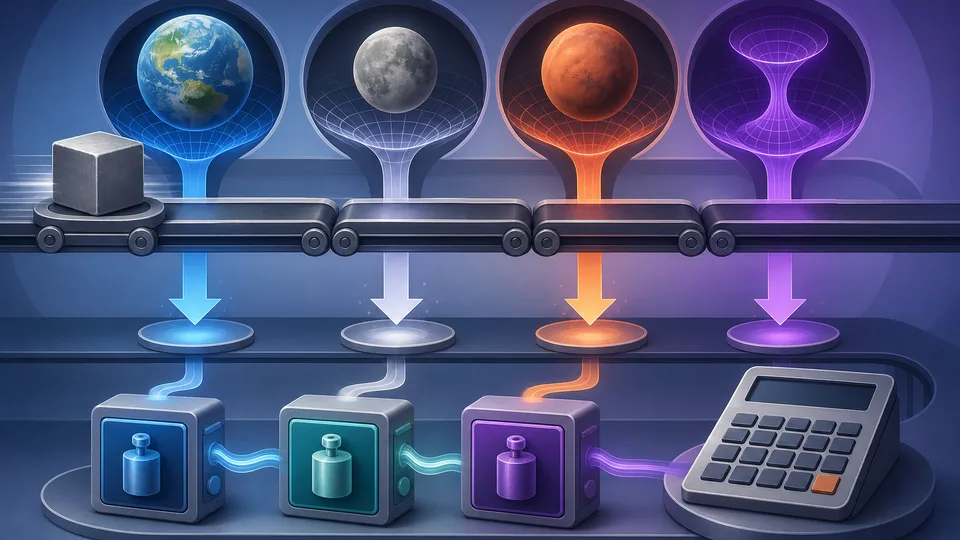
Weight and mass are often used as if they mean the same thing, but in physics they describe different ideas. Mass is the amount of matter in an object. Weight is the force on that mass caused by gravity.
That difference is why the same object can have the same mass on Earth, the Moon, Mars, or Jupiter while having a different weight force in each place. The object has not changed. The gravitational field acting on it has changed.
If you already have mass and a local gravity value, use the weight gravity force calculator to calculate weight force. This guide explains what the calculator is doing, why kilograms and newtons should not be mixed up, and how to interpret planet comparisons without turning the result into a body-weight discussion.
The short version
The relationship is simple: weight force equals mass multiplied by gravitational acceleration. In symbols, that is often written as W = m g. Mass is usually measured in kilograms. Gravitational acceleration is usually measured in metres per second squared. Weight force is measured in newtons.
On Earth, standard gravity is commonly approximated as 9.81 m/s². A 10 kg object therefore has a weight force of about 98.1 newtons on Earth. On the Moon, where gravity is much weaker, the same 10 kg object has far less weight force even though its mass is still 10 kg.
Mass stays with the object
Mass is an intrinsic property. If you move a toolbox from Earth to the Moon, the amount of matter in the toolbox does not change. It still has the same inertia, which means it resists changes in motion by the same amount.
This is why mass belongs in kilograms. Kilograms do not measure how hard gravity pulls on something. They measure the amount of matter, or more practically, the quantity that determines how difficult the object is to accelerate.
In everyday speech, people often say they weigh a certain number of kilograms. That phrasing is familiar, but in physics it is imprecise. The calculator keeps the terms separate so a force result does not get mistaken for a mass result.
Weight changes with gravity
Weight is a force, and force depends on the gravitational field. If gravity is stronger, the same mass experiences a larger weight force. If gravity is weaker, the same mass experiences a smaller weight force.
That is why planet comparisons are useful. They reveal the role of gravity without changing the mass. The comparison is not saying the object becomes physically smaller or larger. It is showing how strongly that location pulls on the object.
The same idea applies beyond planets. A custom gravity value may be used in physics examples, engineering estimates, or simulations. The calculation is still mass times gravity.
Newtons are the force unit
A newton is the force needed to accelerate one kilogram of mass at one metre per second squared. That definition connects force, mass, and acceleration directly.
When the calculator returns newtons, it is returning force. That force might be the downward force on a hanging object, the load a support must resist, or the gravitational force used in a basic mechanics problem.
Do not read newtons as kilograms. A force of 98.1 newtons near Earth corresponds to the weight force of a 10 kg mass under standard gravity, but 98.1 is not the mass.
Why local gravity matters
Earth gravity is not perfectly identical everywhere, and many physics problems use rounded values. Some use 9.8 m/s², some use 9.81 m/s², and some use 10 m/s² for mental arithmetic. The difference is usually small, but the input should match the precision expected by the task.
For classroom or estimation work, a rounded gravity value is often fine. For a more controlled calculation, use the gravity value specified by the problem. The calculator lets the gravity input be explicit so the assumption is visible.
Where this connects to other physics tools
Weight force is one piece of mechanics. If the question asks how motion changes over time, use the acceleration kinematics calculator. If it asks about energy from mass and velocity, use the kinetic energy calculator. If it asks about straight-line speed, distance, and time without acceleration, use the speed distance time calculator.
The boundary is important. Weight force is about gravity acting on mass. It is not a full free-body diagram, friction model, torque calculation, or structural design check.
Common mistakes
The first mistake is entering a weight stated in everyday kilograms as if it were already a force. If the value is a mass, treat it as mass. If the value is force, it should be in newtons or another force unit.
The second mistake is changing both mass and gravity during a planet comparison. To compare locations, keep mass fixed and change gravity only. Otherwise, you are changing two things at once and the comparison loses meaning.
The third mistake is forgetting direction. Weight force points toward the body creating the gravitational field. In simple calculations the calculator gives the magnitude, but in vector problems the direction may matter too.
A worked way to think about the inputs
Imagine you are comparing a 25 kg equipment case in several gravity fields. The mass is 25 kg in every case. On Earth, multiply 25 by about 9.81 to get roughly 245 newtons. On the Moon, multiply the same 25 kg by the Moon gravity value and the force is much lower. On Mars, it lands between those two examples.
The useful part of this comparison is that only one input changes. Mass stays fixed. Gravity changes. Weight force responds to the gravity value. That is exactly the relationship the calculator is designed to show.
If you are checking homework or a practical estimate, write the gravity value next to the result. A weight force without its gravity assumption is incomplete, because the same mass can produce a different force somewhere else.
Why ordinary scales can make the language messy
Everyday weighing devices often display a mass-equivalent value in kilograms, even though they are responding to force. That is convenient on Earth because the device is calibrated around local gravity. It is not a good reason to erase the physics distinction.
For normal shopping, cooking, and body-weight language, everyday phrasing is fine. For physics calculations, keep the units clean. Kilograms belong to mass. Newtons belong to force. Gravity connects them.
A final sense-check is to compare planets qualitatively. The Moon result should be much smaller than Earth for the same mass. Jupiter should be much larger. If the pattern does not follow the gravity inputs, the mass or unit conversion has probably been entered incorrectly.
That sense-check is especially useful when a calculator offers preset gravity values. Presets make comparison fast, but they should not hide the input. The gravity number is part of the answer, because it explains why the same mass produces a different force in each location.
A reliable workflow
Start by identifying whether the given quantity is mass or force. Convert mass to kilograms if needed. Choose the local gravity value. Multiply mass by gravity to get weight force. Then interpret the result as newtons, not kilograms.
That workflow keeps the physics clean. Mass tells you what the object is. Gravity tells you the field it is in. Weight force tells you how strongly that field pulls on the mass.