
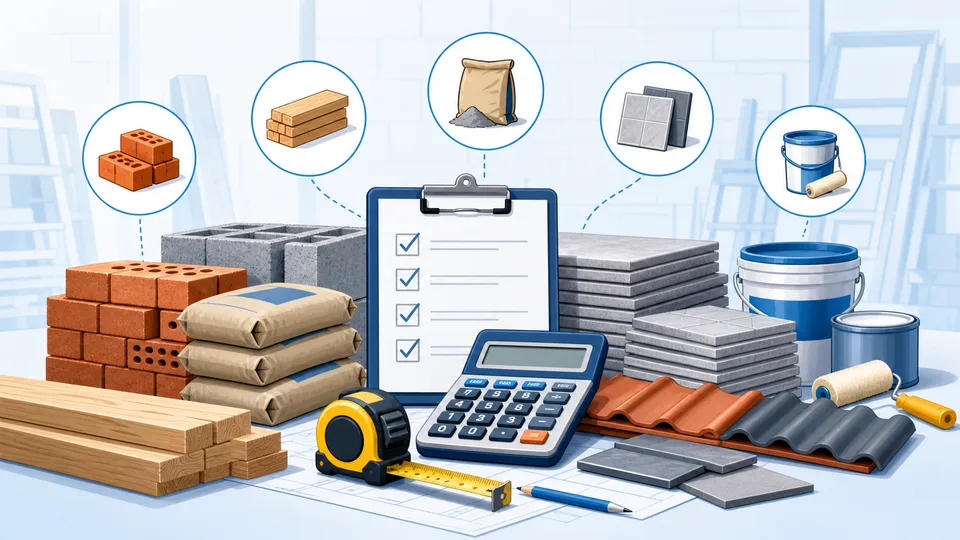
My material orders for home projects were consistently slightly wrong — either too little or too much — before I started using proper calculation methods rather than rough estimates.
Ordering building materials accurately is a skill that separates smooth projects from frustrating ones. Too much and you're paying for waste and storage. Too little and your project stalls while you wait for a re-delivery. Neither scenario is pleasant. Here's the systematic approach to getting quantities right for the most commonly used materials.
The Fundamental Principle: Area or Volume First
Almost all material calculations start from either a surface area or a volume. Get those numbers right first, then apply the coverage rate for your specific material. Our area calculator handles the geometry for any room or surface shape. For volume-based materials like concrete and fill, our concrete calculator works out cubic metres from your dimensions, and our volume calculator handles any 3D shape — cylinders, spheres, and irregular forms.
Bricks
Standard UK brick dimensions: 215mm × 102.5mm × 65mm. With a standard 10mm mortar joint, each brick in a single-leaf wall occupies a face area of 225mm × 75mm = 0.016875 m².
Bricks per m² of single-leaf wall: 1 ÷ 0.016875 ≈ 59 bricks/m². A common rule of thumb used in the industry is 60 bricks per m² of single-leaf wall.
For a wall 3m wide × 2m high = 6 m²: 6 × 60 = 360 bricks. Add 10% wastage for cuts and breakage: 396 bricks. Order 400.
Concrete Blocks
Standard concrete blocks: 440mm × 215mm × 100mm (or 140mm). With 10mm mortar joint, face area per block = 450mm × 225mm = 0.10125 m². Blocks per m² = 1 ÷ 0.10125 ≈ 10 blocks/m². This is the standard rule of thumb. Add 5% wastage.
Timber (Structural)
Timber quantities depend on what you're building. For stud walls: studs are typically placed at 400mm or 600mm centres. A 3m-wide wall at 400mm centres needs: 3 ÷ 0.4 + 1 = 8.5 → 9 studs, plus 2 horizontal plates (top and bottom) at 3m each. Total timber = (9 studs × height) + (2 × 3m). Always add lengths for noggings (horizontal bracing).
For floor joists: span ÷ joist spacing + 1 = number of joists. Standard residential floor joist spacing: 400mm.
Sand and Aggregate
For mortar (bricklaying): approximately 1 bag of cement and 3-4 bags of sand per 200 bricks laid. For concrete: see the dedicated concrete calculator. For hardcore sub-base: volume = area × depth (as m³), with an additional 10-15% compaction factor (hardcore compresses when rolled).
The 10% Rule and Beyond
Standard waste allowances: bricks and blocks 10% | timber 10-15% (cutting waste) | plasterboard 10% | insulation batts 5% | roofing tiles 10-15%.
For any project involving significant cutting (diagonal layouts, complex shapes, lots of openings), increase waste allowances to 15-20%. Getting this wrong in either direction is expensive.
Creating a Materials Schedule
List every material with its quantity, unit, unit price, and total. This is called a materials schedule or Bill of Quantities (BOQ) in professional construction. Even a basic spreadsheet version helps you see the full material cost before ordering anything, identify what you can shop around for on price, and track deliveries against what was ordered.
Further reading: The Federation of Master Builders provides guidance on working with builders and understanding material costs. Visit the Federation of Master Builders for consumer guidance.
Working from a Bill of Materials
For any project involving multiple material types, a bill of materials (BoM) is the most reliable planning tool. List every material required, its specification, the calculated quantity, the unit of purchase, and the total order quantity including waste allowance. This approach prevents omissions and makes it straightforward to get supplier quotes on a like-for-like basis. A missing item discovered mid-project typically causes delay, additional delivery charges, and sometimes compatibility problems if a different batch is substituted.
Waste Factors by Material Type
Different materials waste differently. Bricks: allow 5–10% depending on the amount of cutting. Timber: allow 10–15% for a framed structure. Roofing tiles: 10–15% for cuts at ridges and hips. Floor tiles: 10% for a straight lay, 15–20% for diagonal or complex patterns. Plasterboard: 10% for standard rooms, 15% for rooms with many openings. Ready-mix concrete: 5–10%. Aggregates (gravel, sand): 10–15%. If in doubt, apply 10% as a standard minimum for any material where cutting is required.
Reading Product Specifications Correctly
Coverage and yield figures are usually stated per pack, per board, or per tonne, and can be easy to misinterpret. A bag of cement covering "20m² at 3mm thickness" covers half that area at 6mm thickness. Bricks sold at "500 per cubic metre of brickwork" assume standard UK brick dimensions and 10mm mortar joints — different brick sizes or mortar joints change the count. Always read the specification carefully and, if working with an unfamiliar product, ask the supplier to confirm the coverage before ordering.
Sourcing and Lead Times
Some materials — particularly natural stone, specific timber species, and custom-length structural sections — have significant lead times. For any project with a fixed schedule, confirm lead times when ordering rather than after other trades have started work and are waiting on materials. Similarly, confirm minimum order quantities: some suppliers have minimums that exceed your project requirement, which affects cost per unit and storage requirements on site.