
I've spent time on both sides of the LTV/CAC equation and found that improvements to LTV are almost always more accessible than reductions to CAC — yet most businesses focus their effort on acquisition.
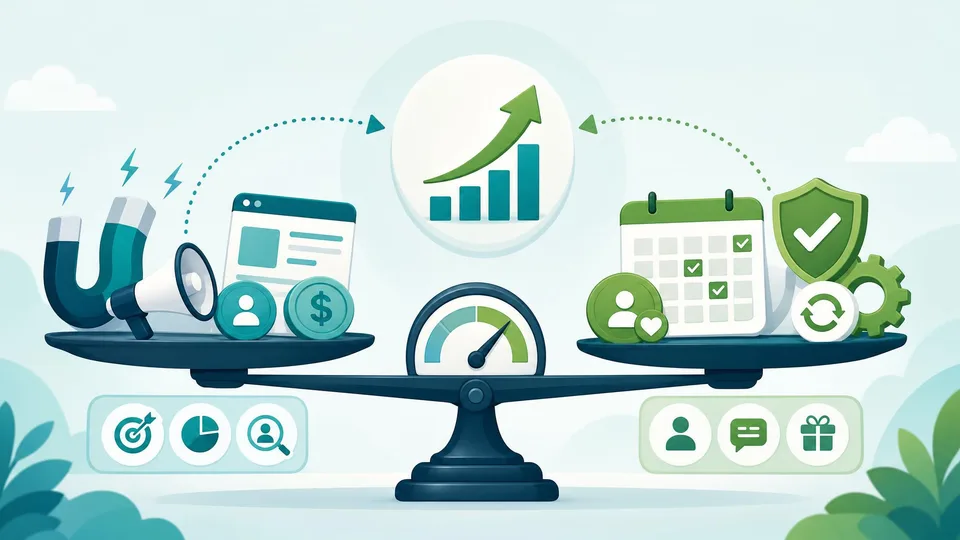
A weak LTV:CAC ratio has two levers: increase LTV or decrease CAC. In practice, both matter, but they have different time horizons and different mechanisms. LTV improvements tend to be structural and slower-moving; CAC reductions can be faster but are often limited by market dynamics. Here is how to work both sides effectively.
Increasing Retention
LTV is a function of three variables: gross margin per customer, average revenue per customer, and how long customers stay. Of these, retention has the largest lever effect because it multiplies the value of every improvement to the other two.
A customer retained for 24 months instead of 18 is worth 33% more, with no change to pricing or margin. Applied across a customer base of 500, moving average lifetime from 18 months to 24 months adds the equivalent of 167 full-lifetime customers to LTV without acquiring a single new one.
The most effective retention improvements address the specific reasons customers leave, which requires measuring churn by cohort and identifying patterns. Customers who churn in the first 90 days are typically failing to achieve the outcome the product promised — an onboarding and activation problem. Customers churning at month 12 or 18 may be hitting a usage ceiling or facing a contract renewal decision — a value communication and expansion problem. Each requires a different intervention.
Practical retention improvements with measurable impact:
- Improved onboarding: Reducing time-to-value in the first 30 days is the single highest-impact retention intervention for most SaaS products. Customers who reach their first meaningful outcome quickly are significantly less likely to churn in the first 90 days.
- Proactive engagement: Identifying low-engagement customers before they decide to cancel — through usage monitoring — and reaching out with targeted support or content, reduces passive churn from customers who drifted away rather than actively decided to leave.
- Annual billing: Offering a discount for annual prepayment increases retention (customers who have paid a year are unlikely to leave mid-year) and improves cash flow simultaneously. The retention improvement alone typically justifies a 10 to 20% discount.
The LTV vs CAC Calculator models the ratio impact of improved retention directly. Enter a reduced monthly churn rate and the calculator recalculates LTV and the resulting ratio — showing the financial value of each percentage point of retention improvement.
Lowering Acquisition Cost
CAC reduction is limited by market reality — you cannot acquire customers for less than the market requires — but most businesses have meaningful room to reduce CAC through channel mix and conversion optimisation before hitting those limits.
Channel mix optimisation: Paid acquisition (Google Ads, LinkedIn, Meta) tends to have the highest and most visible CAC. Organic acquisition (SEO, content, word-of-mouth, product-led growth) has lower marginal CAC at scale because the content investment is fixed while the customer volume it produces compounds over time. Shifting acquisition mix toward organic channels takes longer but produces structurally lower CAC.
Conversion rate improvement: If the same acquisition spend produces more trial sign-ups that convert to paying customers, CAC falls without any reduction in spend. A 25% improvement in trial-to-paid conversion rate reduces CAC by 20%. Conversion improvements typically require A/B testing, onboarding optimisation, and pricing page review — relatively low-cost interventions relative to their impact on unit economics.
Referral and product-led growth: Customers acquired through referral have near-zero CAC and typically higher LTV (referred customers trust the product before they start and tend to retain better). Building referral mechanics into the product — sharing features, referral incentives, network effects — creates an acquisition channel with fundamentally better economics than paid.
Growth Strategies
The highest-impact growth strategy for a business with a strong LTV:CAC ratio is to increase acquisition spend — the economics support it. For a business with a weak ratio, growth acceleration before fixing unit economics is a path to accelerated losses.
A useful decision rule: before increasing acquisition budget, verify that the existing cohorts are achieving the LTV assumed in the ratio calculation. Actual cohort retention data from customers acquired 12 to 18 months ago provides the most reliable LTV estimate. Projected LTV based on early cohort data routinely overstates the final figure because early cohort behaviour is often atypical. Confirm the economics are real in the data before scaling them up in the budget.