
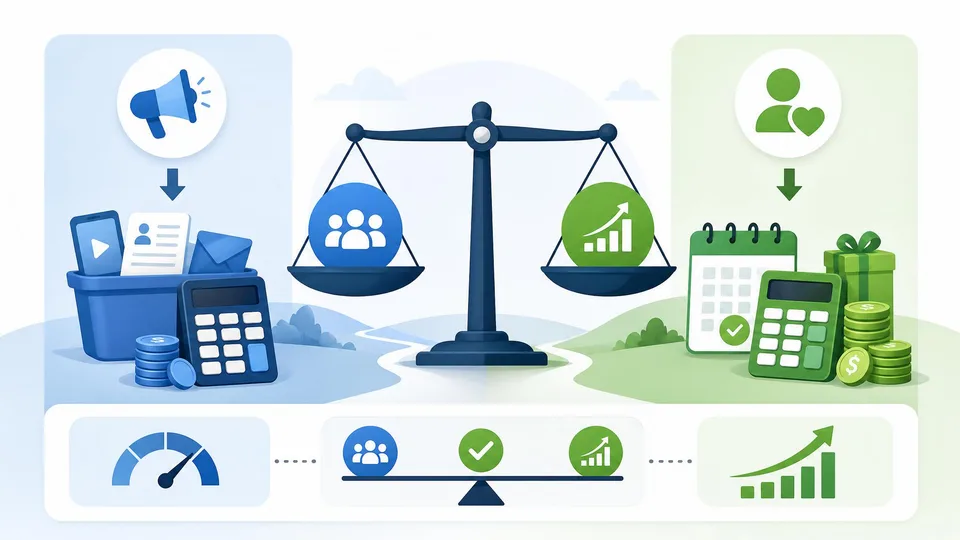
I've seen businesses where the LTV/CAC ratio looked healthy until someone examined the assumptions underneath the lifetime value figure — which is why understanding what the ratio actually measures matters.
LTV and CAC are two of the most important metrics in any subscription or repeat-purchase business, and two of the most commonly misunderstood. Companies that do not track the ratio between them are often growing revenues while destroying value — acquiring customers at a cost that the lifetime relationship will never recover. Getting these numbers right changes how you think about marketing spend, pricing, and growth strategy.
Definitions
Customer Acquisition Cost (CAC) is the total cost of acquiring one new customer. It includes all sales and marketing expenditure — paid advertising, content production, sales team costs, agency fees, event sponsorships, and any other cost incurred specifically to generate and convert new customers — divided by the number of new customers acquired in the same period.
CAC = Total sales and marketing spend / Number of new customers acquired
A business spending £40,000 per month on sales and marketing that acquires 50 new customers has a CAC of £800. This figure should include all relevant costs — a common mistake is including only paid advertising spend while excluding the salary costs of the sales team or the content team that supports acquisition.
Customer Lifetime Value (LTV) is the total gross profit expected from a customer relationship over its full duration. Not total revenue — gross profit. The costs of delivering the service must be subtracted, because LTV is a measure of economic value, not topline revenue.
LTV = Average gross profit per customer per month × Average customer lifetime in months
For a SaaS product charging £120/month at 70% gross margin, the monthly gross profit per customer is £84. If the average customer stays for 24 months, LTV = £84 × 24 = £2,016.
The LTV vs CAC Calculator calculates both figures from your inputs and shows the ratio, payback period, and break-even timeline — the key outputs for evaluating whether your acquisition economics are sustainable.
Ratio Importance
The LTV:CAC ratio is the single most useful summary of acquisition economics. It answers the question: for every pound spent acquiring a customer, how many pounds of lifetime gross profit does that customer produce?
A ratio of 1:1 means you are breaking even on acquisition — the customer produces exactly as much gross profit as it cost to acquire them. There is no residual value. A ratio of 3:1 means each pound of acquisition cost produces three pounds of lifetime gross profit — a sustainable and healthy position for most businesses. A ratio below 1:1 means you are destroying value with every new customer acquired, regardless of how fast revenue is growing.
The ratio also determines how aggressively you can invest in growth. A business with a 5:1 LTV:CAC ratio can afford to increase acquisition spend knowing that returns are strong. A business at 1.5:1 cannot — the margin between LTV and CAC is too thin to survive execution risk, churn variation, or cost increases.
Business Health
LTV:CAC tells you not just whether the business is profitable on a customer basis, but whether it is structurally healthy. Three diagnostic questions the ratio answers:
Is growth creating value? A business growing revenue at 40% per year while maintaining a 1.2:1 LTV:CAC ratio is likely burning cash faster than it is creating enterprise value. The growth looks impressive; the unit economics are problematic.
Is the pricing model sustainable? If CAC is rising — because the most efficient acquisition channels are saturating — and LTV is not rising proportionally, the ratio deteriorates over time. This is a warning signal that pricing or retention improvements are needed to maintain acquisition viability.
How long until acquisition investment is recovered? The CAC payback period — CAC divided by monthly gross profit per customer — shows how many months a customer must stay before the acquisition cost is recovered. A payback period of eight months means the business is cash flow negative on new customers for eight months. At 30 months, growth requires significant capital to fund the gap between acquisition spend and recovery.
Businesses with high LTV and long payback periods (enterprise software, for example) can sustain healthy long-term economics while appearing cash-hungry in the short term. Businesses with short payback periods (high-volume consumer subscriptions) can grow rapidly without heavy capital requirements. Understanding which profile your business fits shapes every major financial decision.